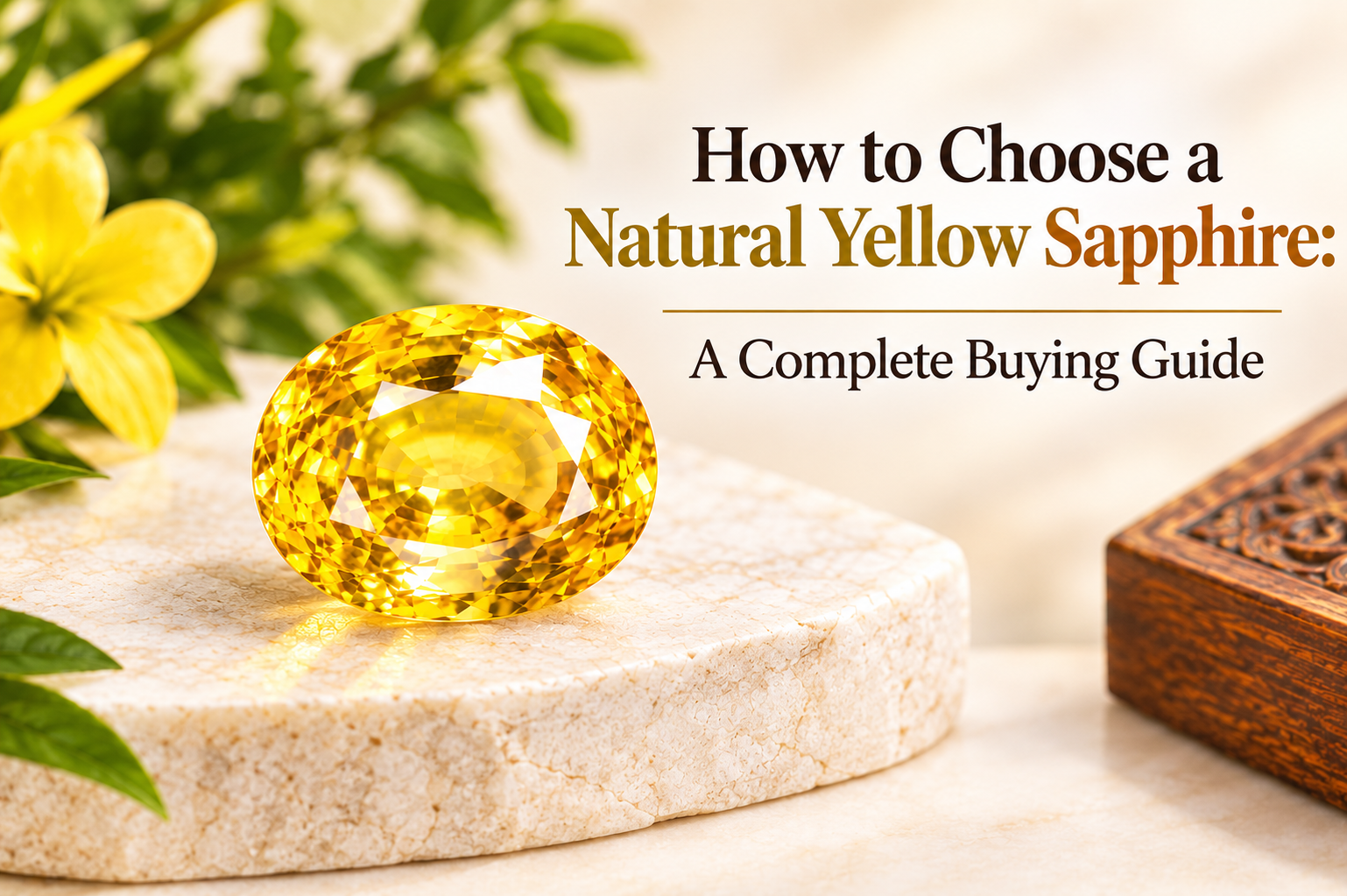
Yellow Sapphire, traditionally known as Pukhraj, is one of the most popular gemstones in Vedic astrology. It is traditionally associated with Jupiter (Guru/Brihaspati) and is often considered in connection with knowledge, wisdom, prosperity, education, marriage, and spiritual growth.
However, choosing a Yellow Sapphire is not simply about finding the brightest yellow stone or the largest carat weight.
If you are planning to buy one, you should understand the difference between natural, synthetic, treated, and imitation stones, along with important quality factors such as colour, clarity, cut, carat weight, origin, and laboratory certification.
This guide explains how to choose a natural Yellow Sapphire with greater confidence.
Important note: Astrological benefits mentioned in this article are based on traditional Vedic beliefs. There is no scientific evidence that Yellow Sapphire changes planetary influences or guarantees wealth, marriage, career success, health, or other outcomes.
What Is Yellow Sapphire?
Yellow Sapphire is a yellow variety of corundum, the same mineral family that includes Ruby.
Its yellow colour can range from:
- Pale yellow
- Lemon yellow
- Golden yellow
- Honey yellow
- Rich vivid yellow
In Vedic astrology, Yellow Sapphire is traditionally known as Pukhraj and is associated with Jupiter (Guru/Brihaspati).
The traditional association is: Yellow Sapphire → Jupiter
This is why it is often considered by people who follow Vedic gemstone traditions.
Why Is It Important to Choose a Natural Yellow Sapphire?
The gemstone market contains different types of yellow stones that can look similar.
You may encounter:
- Natural Yellow Sapphire
A gemstone that formed naturally in the earth. - Synthetic Yellow Sapphire
A laboratory-created corundum with essentially the same chemical composition and crystal structure as natural sapphire, but not formed naturally. - Treated Yellow Sapphire
A natural stone that has undergone treatment to improve characteristics such as colour or clarity. - Imitation
A different material that is made to resemble Yellow Sapphire.
These categories can differ substantially in value and should not be represented as interchangeable.
1. Check Whether the Sapphire Is Natural
The first question to ask is:
Is this Yellow Sapphire natural or synthetic?
Visual inspection alone cannot reliably establish this in every case.
A professional gemological laboratory can examine the stone using specialised instruments and may provide information about:
- Natural or synthetic origin
- Detectable treatments
- Gemstone identity
- Relevant characteristics
For an expensive Yellow Sapphire, an independent laboratory report can provide useful documentation.
2. Look for a Reliable Laboratory Certificate
A laboratory certificate is one of the most useful things to consider when purchasing a valuable gemstone. A good report should clearly identify the gemstone and, depending on the laboratory and report type, may provide information about:
- Natural or synthetic status
- Species/variety
- Treatments
- Measurements
- Weight
- Colour observations
- Other gemological characteristics
Always check:
- Laboratory name
- Report number
- Date
- Stone description
- Weight and measurements
- Treatment information
If a seller provides a certificate, make sure the report actually corresponds to the gemstone being offered.
3. Pay Attention to Colour
Colour is one of the most important factors when evaluating Yellow Sapphire. A desirable stone may display an attractive, lively yellow colour with good saturation.
Common shades include:
- Lemon Yellow
Light and fresh-looking.
- Bright Yellow
A vivid, attractive yellow.
- Golden Yellow
A richer and warmer appearance.
- Honey Yellow
A deeper yellow with warm tones.
There is no single “perfect” shade for every buyer. Colour preference and market value can vary.
4. Look at Clarity
Natural gemstones often contain inclusions.
Therefore: Natural does not mean flawless.
Some internal characteristics can be expected in natural Yellow Sapphire.
However, excessive inclusions may affect:
- Transparency
- Brilliance
- Durability
- Appearance
- Market value
A good Yellow Sapphire should ideally have attractive transparency and appearance without excessive distracting inclusions.
5. Understand Inclusions
Inclusions are internal features within a gemstone. In a natural Yellow Sapphire, inclusions may provide useful information to a gemologist about its formation and origin.
However, you should not assume that:
More inclusions = More natural
or: No inclusions = Fake
Neither statement is reliable by itself.
Gemstone identification requires proper gemological examination.
6. Check the Cut
Cut influences how a Yellow Sapphire interacts with light.
A well-cut gemstone can appear:
- Brighter
- More lively
- More attractive
- Better proportioned
Common cuts include:
- Oval
- Cushion
- Round
- Emerald cut
- Cushion mixed cuts
- Other custom shapes
For jewellery, the best cut also depends on the setting and design.
7. Consider Carat Weight Carefully
Yellow Sapphire is generally sold according to carat weight. A larger stone is not automatically a better stone.
For example: A smaller, attractive, natural, well-cut stone
may be more desirable than
A larger stone with poor colour, excessive inclusions, or undisclosed treatment. If you are purchasing Yellow Sapphire for traditional astrological use, the required weight is usually determined according to the individual’s horoscope and the astrologer’s methodology.
Do not select a carat weight solely because a seller says:
“More carats always means stronger results.”
That is not a universal rule.
8. Does Origin Matter?
Yellow Sapphires can originate from different locations around the world. Origin may sometimes influence market value or collector interest.
However: Origin alone does not prove that a Yellow Sapphire is natural, untreated, or astrologically suitable.
If origin is important to your purchase, look for reliable laboratory documentation supporting the claimed origin.
9. Ask About Heat Treatment
Gemstone treatments are an important part of buying Yellow Sapphire. Some sapphires may undergo heat treatment to modify their appearance. Treatment is not necessarily synonymous with “fake.” The important issue is disclosure.
Before purchasing, ask:
“Is this Yellow Sapphire treated or untreated?”
If a stone is advertised as untreated, an appropriate laboratory report can provide additional confidence.
10. Don’t Choose Yellow Sapphire Only by Price
A very cheap “natural Yellow Sapphire” should be approached carefully.
Price can vary considerably depending on:
- Natural or synthetic status
- Treatment
- Colour
- Clarity
- Carat weight
- Cut
- Origin
- Certification
- Overall quality
A low price does not automatically mean a good deal.
Likewise, a high price does not automatically prove authenticity. Compare documentation, quality, and transparency—not just price.
11. Consider the Jewellery Setting
If you plan to wear Yellow Sapphire in a ring or pendant, consider the setting carefully.
A good setting should:
- Hold the stone securely
- Protect vulnerable edges
- Allow appropriate visibility of the gemstone
- Complement the stone’s cut
- Be comfortable for everyday use
For an expensive gemstone, professional jewellery setting is preferable.
12. Yellow Sapphire and Vedic Astrology
In traditional Vedic astrology, Yellow Sapphire is associated with Jupiter (Guru/Brihaspati).
Jupiter is traditionally connected with themes such as:
- Knowledge
- Wisdom
- Education
- Prosperity
- Guidance
- Spirituality
- Expansion
- Children
- Marriage in certain astrological interpretations
Because of these associations, Yellow Sapphire is sometimes recommended for specific horoscope configurations.
However: Yellow Sapphire is not automatically suitable for everyone.
An astrologer may examine the individual’s:
- Ascendant
- Jupiter’s house
- Jupiter’s sign
- Aspects
- Conjunctions
- Strength
- Nakshatra
- Dasha
- Overall horoscope
before making a traditional gemstone recommendation.
13. What Does a Traditional Yellow Sapphire Represent?
According to traditional astrology, a suitable Yellow Sapphire may be associated with:
- Knowledge
Jupiter’s traditional connection with learning and wisdom.
- Guidance
Jupiter is associated with teachers, mentors, and spiritual guidance.
- Prosperity
Jupiter is traditionally connected with abundance and expansion.
- Spiritual Growth
Jupiter is associated with philosophy, spirituality, and higher knowledge.
- Marriage
In some Vedic astrology traditions, Jupiter has an important role in marriage-related interpretations, particularly in women’s charts.
These are traditional interpretations and should not be treated as guaranteed effects.
14. Verify the Certificate
If you receive a laboratory report, don’t simply look for the word “certificate.”
Check whether:
- The report number is present.
- The gemstone description matches your stone.
- Weight and measurements correspond.
- Natural/synthetic status is stated.
- Treatment information is included where applicable.
- The issuing laboratory can verify the report.
For expensive stones, independent verification can provide additional confidence.
15. Natural Yellow Sapphire Buying Checklist
Before purchasing, ask these questions:
- Is the gemstone natural?
- Is it Yellow Sapphire and not an imitation?
- Is it treated or untreated?
- Is the treatment disclosed?
- Is there a reliable laboratory report?
- Does the certificate match the stone?
- Is the colour attractive and evenly distributed?
- Is the clarity suitable for the price?
- Is the cut well executed?
- Is the seller transparent about quality and origin?
- If buying for astrology, has the horoscope been assessed?
If you can answer these questions confidently, you are in a much better position to make an informed purchase.
How to Buy Yellow Sapphire for Astrological Use?
If you are purchasing Pukhraj specifically for traditional astrological purposes, consider two separate questions:
Question 1: Is the gemstone genuine?
This is a gemological question.
It can involve laboratory identification and treatment assessment.
Question 2: Is the gemstone suitable for my horoscope?
This is an astrological question.
It traditionally requires examination of your birth chart.
These two questions should not be confused.
A genuine Yellow Sapphire is not automatically astrologically suitable for every person.
Natural Yellow Sapphire for Different Purposes
Jewellery
Focus on colour, clarity, cut, durability, design, and comfort.
Traditional Astrology
Consider gemstone authenticity plus personalised horoscope guidance.
Collection
Origin, rarity, colour, documentation, and overall quality may become particularly important.
Gifting
Choose based on the recipient’s preferences and intended use rather than making guaranteed astrological claims.
Buying Yellow Sapphire Online
If purchasing online, ask the seller for:
- Clear gemstone photographs
- Exact carat weight
- Dimensions
- Natural/synthetic status
- Treatment disclosure
- Laboratory certificate where applicable
- Return/exchange policy
- Invoice
- Details of the gemstone offered
Avoid purchasing solely from edited photographs or exaggerated claims.
Why Certification Matters?
A natural Yellow Sapphire can be a significant purchase. A laboratory report can help establish important information that cannot always be confirmed simply by looking at the gemstone.
This is particularly valuable when:
- The stone is expensive.
- The stone is claimed to be untreated.
- A specific origin is being claimed.
- The stone is being purchased for astrological purposes.
- You are unfamiliar with gemstone identification.
- Documentation adds transparency to the purchase.
Natural Yellow Sapphire: Traditional Astrological Perspective
From the traditional Vedic astrology viewpoint:
Jupiter → Yellow Sapphire
A practitioner may recommend Pukhraj when Jupiter is considered suitable to strengthen.
But gemstone selection should ideally involve both:
Gemstone authenticity and Astrological suitability
Neither should be overlooked.
Quick Guide: How to Choose a Natural Yellow Sapphire
Step 1: Decide your purpose.
Jewellery, collection, or traditional astrology?
Step 2: Confirm the gemstone identity.
Make sure it is actually Yellow Sapphire.
Step 3: Check natural vs synthetic.
Do not rely only on appearance.
Step 4: Ask about treatment.
Make sure treatments are disclosed.
Step 5: Evaluate colour and clarity.
Choose a stone with an attractive appearance appropriate to its price.
Step 6: Examine the cut.
Look for good proportions and lively appearance.
Step 7: Verify certification.
Match the report with the gemstone.
Step 8: Consider carat weight.
Don’t assume bigger automatically means better.
Step 9: Compare sellers.
Look at transparency, documentation, and policies.
Step 10: If buying for astrology, check your horoscope.
Do not select Pukhraj solely because Jupiter is described as weak.
Conclusion:
Choosing a Natural Yellow Sapphire requires more than simply selecting a bright yellow gemstone.
A thoughtful buyer should consider:
- Natural or synthetic status
- Laboratory certificatio
- Colour
- Clarity
- Cut
- Carat weight
- Treatment
- Origin, where relevant
- Astrological suitability
In traditional Vedic astrology, Yellow Sapphire or Pukhraj is associated with Jupiter (Guru/Brihaspati) and is traditionally connected with knowledge, wisdom, prosperity, guidance, and spiritual growth.
However, a genuine Yellow Sapphire and an astrologically suitable Yellow Sapphire are not necessarily the same question. First verify the gemstone. Then evaluate its quality. And if you are buying it for astrology, assess whether it suits your horoscope.
At Effective Gems, buyers can explore natural gemstone options while giving importance to gemstone identification, quality information, certification, and traditional astrological guidance.
Choose with knowledge. Buy with transparency. Wear with awareness.