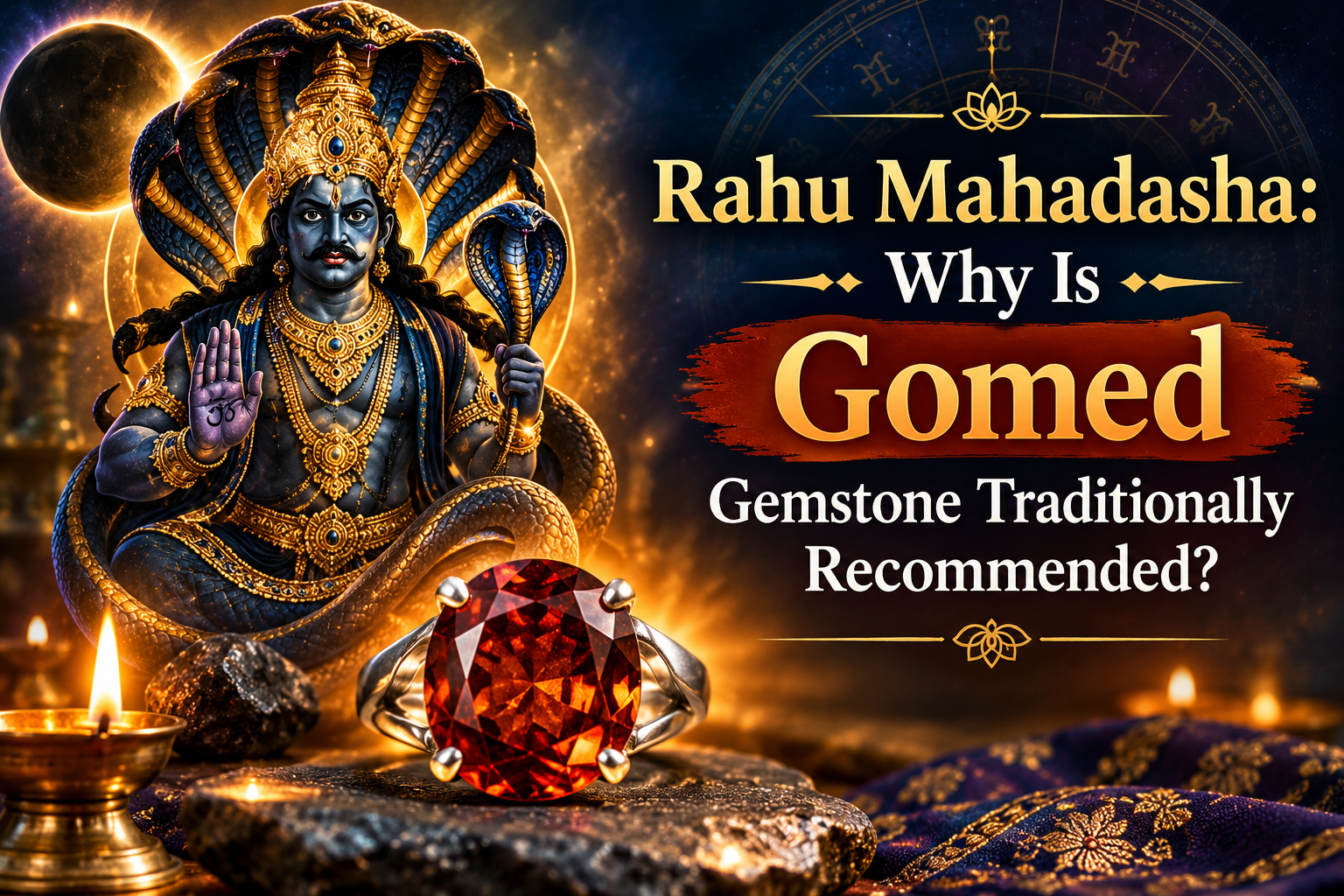
In Vedic astrology, Rahu Mahadasha is traditionally considered an important period because Rahu is associated with ambition, material desires, unconventional experiences, sudden changes, and strong worldly influences.
One gemstone frequently discussed during this period is Gomed, also known as Hessonite Garnet.
But why is Gomed traditionally recommended during Rahu Mahadasha? Is it suitable for everyone? How is it believed to work according to Vedic astrology?
Let’s understand the traditional astrological perspective.
Important note: The gemstone recommendations discussed in this article belong to traditional Vedic astrology. There is no scientific evidence that wearing Gomed changes planetary influences or guarantees financial, professional, health, or personal outcomes.
What Is Rahu Mahadasha?
In the Vimshottari Dasha system of Vedic astrology, Mahadasha refers to a major planetary period. Rahu Mahadasha is traditionally considered a period of 18 years. Rahu is different from the physical planets because it represents the North Lunar Node, an astronomical point rather than a physical celestial body.
In traditional astrology, Rahu is associated with themes such as:
- Ambition and strong desires
- Material pursuits
- Sudden changes
- Unconventional paths
- Foreign connections
- Technology and modern influences
- Obsession or intense focus
- Breaking established patterns
- Attraction toward new experiences
The interpretation can vary considerably depending on Rahu’s house, sign, nakshatra, aspects, conjunctions, and overall birth chart.
What Is Gomed Gemstone?
Gomed is the traditional Indian name for Hessonite Garnet.
It is generally recognised by its characteristic:
- Honey-brown
- Cinnamon
- Golden-brown
- Reddish-brown
appearance. In Vedic astrology, Gomed is traditionally associated with Rahu.
This creates the basic astrological connection:
Rahu → Gomed (Hessonite Garnet)
Because of this association, Gomed is often discussed when Rahu becomes an important factor in an individual’s horoscope.
Why Is Gomed Traditionally Recommended During Rahu Mahadasha?
The traditional astrological reasoning is that a gemstone associated with a particular planetary influence may be used to strengthen or harmonise that planet’s influence, depending on the horoscope.
Since: Rahu → Hessonite/Gomed
Gomed is traditionally considered during Rahu-related periods, including Rahu Mahadasha. However, this does not mean that every person experiencing Rahu Mahadasha should automatically wear Gomed. The complete birth chart matters.
What Does Rahu Represent in Vedic Astrology?
Rahu is often associated with experiences that are:
- Unpredictable
Situations may seem to change suddenly.
- Ambitious
There may be a strong desire to achieve something significant.
- Unconventional
Rahu is traditionally linked with foreign environments, unusual careers, technology, and unconventional approaches.
- Desire-driven
Rahu is strongly connected with worldly desires and attachments.
- Intense
Its influence is often interpreted as increasing focus on particular goals or experiences. These themes can be interpreted positively or challenging depending on the horoscope.
Traditional Significance of Gomed
Gomed is traditionally associated with qualities such as:
- Clarity
- Focus
- Stability
- Confidence
- Practical decision-making
- Managing intense desires
- Handling uncertainty
These are traditional astrological interpretations, not scientifically established effects of the gemstone. The purpose of Gomed in Vedic astrology is not simply to “remove Rahu.” Rather, practitioners may consider it as a way of working with the symbolism and planetary influence associated with Rahu.
Should Everyone Wear Gomed During Rahu Mahadasha?
No. This is one of the most important points. Simply entering Rahu Mahadasha does not automatically mean that Gomed is appropriate.
A Vedic astrologer may examine factors such as:
- Rahu’s house placement
- Rahu’s zodiac sign
- Nakshatra
- Planetary aspects
- Conjunctions
- Rahu’s relationship with the chart’s Ascendant
- Antardasha
- Strength and condition of other planets
- Overall chart patterns
What Is Rahu Antardasha?
Mahadasha is a major planetary period, while Antardasha is a sub-period within a Mahadasha. During Rahu Mahadasha, different planetary Antardashas occur.
For example:
- Rahu/Rahu
- Rahu/Jupiter
- Rahu/Saturn
- Rahu/Mercury
- Rahu/Ketu
- Rahu/Venus
- Rahu/Sun
- Rahu/Moon
- Rahu/Mars
The interpretation can change considerably from one Antardasha to another. Therefore, gemstone recommendations should not be made solely from the Mahadasha name.
Why Do Some People Consider Gomed During Rahu Periods?
From a traditional astrological perspective, Gomed may be considered when Rahu is judged to be:
- Significant in the horoscope
- Suitable to strengthen
- Connected with important life areas
- A relevant focus during the current Dasha
Practitioners may also consider whether strengthening Rahu is appropriate at all. This is why personalised horoscope analysis is important.
Gomed and Rahu: Traditional Benefits:
Depending on the individual’s horoscope, traditional practitioners may associate Gomed with:
- Greater Clarity
Traditionally believed to support clearer thinking when Rahu-related confusion or uncertainty is prominent. - Focus
Often associated with helping channel intense Rahu-like ambition toward specific goals. - Confidence
Traditionally linked with confidence in navigating unconventional circumstances. - Stability
Some traditions associate Gomed with greater steadiness during periods of change. - Career Ambition
Rahu is traditionally associated with ambition, technology, foreign connections, media, politics, research, and unconventional professions. Gomed may therefore be considered in certain career-related charts. - Managing Excessive Desires
Traditional interpretations sometimes connect Gomed with balancing intense material desires and attachments. Again, these are astrological beliefs, not scientifically proven effects.
Rahu, Foreign Connections and Gomed
Rahu is traditionally associated with foreign places, international connections, unconventional environments, technology, and unfamiliar experiences.
Therefore, people whose professional or personal lives involve:
- International business
- Technology
- Digital industries
- Foreign travel
- Research
- Media and entertainment
- Unconventional careers
may sometimes have strong Rahu themes in their charts. Whether Gomed is appropriate still depends on the complete horoscope.
Gomed During Rahu Mahadasha for Career
Rahu is traditionally associated with ambition and unconventional professional paths. During Rahu Mahadasha, a person may experience significant changes in career direction according to their individual horoscope.
Traditional astrology may consider Gomed when Rahu is relevant to career-related houses or planets.
However: Gomed should not be presented as a guaranteed career-success stone. Career outcomes depend on many real-world factors including skills, decisions, opportunities, market conditions, and circumstances.
Gomed and Wealth
Rahu is sometimes associated with strong material desires and unconventional ways of pursuing success.
Because of this, Gomed is sometimes marketed as a wealth or success gemstone. A more accurate traditional framing is: Gomed is associated with Rahu, and Rahu may have strong material and ambition-related symbolism in Vedic astrology.
It should not be presented as a guaranteed money-attracting gemstone. Financial decisions should always be based on practical information rather than gemstone claims.
Gomed and Mental Clarity: A Traditional Perspective
Rahu is sometimes described in astrology as creating confusion, illusion, overthinking, or excessive attachment.
For this reason, traditional practitioners may associate a suitable Gomed with:
- Better focus
- Greater clarity
- Reduced indecision
- More controlled ambition
- A more grounded approach
These are traditional interpretations and should not be confused with medical treatment or scientifically demonstrated psychological effects.
How to Choose Gomed?
If you are considering Gomed for astrological use, gemstone quality matters.
Look for:
- Natural Hessonite Garnet
Ask whether the gemstone is natural and properly identified. - Good Transparency
Gomed can range from transparent to translucent. Quality assessment should consider the stone as a whole. - Attractive Colour
Honey, cinnamon, and warm brown-orange shades are commonly seen. - Laboratory Certification
A reliable gemstone laboratory report can help verify identity and disclose relevant information. - Proper Sourcing
Buy from a reputable gemstone seller who clearly explains the stone’s identity, quality, and treatments if applicable.
How Is Gomed Traditionally Worn?
Traditional Vedic astrology may recommend specific details such as:
- Metal
- Finger
- Weight
- Day
- Time
- Mantra
- Purification or energisation ritual
However, these recommendations can vary between astrologers and traditions. There is therefore no single universal wearing rule that applies to every person. If Gomed is being worn specifically as an astrological gemstone, follow a qualified practitioner’s personalised recommendation.
Traditional Mantra Associated With Rahu
One commonly used Rahu mantra in Hindu/Vedic practice is:
“Om Raam Rahave Namah”
Some traditions use different Rahu mantras and ritual practices. If incorporating a mantra into spiritual practice, follow the pronunciation and method taught within your tradition.
Gomed and Rahu Mahadasha: Who May Consider It?
Traditionally, Gomed may be considered for individuals where:
- Rahu has a significant role in the birth chart
- Rahu is considered suitable to strengthen
- Rahu Mahadasha or Antardasha is active
- The astrologer identifies a relevant Rahu-related theme
- The complete horoscope supports the recommendation
It should not be prescribed merely because someone says:
“You are in Rahu Mahadasha, so you must wear Gomed.”
When Should You Be Careful?
Extra caution is appropriate when:
- Someone guarantees results.
- You are pressured to purchase an expensive stone immediately.
- No birth-chart analysis is performed.
- The seller claims Gomed will solve every problem.
- Financial or medical decisions are being based solely on gemstone claims.
- The gemstone’s identity or treatment is unclear.
A responsible gemstone recommendation should combine traditional astrological reasoning with transparent gemstone information.
Gomed vs Cat’s Eye: An Important Difference
Gomed and Cat’s Eye are sometimes confused because both are associated with shadow planets.
But traditionally:
Gomed → Rahu
Cat’s Eye → Ketu
Rahu and Ketu have different roles in Vedic astrology. Therefore, Gomed should not be treated as a substitute for Cat’s Eye, or vice versa, without considering the horoscope.
Gomed: Spiritual Symbolism
Beyond astrology, Gomed’s warm honey-brown colour can also be incorporated into personal spiritual practices.
It can serve as a reminder of:
- Groundedness
Stay centred during change. - Focus
Direct energy toward meaningful goals. - Adaptability
Remain open to unfamiliar experiences. - Ambition
Pursue goals with awareness. - Self-awareness
Observe desires rather than becoming controlled by them. These interpretations can make Gomed meaningful even without making supernatural claims.
Conclusion:
Rahu Mahadasha is traditionally regarded as a significant 18-year period in Vedic astrology, associated with ambition, material desires, unconventional experiences, foreign connections, sudden changes, and intense pursuits.
Gomed (Hessonite Garnet) is traditionally associated with Rahu, which is why it is frequently discussed during Rahu Mahadasha.
However, the most important point is:
Rahu Mahadasha does not automatically mean everyone should wear Gomed. Traditional gemstone recommendations depend on the individual’s complete birth chart and whether strengthening Rahu is considered appropriate.
If you are considering Gomed, focus on three things:
- Astrological suitability
Have the birth chart properly assessed. - Gemstone authenticity
Choose a properly identified and, where appropriate, laboratory-certified stone. - Realistic expectations
Treat gemstone effects as traditional astrological beliefs rather than guaranteed outcomes. At Effective Gems, Gomed can be explored as part of a broader gemstone and spiritual-product collection, with attention to gemstone identification and traditional astrological context.
Understand Rahu. Understand your horoscope. Then choose your gemstone thoughtfully.