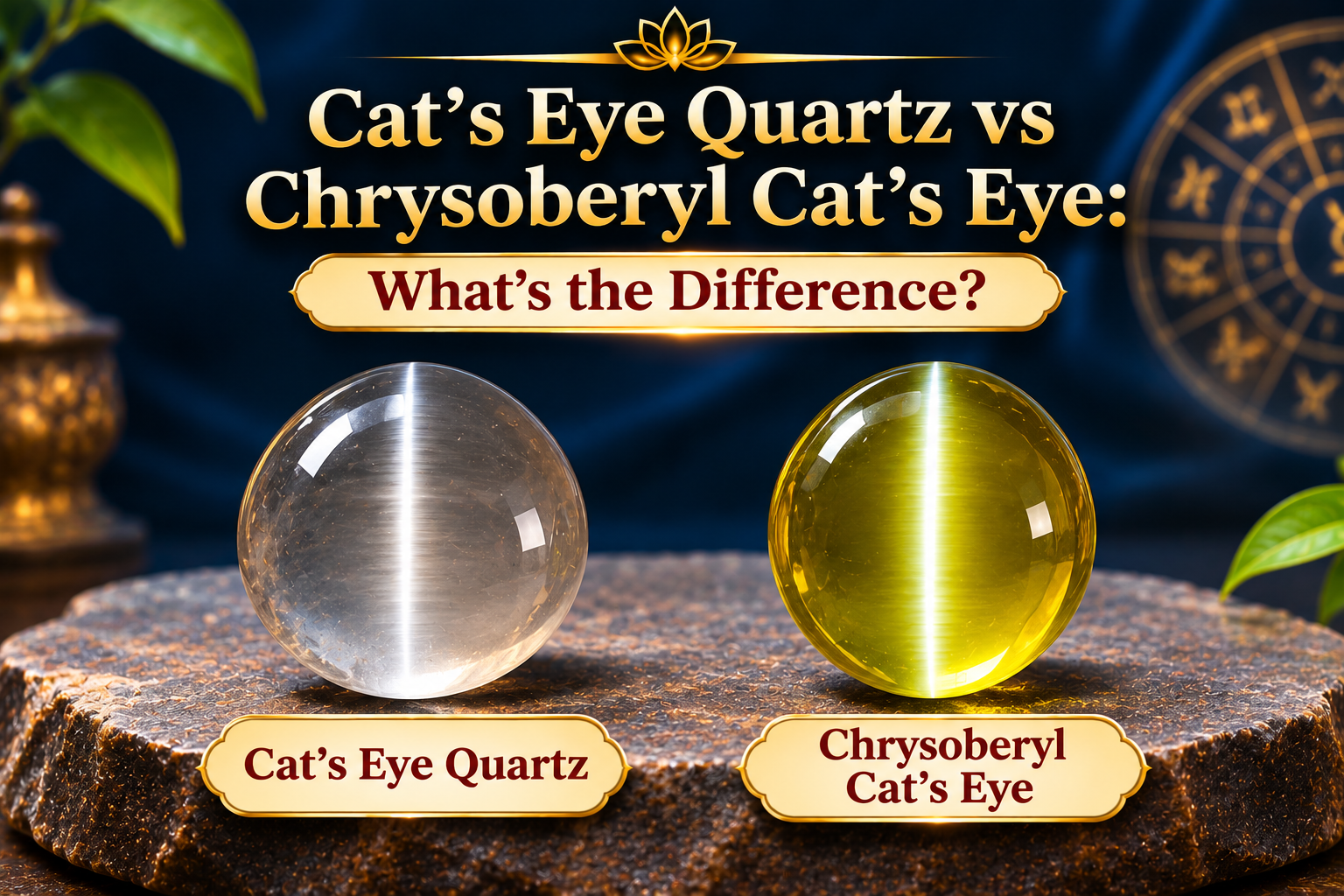
Cat’s Eye gemstones are admired for their distinctive optical effect, which creates a bright line across the surface of a polished stone, resembling the narrow eye of a cat. This fascinating phenomenon is known as chatoyancy.
However, not every gemstone sold as Cat’s Eye is the same. Two varieties that are often compared are Cat’s Eye Quartz and Chrysoberyl Cat’s Eye. Although both display a similar eye-like effect, they differ significantly in mineral composition, hardness, appearance, rarity and traditional astrological associations.
If you are planning to buy a Cat’s Eye gemstone for jewellery, collection or astrological purposes, understanding these differences can help you make a more informed choice.
What Is Cat’s Eye Quartz?
Cat’s Eye Quartz is a variety of quartz that displays chatoyancy due to the presence of fine, parallel inclusions or fibrous structures within the stone.
When properly cut and polished, these internal features reflect light in a way that creates a narrow, bright band across the gemstone. The effect becomes especially noticeable when the stone is viewed under a focused light source.
Key Characteristics of Cat’s Eye Quartz
- Mineral Family: Quartz
- Chemical Composition: Silicon dioxide (SiO₂)
- Mohs Hardness: 7
- Appearance: Usually translucent to opaque, depending on the specimen
- Optical Effect: A visible cat-eye-like band caused by internal structures
- Common Colours: White, grey, brown, yellowish and other natural shades
Cat’s Eye Quartz is appreciated for its distinctive appearance and is used in jewellery, decorative pieces and gemstone collections.
What Is Chrysoberyl Cat’s Eye?
Chrysoberyl Cat’s Eye is a rare and highly valued variety of chrysoberyl that exhibits a sharp and well-defined chatoyant band.
It is particularly famous for its bright, narrow eye-like reflection, which moves across the gemstone when the stone or light source changes position. High-quality specimens may display a strong contrast between the luminous band and the surrounding body colour.
In the gemstone trade, Chrysoberyl Cat’s Eye is often simply called Cat’s Eye. In traditional Vedic astrology, it is known as Lehsunia or Vaidurya and is associated with Ketu.
Key Characteristics of Chrysoberyl Cat’s Eye
- Mineral Family: Chrysoberyl
- Chemical Composition: Beryllium aluminium oxide (BeAl₂O₄)
- Mohs Hardness: 8.5
- Appearance: Usually translucent to opaque
- Optical Effect: Distinctive, often sharp and well-defined chatoyancy
- Common Colours: Honey, yellowish-green, greenish-brown, brown and golden shades
Chrysoberyl Cat’s Eye is especially valued for its optical quality, durability and rarity.
- Difference in Mineral Composition
The biggest difference lies in their chemical composition.
Cat’s Eye Quartz belongs to the quartz mineral family and is composed mainly of silicon dioxide. Chrysoberyl Cat’s Eye is a separate mineral composed of beryllium aluminium oxide.
Although their external appearance can look similar, they are not the same gemstone. Their different mineral structures also influence their hardness, durability and market value.
- Difference in Colour and Appearance
Both varieties are available in different natural shades, but their overall appearance can vary.
Cat’s Eye Quartz:
- Often available in grey, white, brown and yellowish shades.
- May have a softer or less sharply defined eye effect.
- Appearance depends on the nature and arrangement of its internal inclusions.
Chrysoberyl Cat’s Eye:
- Commonly found in honey, golden, yellowish-green and brownish shades.
- Often displays a bright, well-defined eye.
- High-quality stones can show a strong contrast between the eye and body colour.
The quality of the chatoyant band is an important factor when evaluating either gemstone.
- Difference in Hardness and Durability
Hardness is an important consideration when choosing a gemstone for jewellery.
- Cat’s Eye Quartz has a Mohs hardness of 7.
- Chrysoberyl Cat’s Eye has a Mohs hardness of 8.5.
Chrysoberyl is more resistant to scratching than quartz. Both can be used in jewellery, but proper setting and care are important to protect their surfaces.
- Difference in Price and Rarity
Cat’s Eye Quartz is generally more affordable and accessible. It can be a suitable choice for people interested in the cat-eye appearance without purchasing a high-value chrysoberyl gemstone.
Chrysoberyl Cat’s Eye is generally more expensive, particularly when it has a sharp, centred eye, attractive body colour, good transparency and strong visual contrast.
The final price depends on several factors:
- Natural or treated status
- Colour and overall appearance
- Sharpness and position of the eye
- Transparency and clarity
- Weight and cut quality
- Origin and availability
- Independent gem identification and certification
A gemstone’s price should not be judged by appearance alone. Professional gem identification is recommended for valuable purchases.
- Difference in Astrological Significance
In Vedic astrology, Chrysoberyl Cat’s Eye is traditionally known as Lehsunia or Vaidurya and is associated with Ketu, one of the lunar nodes.
According to traditional astrological beliefs, it is considered by some practitioners for people seeking remedies related to Ketu’s planetary influence.
Cat’s Eye Quartz may also be sold under the broader Cat’s Eye name, but it is not considered a direct substitute for Chrysoberyl Cat’s Eye in traditional Vedic gemstone recommendations.
Important: Astrological gemstone recommendations are based on traditional beliefs. Before wearing Chrysoberyl Cat’s Eye for astrological purposes, consult a knowledgeable astrologer and ensure the gemstone has been correctly identified.
How to Identify Cat’s Eye Quartz and Chrysoberyl Cat’s Eye
Visual inspection can provide clues, but it cannot reliably confirm the mineral identity of a gemstone.
Here are some factors to consider:
- Check the gemstone name: Confirm whether the seller is offering Cat’s Eye Quartz or Chrysoberyl Cat’s Eye.
- Observe the eye effect: Examine the sharpness, movement and contrast of the luminous band.
- Consider hardness: Quartz and chrysoberyl have different hardness values, but scratch testing is not recommended.
- Ask about composition: Request clear information about the mineral identity and any treatments.
- Get a laboratory report: For valuable purchases, obtain an independent gemological report identifying the gemstone.
A professional gemologist can use appropriate testing methods to distinguish between the two varieties.
Which Cat’s Eye Gemstone Should You Choose?
The right choice depends on your purpose, budget and preference.
Choose Cat’s Eye Quartz if:
- You appreciate the cat-eye optical effect.
- You are looking for a generally more affordable gemstone.
- You want a distinctive addition to a gemstone collection or jewellery design.
Consider Chrysoberyl Cat’s Eye if:
- You are looking for the traditional Lehsunia gemstone.
- You prefer a gemstone with higher hardness.
- You value its distinctive chatoyancy and relative rarity.
- You have received an astrological recommendation for Chrysoberyl Cat’s Eye.
Always verify the gemstone’s identity before purchasing, especially when buying it for astrological use.
How to Care for Cat’s Eye Gemstones
Proper care helps maintain the appearance and condition of your gemstone.
- Clean gently using a soft cloth.
- Avoid harsh chemicals and abrasive cleaning materials.
- Store separately from harder gemstones to reduce the risk of scratches.
- Avoid sudden temperature changes.
- Ask a professional jeweller about safe cleaning methods for valuable or treated stones.
Conclusion
Cat’s Eye Quartz and Chrysoberyl Cat’s Eye may look similar because both display the fascinating phenomenon of chatoyancy, but they are two different minerals.
Cat’s Eye Quartz is composed of silicon dioxide and has a Mohs hardness of 7, while Chrysoberyl Cat’s Eye is composed of beryllium aluminium oxide and has a Mohs hardness of 8.5. Chrysoberyl Cat’s Eye is also the variety traditionally recognised as Lehsunia in Vedic astrology.
Understanding their differences in composition, appearance, durability, rarity and traditional significance can help you choose the right gemstone with confidence.