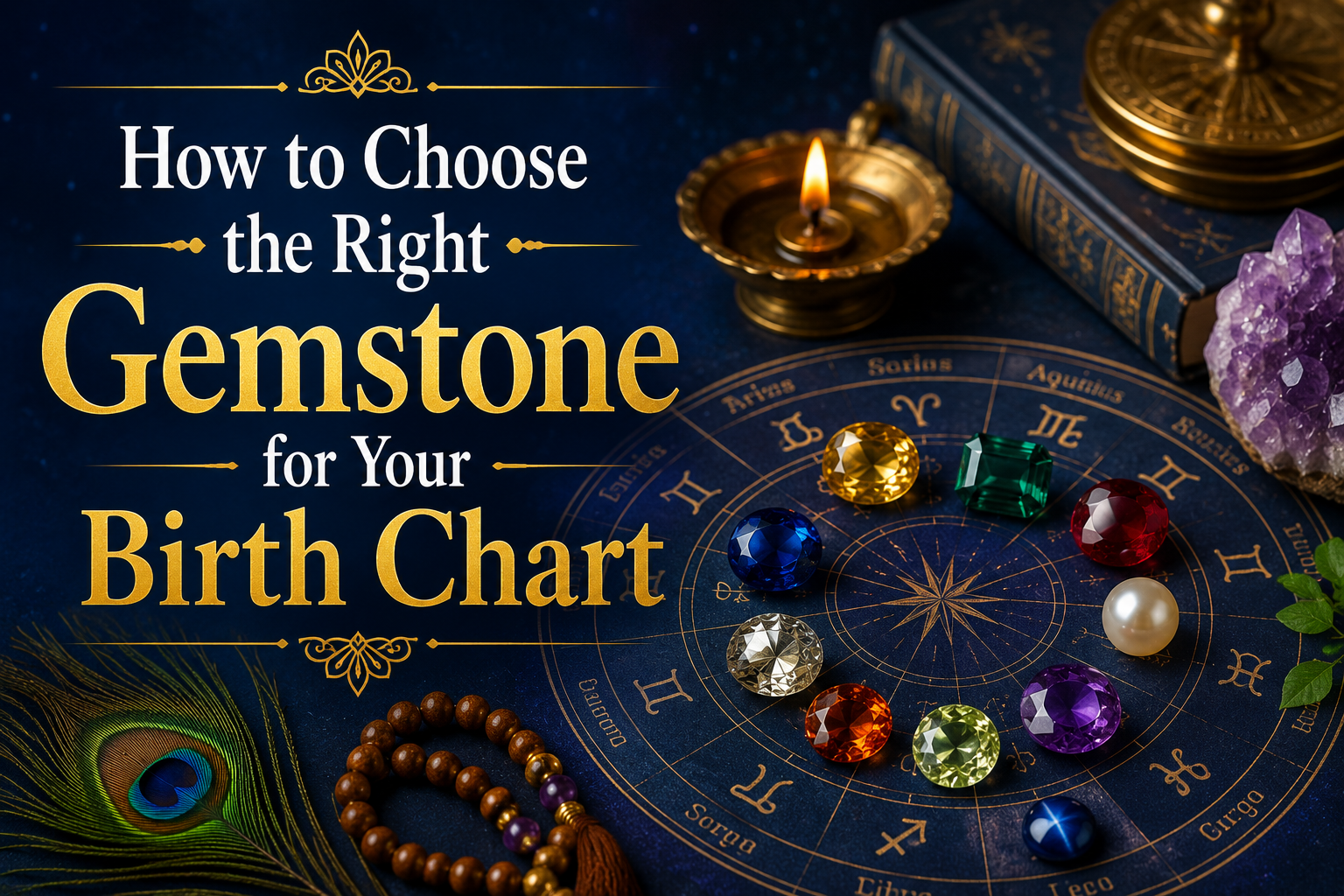
Choosing a gemstone in Vedic astrology is more than selecting a beautiful stone based on your zodiac sign. Traditionally, gemstones are believed to strengthen the influence of specific planets, so the right choice depends on your birth chart (Kundli) and the condition of the planet associated with that gemstone.
A gemstone that is considered beneficial for one person may not be suitable for another. That is why personalised Kundli analysis is important before wearing a strong astrological gemstone.
Note: Gemstone recommendations are based on traditional Vedic astrology and are not scientifically proven to change planetary influences or guarantee specific results.
What Is an Astrological Gemstone?
In Vedic astrology, certain gemstones are traditionally associated with the Navagrahas (nine planetary influences).
Planet Traditional Gemstone:
- Sun: Ruby (Manik)
- Moon: Pearl (Moti)
- Mars: Red Coral (Moonga)
- Rahu: Hessonite (Gomed)
- Mercury: Emerald (Panna)
- Jupiter: Yellow Sapphire (Pukhraj)
- Venus: Diamond / White Sapphire
- Saturn: Blue Sapphire (Neelam)
- Ketu: Cat’s Eye (Lehsunia)
The traditional idea is that wearing the appropriate gemstone may strengthen the qualities associated with a favourable planet.
- Step 1: Start With Your Birth Chart
The first step is to prepare an accurate Janam Kundli.
You generally need:
- Date of birth
- Exact time of birth
- Place of birth
Even a relatively small difference in birth time can sometimes change important chart calculations, so accurate information is valuable.
- Step 2: Identify Your Ascendant (Lagna)
Your Lagna, or Ascendant, is one of the most important factors in traditional gemstone selection.
Why?
Because the same planet can have different functional roles for different Ascendants. For example, a planet considered supportive for one Lagna may not have the same role for another.
Therefore, choosing a gemstone simply because:
“My Sun sign is Leo, so I should wear Ruby” is an oversimplification.
- Step 3: Examine the Planet’s Role in Your Kundli
A Vedic astrologer may consider several factors before recommending a gemstone:
- Which house the planet rules
- Where the planet is placed
- Its strength
- Aspects from other planets
- Whether it is considered benefic or challenging
- Its relationship with the Ascendant
- Current Dasha and Antardasha
- Relevant planetary transits
The gemstone recommendation should come from the overall chart, not one placement in isolation.
- Step 4: Identify the Planet You Actually Want to Strengthen
This is an important distinction. The goal is generally not simply to strengthen every weak planet.
For example, if someone has a weak Saturn, it does not automatically mean they should wear Blue Sapphire.
A traditional astrologer first considers:
Is Saturn beneficial for this person’s chart?
If yes, strengthening Saturn may be considered. If Saturn is functionally challenging, strengthening it may not be the preferred approach. This is why personalised analysis matters.
- Step 5: Consider Your Current Dasha
Your birth chart shows the planetary pattern at birth, but Vedic astrology also considers planetary periods (Dasha). A gemstone recommendation may change depending on the planetary period currently operating.
For example:
Birth chart → Planetary strength → Dasha → Current circumstances
This is why an old gemstone recommendation may not always remain appropriate indefinitely.
- Step 6: Consider the Houses
The houses occupied or ruled by planets can be important.
For example, an astrologer may examine whether a planet relates to:
- Career
- Wealth
- Education
- Marriage
- Children
- Health
- Spirituality
- Foreign travel
The purpose is to understand what areas of life the planet represents in your particular chart.
- Step 7: Check Planetary Relationships
Traditional Vedic astrology also considers relationships between planets. Some planets are considered friendly, neutral, or antagonistic toward one another. This becomes particularly relevant if you are thinking about wearing multiple gemstones.
For example, don’t assume:
“If two gemstones are individually beneficial, they must always be suitable together.”
Their combined astrological symbolism should be evaluated.
- Step 8: Choose the Right Quality of Gemstone
Once an astrologer identifies the gemstone, the next step is choosing the actual stone.
Consider:
– Natural origin
Understand whether the gemstone is natural, synthetic, treated, or imitation.
– Clarity
Different gemstones have different standards for evaluating clarity.
– Colour
Colour quality can significantly influence the appearance and value of many gemstones.
– Cut
A good cut can improve brilliance and appearance.
– Certification
For valuable gemstones, consider obtaining a reputable gemological laboratory report.
– Transparency about treatments
Some gemstones are routinely treated to improve appearance. Ask the seller about treatments rather than assuming every stone is untreated.
Natural vs Synthetic vs Imitation:
This distinction is important.
- Natural Gemstone: Formed naturally in geological conditions.
- Synthetic Gemstone: Laboratory-created material with essentially the same chemical composition and crystal structure as the natural counterpart.
- Imitation: A different material designed to look like the gemstone. If you are purchasing an expensive gemstone for astrological purposes, ask exactly what material you are buying.
- Step 9: Don’t Choose a Gemstone Only by Price
A higher price doesn’t automatically mean:
“More astrological benefit.”
Gemstone prices can depend on:
- Origin
- Colour
- Clarity
- Size
- Cut
- Treatments
- Rarity
- Certification
Your focus should be on authenticity, suitability, and quality, rather than simply buying the most expensive stone.
- Step 10: Decide How to Wear It
Traditional Vedic astrology often specifies details such as:
- Metal
- Finger
- Day
- Time
- Mantra
- Purification or ritual procedure
These recommendations can vary according to the gemstone and astrological school. Therefore, once you know the gemstone, ask your astrologer about the traditional method of wearing it.
Can You Wear Gemstones and Rudraksha Together?
Yes, many people incorporate both into their spiritual routines. However, their traditional roles differ.
Rudraksha: Strongly associated with Shiva and commonly used for Japa, meditation, and spiritual practice.
Gemstones: Traditionally associated with planetary influences and selected through astrological analysis. If you’re wearing multiple gemstones along with Rudraksha, a knowledgeable astrologer can help you determine an appropriate combination.
Gemstones and Spiritual Practice:
A gemstone can be part of a broader spiritual lifestyle, but it shouldn’t become the entire focus.
You can combine traditional gemstone practice with:
- Meditation
- Mantra Japa
- Prayer
- Self-discipline
- Spiritual study
- Positive actions
For Shiva devotees, practices such as Rudraksha Japa and Om Namah Shivaya chanting may be incorporated alongside an astrologically selected gemstone.
Conclusion:
Choosing the right gemstone isn’t about finding the most expensive stone or following a generic zodiac chart. In Vedic astrology, the traditional approach is:
Birth Chart → Planetary Analysis → Suitable Planet → Gemstone → Proper Wearing Method
Your Lagna, planetary placements, house ownership, planetary strength, Dasha, and other chart factors can all influence the recommendation. So before purchasing a gemstone, take the time to understand why that particular stone is being recommended for you.
- Choose consciously.
- Analyse your Kundli.
- Follow your tradition.
- Wear with a clear intention.
And remember: gemstones can be meaningful within an astrological or spiritual tradition, but they should not replace professional medical, financial, or other expert advice when those are needed.