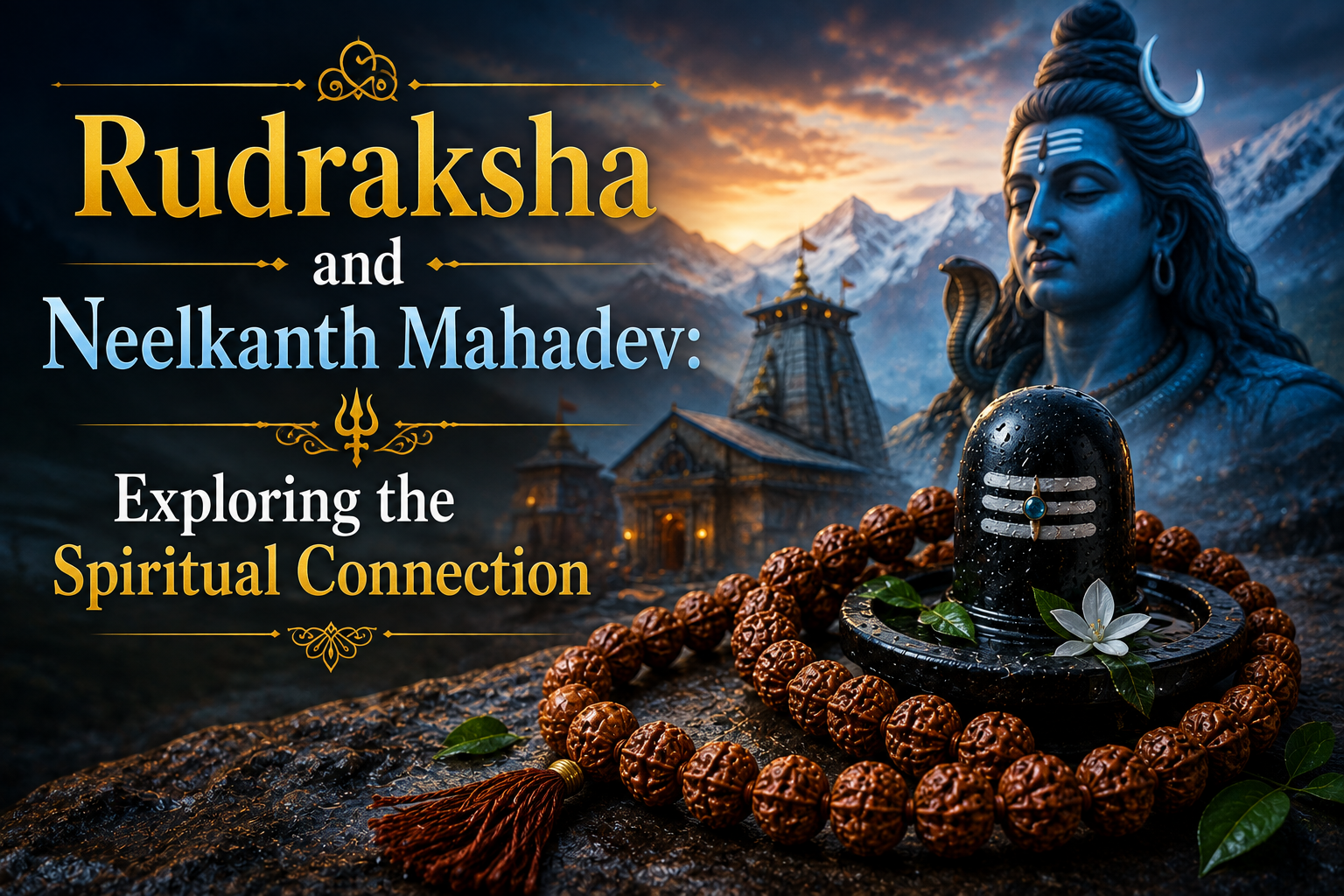
Rudraksha and Neelkanth Mahadev share a deep symbolic connection within Shaiva traditions. Rudraksha is traditionally associated with Lord Shiva, while the name Neelkanth (Nīlakaṇṭha) refers to Shiva’s famous manifestation as the “blue-throated one” who drank the halahala poison during the Samudra Manthan.
This connection becomes especially meaningful during Sawan (Shravan), a month traditionally dedicated to Shiva worship. For devotees, wearing Rudraksha while remembering Neelkanth Mahadev can represent devotion, self-control, courage, sacrifice, and spiritual transformation.
Note: The religious meanings and spiritual benefits discussed here are based on Hindu traditions and beliefs. They should not be interpreted as scientifically proven effects.
Who Is Neelkanth Mahadev?
The name Neelkanth comes from two Sanskrit words:
Neela – blue
Kantha – throat
Together, Neelkanth means “the one with the blue throat.”
According to the well-known story of Samudra Manthan, gods and asuras churned the cosmic ocean to obtain amrita, the nectar of immortality. During this process, a deadly poison known as Halahala emerged.
The poison threatened all creation.
To protect the universe, Lord Shiva consumed the poison. According to the tradition, Goddess Parvati intervened to prevent the poison from moving further into Shiva’s body. It remained in his throat, turning it blue.
Thus Shiva became known as:
Neelkanth Mahadev — the Blue-Throated Lord.
What Is the Connection Between Rudraksha and Lord Shiva?
Rudraksha has a particularly strong place in Shaiva traditions.
The word Rudraksha is traditionally interpreted from:
Rudra + Aksha
where Rudra is a name associated with Shiva and aksha can mean eye. Because of this association, Rudraksha has traditionally been regarded as a sacred bead connected with Shiva.
Devotees commonly use Rudraksha for:
- Japa
- Meditation
- Prayer
- Shiva worship
- Spiritual discipline
This makes Rudraksha a natural symbol through which devotees remember Shiva in his many forms—including Neelkanth Mahadev.
Neelkanth Mahadev and the Meaning of Rudraksha
The connection becomes more meaningful when we look at what the Neelkanth story represents.
Shiva drank poison.
Rudraksha represents Shiva.
Together, they can serve as reminders of:
Courage → Self-control → Sacrifice → Compassion → Spiritual strength
For a devotee, wearing Rudraksha can therefore become more than wearing a sacred bead. It can be a reminder to respond to life’s difficulties with patience and awareness rather than allowing negativity to consume us.
- Rudraksha as a Symbol of Shiva Bhakti
Rudraksha is commonly worn by Shiva devotees as an expression of Shiva Bhakti.
When remembering Neelkanth Mahadev, the bead can represent:
“I remember Shiva and the qualities He represents.”
This can make Rudraksha especially meaningful during Sawan, when Shiva worship becomes an important part of many devotees’ spiritual routines.
- The Blue Throat as a Symbol of Self-Control
One of the deeper interpretations of the Neelkanth story is self-control. Shiva consumes the poison but does not allow it to spread through his body.
Symbolically, this can remind devotees:
Not every negativity needs to be passed on. Anger, criticism, jealousy, and negativity may enter our lives, but we can choose how we respond. Rudraksha worn during meditation or Japa can serve as a physical reminder of this principle.
- Rudraksha and Mantra Japa
One of the most common spiritual uses of Rudraksha is mantra Japa.
For devotees of Neelkanth Mahadev, a simple mantra is:
ॐ नमः शिवाय
Om Namah Shivaya
Using a Rudraksha Mala for repeated chanting can create a structured spiritual routine.
The focus can be on:
Mantra → Breath → Awareness → Devotion
- Why This Connection Is Especially Meaningful During Sawan
Sawan is traditionally associated with Lord Shiva.
During the month, devotees may:
- Visit Shiva temples
- Perform Jalabhishek
- Observe Sawan Somwar
- Chant Shiva mantras
- Wear Rudraksha
- Practise fasting
- Spend more time in prayer
Remembering Neelkanth Mahadev during these practices adds another layer of symbolism.
The story reminds devotees of Shiva’s:
Compassion + Strength + Sacrifice + Detachment
Neelkanth Mahadev and Jalabhishek
Jalabhishek is one of the most recognisable forms of Shiva worship. Devotees traditionally offer water to the Shivling while chanting Shiva mantras.
The practice can be especially meaningful when remembering the Neelkanth story.
The imagery is powerful:
- Neelkanth → Holds the poison
- Devotee → Offers water
- Rudraksha → Represents Shiva
- Mantra → Expresses devotion
Together, these practices create a deeply symbolic Sawan ritual.
Which Rudraksha Can Be Worn for Shiva Worship?
There is no single Rudraksha that everyone must wear to connect with Neelkanth Mahadev.
Different Mukhi Rudrakshas have different traditional associations.
- 5 Mukhi Rudraksha
Widely used for general spiritual practice, meditation, and Japa.
- 6 Mukhi Rudraksha
Traditionally associated with discipline, focus, and balance.
- 11 Mukhi Rudraksha
Traditionally associated with strength, courage, and spiritual practice.
- Gauri Shankar Rudraksha
Traditionally associated with the divine union of Shiva and Shakti.
The appropriate choice depends on your spiritual tradition and personal purpose.
Gauri Shankar Rudraksha and Shiva-Shakti
Gauri Shankar Rudraksha consists of two naturally joined Rudraksha beads.
It is traditionally associated with:
Lord Shiva + Goddess Parvati
This makes it symbolically meaningful for devotees who want to focus on:
- Harmony
- Balance
- Relationships
- Unity
- Divine connection
However, it is not necessary to wear Gauri Shankar Rudraksha specifically to honour Neelkanth Mahadev.
Rudraksha as a Reminder of Inner Strength:
The Neelkanth story can also be viewed as a lesson in inner strength. Life inevitably brings difficult experiences.
The spiritual message is not necessarily:
“Avoid every difficulty.”
Instead, it can be understood as:
“Develop the strength to face difficulty without allowing negativity to define you.”
Rudraksha can serve as a physical reminder of this mindset.
What Can We Learn From Neelkanth Mahadev?
The story of Neelkanth offers several symbolic lessons.
- Courage: Shiva accepts an enormous responsibility to protect creation.
- Compassion: The act is traditionally understood as an expression of compassion for all beings.
- Self-Control: The poison remains contained rather than spreading.
- Sacrifice: Shiva accepts personal suffering for the welfare of others.
- Detachment: Shiva is often portrayed as detached from worldly attachments while remaining compassionate.
These qualities can become powerful themes for meditation during Sawan.
Rudraksha + Neelkanth Mahadev: A Simple Spiritual Practice
You can create a simple practice without elaborate rituals.
- Step 1: Begin Your Morning
Take a bath and wear clean clothes.
- Step 2: Remember Shiva
Sit quietly before a Shiva image or Shivling.
- Step 3: Offer Water
Perform Jalabhishek according to your tradition.
- Step 4: Hold Your Rudraksha Mala
Take a few moments to settle your breath.
- Step 5: Chant
Om Namah Shivaya
Repeat the mantra at a comfortable pace.
- Step 6: Reflect on Neelkanth
Think about the symbolic lesson:
“May I have the strength to face negativity without spreading it.”
- Step 7: End With Gratitude
Conclude your practice with a simple prayer of gratitude.
Can Rudraksha Help Protect Against Negativity?
Traditional Rudraksha beliefs often associate the bead with spiritual protection and positive energy. However, there is no scientific evidence that Rudraksha can physically block negative energy or protect someone from supernatural forces.
A healthier way to understand its role is as a spiritual and psychological reminder of prayer, mindfulness, and self-discipline.
Why This Message Matters Today?
The story of Neelkanth Mahadev can be especially relevant in modern life.
We encounter negativity through:
- Social media
- Arguments
- Workplace pressure
- Stress
- Criticism
- Constant information
The symbolic lesson of Neelkanth is simple:
You cannot always control what enters your life. You can control how you respond to it. Wearing Rudraksha can serve as a daily reminder of that principle.
Conclusion:
The connection between Rudraksha and Neelkanth Mahadev is rooted in their shared association with Lord Shiva and the deeper spiritual symbolism of Shiva’s Neelkanth form. For devotees, Rudraksha can represent Shiva Bhakti, meditation, Japa, and spiritual discipline, while the Neelkanth story reminds us of courage, compassion, sacrifice, and self-control.
During Sawan, these ideas can become part of a meaningful spiritual routine.
- Wear Rudraksha with devotion.
- Perform Jalabhishek with sincerity.
- Chant with awareness.
- Learn from Neelkanth Mahadev.
- Carry the spirit of Shiva beyond Sawan.
ॐ नमः शिवाय