Maa Chandraghanta is traditionally worshipped as the third form of Navadurga, the nine forms of Maa Durga revered during Navratri. She is known for her powerful yet graceful appearance and is traditionally associated with courage, peace, strength, protection, and divine determination.
Devotees worship Maa Chandraghanta on the third day of Navratri, following Maa Shailputri and Maa Brahmacharini.
Her name and iconography tell an important story about the transformation of Parvati into a powerful and protective form of the Goddess.
Who Is Maa Chandraghanta?
Maa Chandraghanta is traditionally regarded as a form of Parvati, the divine consort of Lord Shiva.
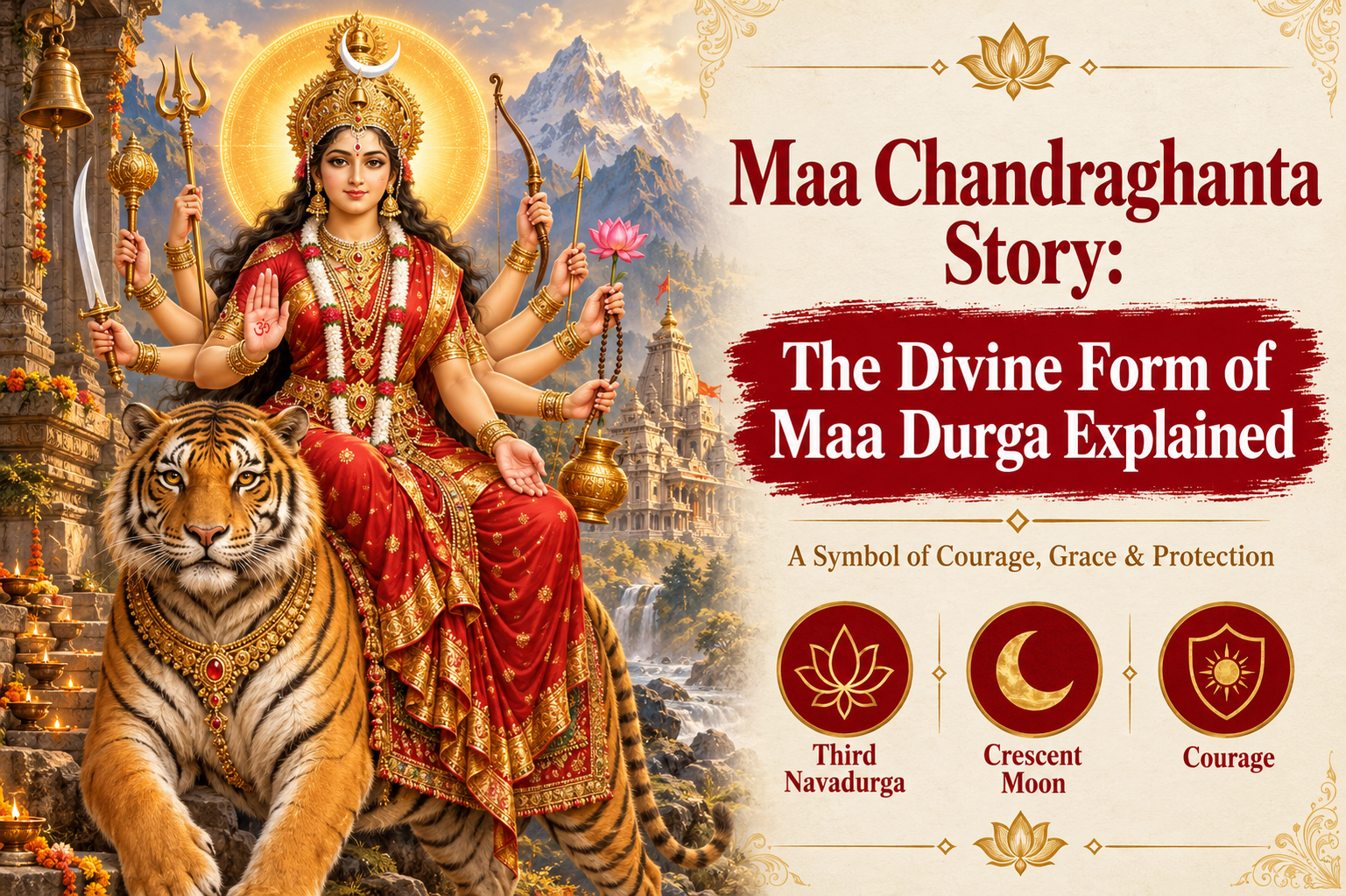
Her name comes from the crescent moon shaped like a bell (ghanta) that is traditionally depicted on her forehead.
- Chandra – Moon
- Ghanta – Bell
Thus, Chandraghanta can be understood as “the Goddess who bears a bell-shaped crescent moon.”
Her appearance combines beauty and serenity with the power of a warrior Goddess.
The Story Behind Maa Chandraghanta
The traditional story of Maa Chandraghanta is connected with Parvati’s marriage to Lord Shiva.
After completing her intense penance, represented by Maa Brahmacharini, Parvati’s devotion toward Shiva is fulfilled and she becomes his consort.
According to popular devotional traditions, Parvati assumes a magnificent and powerful form after her marriage to Shiva.
She adorns her forehead with a crescent moon resembling a bell and rides a tiger or lion. Her appearance reflects both divine grace and warrior-like strength.
This form becomes known as Maa Chandraghanta.
Different regional and devotional traditions may narrate aspects of her story differently, but her central symbolism remains connected with courage, protection, and divine power.
Why Is Maa Chandraghanta Worshipped on the Third Day?
Maa Chandraghanta is traditionally the third form of Navadurga.
The sequence is commonly given as:
- Maa Shailputri
- Maa Brahmacharini
- Maa Chandraghanta
- Maa Kushmanda
- Maa Skandamata
- Maa Katyayani
- Maa Kalaratri
- Maa Mahagauri
- Maa Siddhidatri
The first two forms emphasize the beginning of the spiritual journey, devotion, and tapasya. Maa Chandraghanta introduces another dimension—courage, protective strength, and readiness to face challenges.
How Is Maa Chandraghanta Depicted?
Maa Chandraghanta is traditionally portrayed with:
- A crescent moon shaped like a bell on her forehead
- A tiger or lion as her mount
- Multiple arms
- Various divine weapons
- A peaceful yet powerful expression
Her iconography varies between traditions, but she is commonly shown carrying weapons such as the Trishul, sword, mace, bow, and other divine objects, while one or more hands may be shown in blessing or protective gestures.
What Does the Crescent Moon Bell Symbolize?
The crescent moon on Maa Chandraghanta’s forehead is one of her most distinctive features.
The bell-like shape gives her the name Chandraghanta.
The bell can symbolically represent:
- Alertness
- Awakening
- Protection
- Removal of fear
- Readiness to confront challenges
The moon itself is traditionally associated with qualities such as calmness, serenity, and emotional balance.
Together, these elements create a symbolic contrast between peace and power.
Why Does Maa Chandraghanta Have So Many Arms?
Like several other forms of Maa Durga, Maa Chandraghanta is depicted with multiple arms.
Each hand may carry a different weapon or sacred object.
The multiple arms symbolically communicate the Goddess’s many abilities and powers.
Her weapons represent the divine capacity to confront different forms of negativity and challenges.
The imagery is not simply about physical combat—it represents the idea that divine strength can take many forms.
What Does Maa Chandraghanta’s Mount Represent?
Maa Chandraghanta is commonly depicted riding a tiger or lion, depending on the artistic and regional tradition.
Both animals symbolize qualities such as:
- Courage
- Strength
- Fearlessness
- Determination
- Power
The powerful mount reinforces the warrior aspect of the Goddess.
What Does Maa Chandraghanta Symbolize?
Maa Chandraghanta is traditionally associated with several qualities.
Courage
Her warrior form represents the courage to face difficult situations.
Protection
Her weapons and powerful appearance symbolize divine protection.
Peace
The crescent moon reflects a peaceful and composed aspect of the Goddess.
Strength
Her multiple arms and weapons represent powerful divine energy.
Inner Balance
Her peaceful expression despite her warrior-like form symbolizes the balance between strength and calmness.
Maa Chandraghanta: The Balance of Peace and Power
One of the most interesting aspects of Maa Chandraghanta is the contrast in her appearance.
She can be simultaneously understood as:
Peaceful yet powerful
Compassionate yet protective
Graceful yet fearless
This symbolism offers an important spiritual lesson: strength does not always require anger or aggression.
True strength can also involve calmness, awareness, and self-control.
Maa Chandraghanta Mantra
A commonly recited mantra associated with Maa Chandraghanta is:
“Om Devi Chandraghantayai Namah.”
Devotees may chant this mantra during prayer and meditation on the third day of Navratri.
Mantras and worship practices may differ between traditions.
How Is Maa Chandraghanta Worshipped?
Devotees may worship Maa Chandraghanta through practices such as:
- Lighting a diya
- Offering flowers
- Reciting her mantra
- Meditation
- Reading devotional texts
- Offering traditional bhog
- Prayer and devotional singing
Navratri rituals vary by region, family, temple, and religious tradition.
What Can We Learn From Maa Chandraghanta?
Her traditional story offers several meaningful lessons.
1. Face Challenges With Courage
The Goddess’s warrior form symbolizes the importance of confronting difficulties rather than allowing fear to control us.
2. Stay Calm While Being Strong
Her peaceful face and powerful weapons represent the balance between inner calm and outer strength.
3. Protection Can Come From Awareness
The bell symbolism can be understood as a reminder to remain alert and conscious of one’s surroundings and actions.
4. Strength Should Be Guided by Wisdom
Weapons symbolize power, but the Goddess’s calm expression reminds devotees that strength is most meaningful when guided by awareness and self-control.
Maa Chandraghanta and Navratri
Navratri provides devotees with an opportunity for prayer, reflection, and spiritual discipline.
On the third day, Maa Chandraghanta’s symbolism can encourage devotees to focus on:
- Courage
- Confidence
- Inner peace
- Protection
- Determination
- Positive action
Her form can be seen as a reminder to approach life’s challenges with both a strong heart and a calm mind.
Final Thoughts
The story of Maa Chandraghanta beautifully combines the peaceful and powerful aspects of Maa Durga.
As the third form of Navadurga, she represents the transition from devotion and spiritual discipline toward courage, protection, and confident action.
Her crescent moon bell, multiple arms, divine weapons, and powerful mount all contribute to her distinctive symbolism.
The deeper message of Maa Chandraghanta can be understood as a reminder to stay calm in difficult moments, remain courageous in the face of challenges, and use strength with wisdom and compassion.