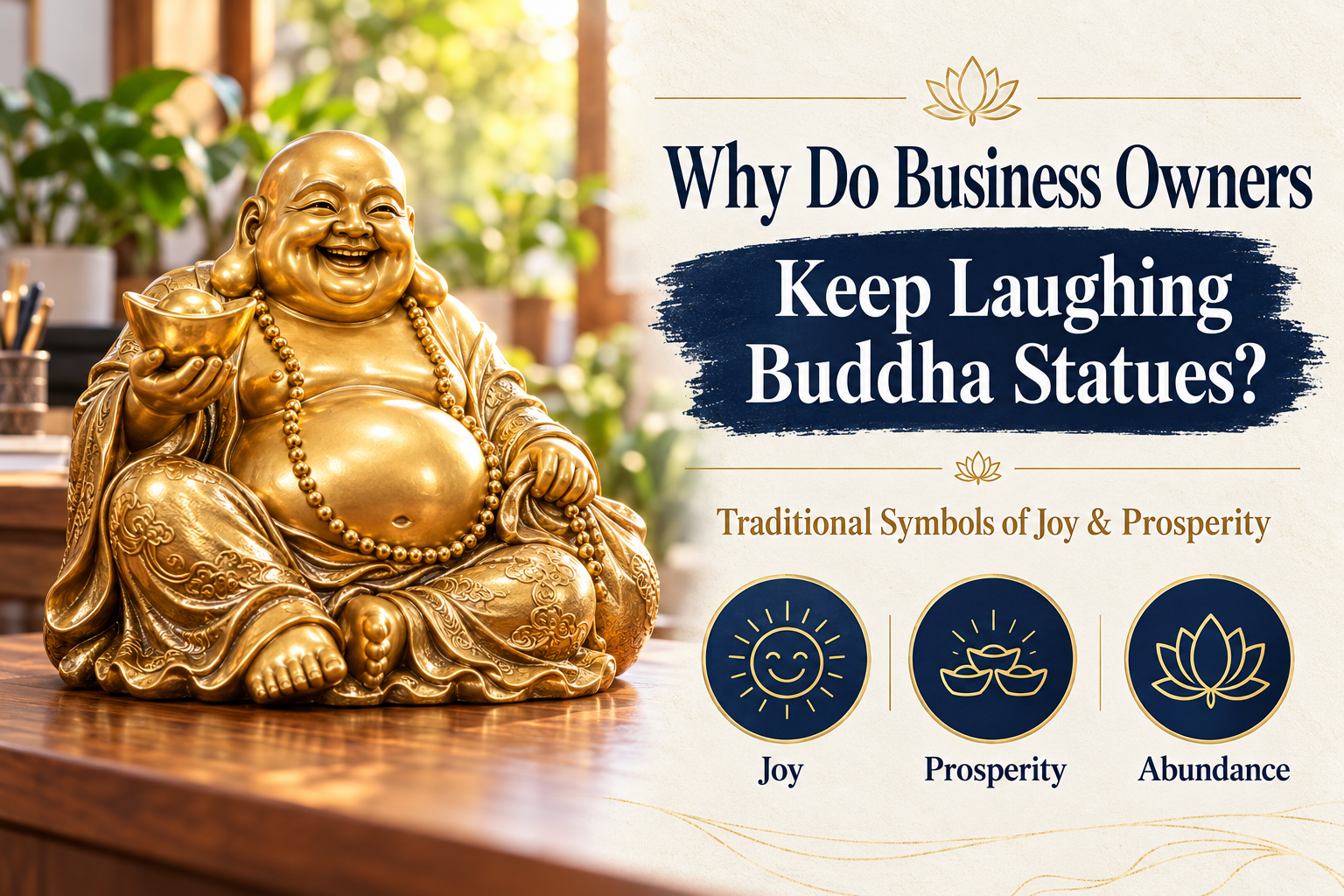
Walk into many offices, shops, reception areas, or business establishments and you may notice a familiar smiling figure—the Laughing Buddha.
Known for his cheerful expression, rounded belly, and joyful appearance, the Laughing Buddha has become a popular decorative symbol in homes and workplaces. In particular, many business owners keep Laughing Buddha statues because they associate them with happiness, abundance, positivity, good fortune, and a welcoming atmosphere.
But why is the Laughing Buddha so popular in business spaces?
The answer lies largely in Feng Shui traditions and the symbolic meaning attached to the figure. It is important to note that the Laughing Buddha commonly used in décor is generally associated with Budai (Hotei), a Chinese Buddhist folk figure, rather than the historical Gautama Buddha.
Who Is the Laughing Buddha?
The figure popularly known as the Laughing Buddha is commonly identified with Budai, also called Hotei in Japan.
Budai is traditionally portrayed as a cheerful monk with a large cloth sack and a smiling or laughing expression. Stories and legends about him contributed to his later association with happiness, generosity, contentment, and abundance.
Over time, his image became especially popular in Chinese and East Asian cultural traditions and later became widely used as a Feng Shui-inspired symbol.
Why Do Business Owners Keep Laughing Buddha Statues?
- Symbol of Happiness and Positivity
The most obvious feature of the Laughing Buddha is his smile.
For a business environment, this symbolism can represent:
- Happiness
- Optimism
- Positive thinking
- Cheerfulness
- Emotional ease
A cheerful decorative figure can also contribute to a more welcoming visual atmosphere for employees and visitors.
- Traditionally Associated With Abundance
In popular Feng Shui practices, the Laughing Buddha is frequently associated with abundance, prosperity, and good fortune.
Because of this symbolism, business owners may place a Laughing Buddha in offices, shops, reception areas, or workspaces as a traditional reminder of prosperity and positive intentions.
This should be understood as a cultural and spiritual belief, not a scientifically proven method of increasing sales or profits.
- Represents Generosity and Contentment
Budai’s traditional image is often connected with generosity and a carefree attitude.
For business owners, this can offer a broader message: success is not only about accumulating wealth but also about contentment, relationships, generosity, and creating value for others.
- Creates a Welcoming Atmosphere
The smiling appearance of the statue makes it a popular choice for customer-facing spaces.
A Laughing Buddha can be placed in:
- Reception areas
- Retail stores
- Waiting areas
- Offices
- Showrooms
- Consultation spaces
Its cheerful appearance can make the environment feel more inviting and friendly.
- Symbolizes Good Fortune
The Laughing Buddha is widely recognized in popular Feng Shui décor as a symbol of good luck and favorable circumstances.
This is one reason entrepreneurs and business owners often choose the figure for their workplaces.
What Does the Laughing Buddha’s Belly Symbolize?
The large belly is one of the most recognizable features of the Laughing Buddha. In popular interpretations, it is associated with contentment, generosity, abundance, and a carefree spirit.
It is not simply intended as a representation of physical wealth. Rather, the cheerful figure is often understood as symbolizing a joyful and satisfied approach to life.
What Does the Laughing Buddha’s Sack Represent?
Traditional depictions of Budai often show him carrying a cloth sack.
The meaning of the sack can vary across stories and interpretations. In popular symbolism, it may be associated with generosity, possessions, travel, or carrying life’s experiences.
Different Laughing Buddha statues may also feature different objects, gestures, and postures, each carrying its own symbolic interpretation.
Different Laughing Buddha Poses and Their Meanings
Not every Laughing Buddha statue represents exactly the same thing.
Laughing Buddha With Gold Ingot
Often associated with wealth, prosperity, and abundance in popular Feng Shui décor.
Laughing Buddha With Children
Commonly associated with family happiness, blessings, and joyful relationships.
Laughing Buddha With a Sack
Often connected with generosity, travel, and abundance, depending on the traditional interpretation.
Laughing Buddha With Beads
Frequently associated with meditation, spiritual practice, and inner peace.
Laughing Buddha Standing With Raised Hands
Often interpreted in popular Feng Shui as a symbol of joy, celebration, and success.
The exact symbolism can vary between traditions and manufacturers.
Where Do Business Owners Keep Laughing Buddha Statues?
Placement recommendations vary depending on the Feng Shui school or cultural tradition being followed.
Common locations include:
Reception Area
A Laughing Buddha in a reception area can symbolize welcome, happiness, and positive interaction.
Office
Keeping one in an office can serve as a visual reminder of optimism and abundance.
Shop or Showroom
Some business owners choose a prominent location where customers can easily see the statue.
Near the Entrance
Certain Feng Shui practices recommend placing a Laughing Buddha near an entrance, while others provide more specific guidelines regarding distance and orientation.
Rather than treating one placement rule as universal, follow the particular Feng Shui tradition you practice.
Should the Laughing Buddha Face the Entrance?
In popular Feng Shui practices, some Laughing Buddha statues are positioned toward the entrance as a symbolic gesture of welcoming positive energy and opportunities.
However, placement rules differ across schools and interpretations. For practical purposes, the statue should be placed somewhere clean, stable, respectful, and visually appropriate, without obstructing movement or business operations.
Laughing Buddha for Business Growth
Business growth depends on many practical factors, including:
- Customer service
- Product quality
- Marketing
- Financial planning
- Consistent effort
- Market demand
- Teamwork
- Decision-making
A Laughing Buddha cannot guarantee business growth.
Its value for many business owners is symbolic—representing optimism, abundance, generosity, and a positive attitude toward work.
How to Choose a Laughing Buddha for Your Office?
When selecting a statue, consider:
Pose
Choose a pose according to the symbolism that is meaningful to you.
Material
Laughing Buddha statues are available in materials such as resin, metal, ceramic, stone, and other decorative materials.
Size
Choose a size that fits naturally into your office, reception, or shop.
Craftsmanship
Look for a stable base, good finishing, and clear detailing.
Placement
Think about the available space before purchasing. A statue should enhance the workspace rather than make it feel crowded.
Common Mistakes to Avoid
Treating It as a Guaranteed Wealth Remedy
The Laughing Buddha is a symbolic and cultural object. It should not be promoted as a guaranteed way to attract money or business success.
Choosing a Statue Only for Its Size
A huge statue is not automatically more meaningful. Proportion and placement matter.
Ignoring the Workspace
Keep the surrounding area clean and uncluttered so the statue complements the overall environment.
Following Random Feng Shui Rules
Different schools can offer different placement recommendations. Choose a consistent tradition rather than mixing unrelated rules.
Conclusion:
The popularity of the Laughing Buddha among business owners comes from its cheerful appearance and rich cultural symbolism.
Traditionally associated with happiness, generosity, contentment, good fortune, and abundance, the figure can bring a positive symbolic message to an office or business environment.
For entrepreneurs, it can serve as a simple reminder that meaningful success involves more than financial results—it can also include positive relationships, optimism, generosity, and contentment.
A Laughing Buddha may therefore be a meaningful addition to a business space, especially when its symbolism is combined with practical effort, responsible decisions, and a positive approach to work.