Maa Brahmacharini is traditionally worshipped as the second form of Navadurga, the nine manifestations of Maa Durga revered during Navratri. She represents penance, devotion, discipline, determination, and spiritual perseverance.
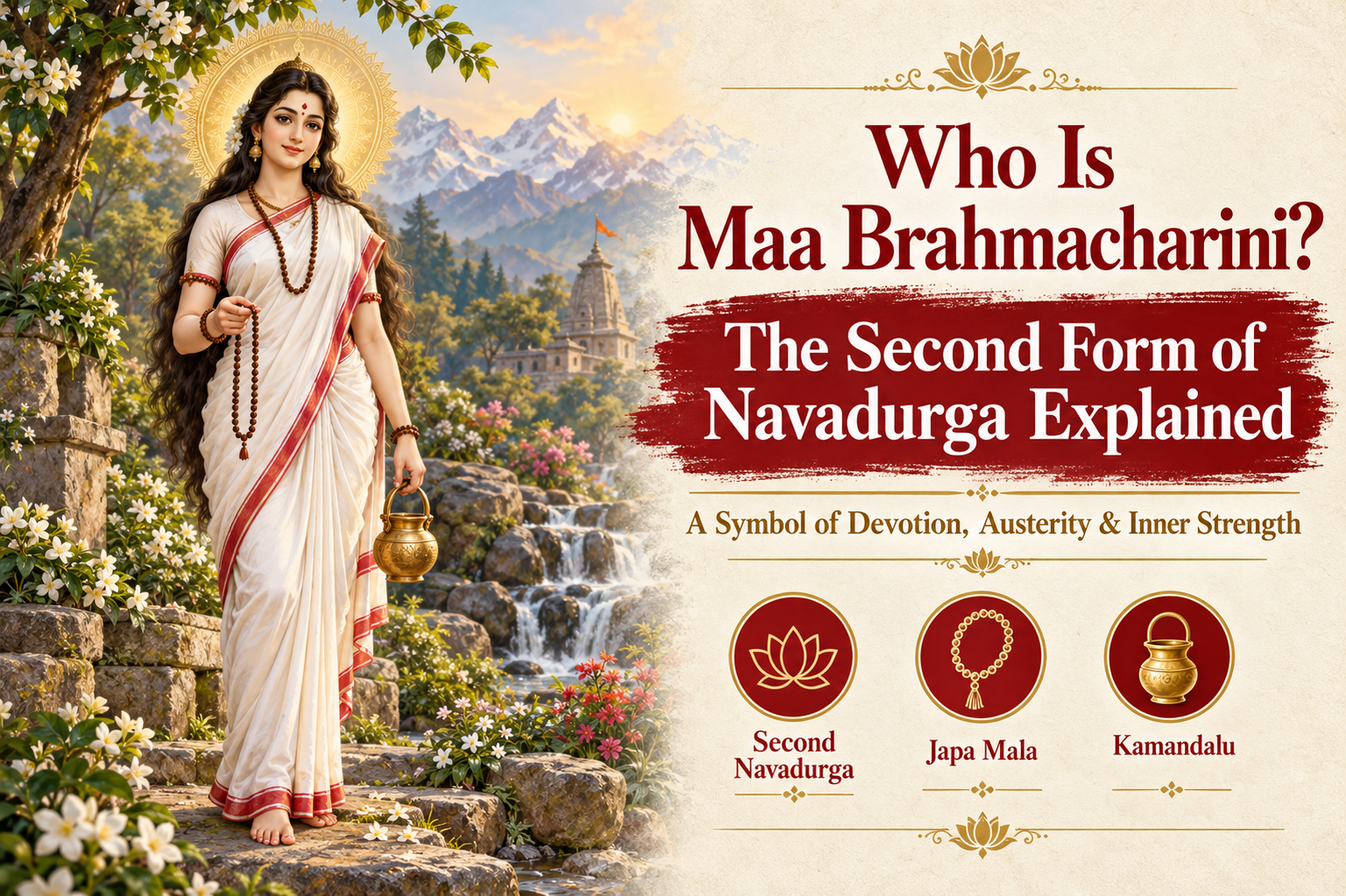
Worshipped on the second day of Navratri, Maa Brahmacharini is depicted in a peaceful form, carrying a rudraksha mala in one hand and a kamandalu (water pot) in the other.
Her story is closely connected with the tapasya, or intense spiritual practice, undertaken by Parvati to attain Lord Shiva as her consort.
Who Is Maa Brahmacharini?
The name Brahmacharini comes from the Sanskrit word Brahmacharya, which can refer to a disciplined spiritual way of life, and Charini, meaning one who follows or practices.
Thus, Maa Brahmacharini is traditionally understood as the Goddess who practices spiritual discipline and austerity. In Navadurga traditions, she represents the second stage of the Goddess’s spiritual journey after Maa Shailputri.
The Story of Maa Brahmacharini
Maa Brahmacharini is traditionally connected with Parvati’s intense penance for Lord Shiva. According to devotional traditions, after her birth as the daughter of Himavan, Parvati developed a deep desire to marry Lord Shiva.
To attain this, she undertook severe spiritual practices and devoted herself to prolonged meditation and austerity.
Her determination was so strong that she continued her penance despite significant hardships.
This form of Parvati came to be revered as Maa Brahmacharini.
Maa Brahmacharini’s Tapasya
The story of her penance is one of the most important aspects of her traditional symbolism.
According to popular devotional narratives, Parvati initially survived on fruits and later gave them up as well. She continued her austerities with extraordinary determination.
The details of the story can vary across devotional texts and regional traditions, but the central theme remains: Determination + Devotion + Discipline = Spiritual Perseverance
Her tapasya represents the strength required to remain committed to a chosen spiritual path.
Why Is Maa Brahmacharini Worshipped on the Second Day of Navratri?
Maa Brahmacharini is traditionally the second form of Navadurga.
The nine forms are commonly listed as:
- Maa Shailputri
- Maa Brahmacharini
- Maa Chandraghanta
- Maa Kushmanda
- Maa Skandamata
- Maa Katyayani
- Maa Kalaratri
- Maa Mahagauri
- Maa Siddhidatri
After the first day, which is associated with Maa Shailputri and the beginning of the Navratri journey, the second day focuses on discipline, devotion, and perseverance through Maa Brahmacharini.
The sequence is interpreted differently across traditions, but her place as the second Navadurga is widely recognized.
How Is Maa Brahmacharini Depicted?
Maa Brahmacharini is traditionally shown as a peaceful and graceful Goddess.
She is commonly depicted:
- Walking barefoot
- Holding a rudraksha mala in her right hand
- Carrying a kamandalu in her left hand
- Wearing simple clothing
- Having a calm and meditative expression
Unlike some other forms of Durga, she is generally portrayed without weapons.
Her imagery emphasizes tapasya, simplicity, patience, and spiritual strength rather than physical battle.
What Does the Rudraksha Mala Symbolize?
The rudraksha mala in Maa Brahmacharini’s hand represents her connection with spiritual practice, meditation, and devotion. Rudraksha has a long-standing association with Lord Shiva and Shaiva traditions.
In the iconography of Maa Brahmacharini, the mala can therefore symbolize:
- Meditation
- Prayer
- Devotion
- Concentration
- Spiritual discipline
What Does the Kamandalu Symbolize?
The kamandalu, or traditional water pot, is commonly associated with ascetics, sages, and spiritual practitioners.
In Maa Brahmacharini’s imagery, it reinforces the themes of:
- Simplicity
- Renunciation
- Austerity
- Self-discipline
- Spiritual dedication
Together, the mala and kamandalu communicate the essence of her character.
What Does Maa Brahmacharini Symbolize?
Maa Brahmacharini is traditionally associated with several important qualities.
Devotion
Her story represents unwavering devotion toward a spiritual goal.
Discipline
Her tapasya symbolizes the importance of discipline and consistent practice.
Determination
She continued her spiritual journey despite hardship, making determination one of her central symbolic qualities.
Patience
Her story teaches the value of patience and perseverance rather than seeking immediate results.
Inner Strength
Although she is depicted peacefully, her character represents tremendous inner strength.
Maa Brahmacharini and Spiritual Discipline
One of the key messages associated with Maa Brahmacharini is that meaningful transformation often requires patience and sustained effort.
Her story can be understood as a reminder that spiritual practice is not always about dramatic action. Sometimes strength is expressed through:
- Staying committed
- Maintaining discipline
- Remaining patient
- Controlling distractions
- Continuing despite obstacles
This makes her particularly significant during the second day of Navratri.
Maa Brahmacharini Mantra
A commonly recited mantra associated with Maa Brahmacharini is: “Om Devi Brahmacharinyai Namah.”
Devotees may chant this mantra during prayer or meditation on the second day of Navratri. Mantras and worship practices can vary across different traditions.
What Can We Learn From Maa Brahmacharini?
The story of Maa Brahmacharini carries several timeless symbolic lessons.
- Stay Committed to Your Goal
Her tapasya represents the power of consistent effort. - Patience Is a Form of Strength
Not every goal produces immediate results. Her story emphasizes perseverance. - Discipline Creates Focus
Spiritual discipline can help reduce distractions and strengthen commitment to a chosen path. - Inner Strength Does Not Always Look Powerful
Maa Brahmacharini’s peaceful appearance contrasts with the extraordinary strength represented by her tapasya. - Devotion Requires Consistency
Her story emphasizes that devotion is expressed not only through prayer but also through dedication and practice.
Maa Brahmacharini During Navratri
On the second day of Navratri, devotees may worship Maa Brahmacharini through:
- Lighting a diya
- Offering flowers
- Reciting her mantra
- Meditation
- Reading devotional texts
- Observing fasting according to personal and family tradition
- Offering prayers with sincerity
Navratri rituals vary considerably between regions and communities, so there is no single practice that applies to everyone.
Conclusion:
Maa Brahmacharini, the second form of Navadurga, represents the quiet power of discipline, devotion, patience, and determination.
Her story of tapasya reminds devotees that meaningful spiritual journeys require commitment and perseverance. Her peaceful appearance, rudraksha mala, and kamandalu all reinforce the symbolism of a life dedicated to spiritual practice.
As Navratri progresses from Maa Shailputri to Maa Brahmacharini, the traditional message moves from establishing a foundation to developing discipline and determination—a meaningful beginning to the deeper spiritual journey of Navadurga.