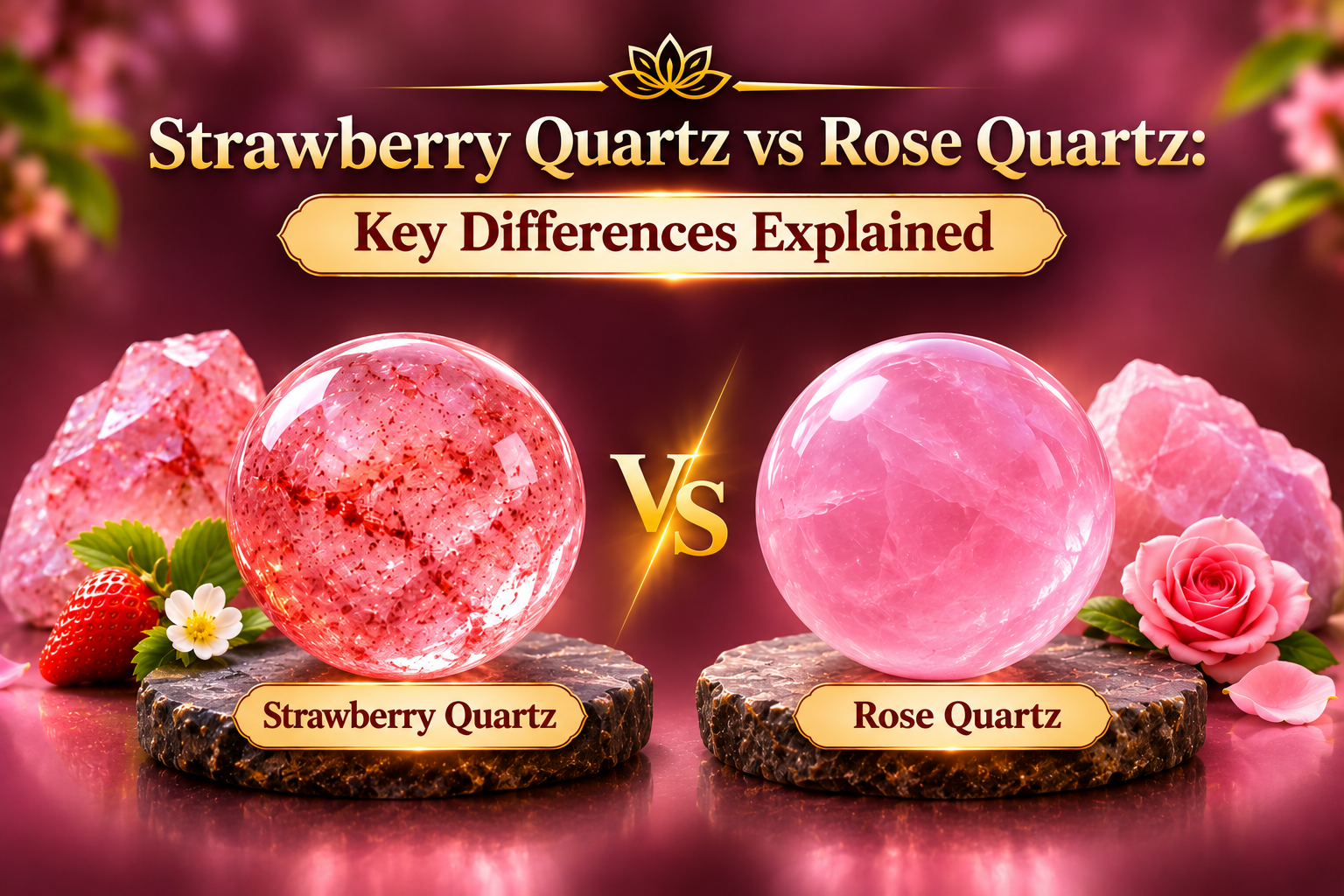
Quartz gemstones are admired for their beautiful colours, natural patterns, and traditional associations with love, emotional balance, and positive energy. Among the many varieties of Quartz, Strawberry Quartz and Rose Quartz are especially popular among crystal enthusiasts and jewellery lovers.
At first glance, both gemstones may appear similar because of their attractive pink shades. However, they have noticeable differences in appearance, colour, inclusions, mineral characteristics, and traditional crystal associations.
While Rose Quartz is widely recognised as the traditional stone of love, Strawberry Quartz is appreciated for its distinctive strawberry-like inclusions and vibrant appearance.
Let’s explore the key differences between Strawberry Quartz and Rose Quartz and understand which crystal may suit your preferences.
What Is Strawberry Quartz?
Strawberry Quartz is a pink to reddish-pink variety of Quartz that gets its distinctive appearance from tiny mineral inclusions within the stone.
These inclusions can create sparkling, speckled, or strawberry-like patterns, giving the gemstone its characteristic look.
Depending on its mineral inclusions, Strawberry Quartz may display shades ranging from light pink to deep reddish pink.
Key Characteristics of Strawberry Quartz:
- Mineral Family: Quartz.
- Chemical Composition: Silicon Dioxide (SiO₂).
- Hardness: 7 on the Mohs scale.
- Colour: Pink, reddish pink, and strawberry pink.
- Appearance: Often contains sparkling or speckled inclusions.
- Lustre: Vitreous.
- Traditional Crystal Association: Love, appreciation, positivity, and emotional awareness.
What Is Rose Quartz?
Rose Quartz is one of the most popular pink varieties of Quartz. It is admired for its soft pink colour, gentle appearance, and traditional association with love and emotional harmony.
Its colour generally ranges from very light pink to medium rose pink. Unlike many Strawberry Quartz specimens, Rose Quartz usually has a more uniform appearance, although natural stones may contain internal inclusions or cloudy patterns.
Key Characteristics of Rose Quartz:
- Mineral Family: Quartz.
- Chemical Composition: Silicon Dioxide (SiO₂).
- Hardness: 7 on the Mohs scale.
- Colour: Pale pink to medium pink.
- Appearance: Generally translucent to opaque with a soft, cloudy appearance.
- Lustre: Vitreous.
- Traditional Crystal Association: Love, compassion, harmony, and self-love.
Strawberry Quartz vs Rose Quartz: Key Differences
- Difference in Colour and Appearance
The most noticeable difference between these two crystals is their appearance.
Strawberry Quartz: It often features tiny reddish, pink, or reflective inclusions that resemble strawberry seeds. These inclusions create a distinctive dotted or sparkling effect.
Rose Quartz: It generally displays a soft, delicate pink colour. Its cloudy and gentle appearance makes it a popular choice for crystal jewellery and decorative products.
- Difference in Mineral Inclusions
Both gemstones are varieties of Quartz, but their internal characteristics differ.
Strawberry Quartz gets its appearance from mineral inclusions, which may include iron oxides or other minerals depending on the specimen.
Rose Quartz gets its pink colour from microscopic inclusions and colour centres. The exact colouring mechanism can vary between specimens.
These natural differences give each crystal its own visual identity.
- Difference in Traditional Crystal Significance
Both Strawberry Quartz and Rose Quartz are popularly associated with love and emotional well-being in modern crystal traditions.
Strawberry Quartz is traditionally associated with:
- Love and appreciation.
- Positive thinking.
- Emotional awareness.
- Gratitude and happiness.
- Self-confidence.
Rose Quartz is traditionally associated with:
- Unconditional love.
- Self-love and compassion.
- Emotional harmony.
- Kindness and forgiveness.
- Relationship harmony.
These are traditional crystal beliefs and symbolic associations, not scientifically established healing effects.
- Difference in Uses
Both crystals are widely used in jewellery, crystal accessories, and decorative products.
Strawberry Quartz Uses:
- Crystal bracelets and necklaces.
- Pendants and gemstone jewellery.
- Decorative crystal collections.
- Meditation accessories.
Rose Quartz Uses:
- Crystal bracelets and malas.
- Rose Quartz facial rollers and Gua Sha tools.
- Decorative hearts and crystal towers.
- Meditation and spiritual accessories.
- Difference in Durability
Both Strawberry Quartz and Rose Quartz have a hardness of approximately 7 on the Mohs scale.
This makes them suitable for various jewellery applications.
However, both can chip or fracture if dropped or struck against hard surfaces. They should be stored carefully and protected from harsh chemicals.
Traditional Benefits of Strawberry Quartz
In modern crystal traditions, Strawberry Quartz is associated with several positive qualities:
- Love and Affection: Symbolises warmth, appreciation, and loving connections.
- Positive Mindset: Represents optimism and gratitude.
- Self-Confidence: Traditionally associated with self-worth and personal appreciation.
- Emotional Awareness: Symbolises understanding and acknowledging emotions.
- Relationship Harmony: Represents affection and meaningful connections.
Traditional Benefits of Rose Quartz
Rose Quartz is popularly known as the Stone of Unconditional Love.
Its traditional crystal associations include:
- Self-Love: Symbolises self-acceptance and appreciation.
- Compassion: Represents kindness towards yourself and others.
- Love and Relationships: Traditionally associated with affection and harmonious relationships.
- Emotional Balance: Symbolises calmness and emotional understanding.
- Forgiveness: Represents letting go of resentment and embracing compassion.
These traditional benefits are based on crystal-healing beliefs and should not be considered medical or scientifically proven effects.
Strawberry Quartz vs Rose Quartz: Which One Should You Choose?
Choosing between Strawberry Quartz and Rose Quartz depends on your personal preferences, jewellery style, and interest in their traditional symbolism.
Choose Strawberry Quartz if:
- You prefer a pink crystal with distinctive sparkling inclusions.
- You enjoy unique natural gemstone patterns.
- You are interested in crystal traditions associated with appreciation and positivity.
- You want a visually distinctive crystal bracelet or pendant.
Choose Rose Quartz if:
- You prefer a soft and gentle pink appearance.
- You appreciate the traditional symbolism of unconditional love.
- You are interested in crystals associated with compassion and self-love.
- You want a classic pink crystal for everyday jewellery.
How to Identify Genuine Strawberry Quartz and Rose Quartz?
Before purchasing either gemstone, it is important to understand its natural characteristics.
For Strawberry Quartz:
- Look for natural-looking inclusions and colour distribution.
- Examine the internal patterns carefully.
- Avoid assuming that every glittery pink stone is genuine Strawberry Quartz.
- Ask about the mineral composition and any treatments.
- Purchase from a trusted gemstone seller.
For Rose Quartz:
- Check its natural pink colour and cloudy appearance.
- Look for natural inclusions and internal characteristics.
- Confirm whether the stone is natural or synthetic.
- Ask about any treatments or enhancements.
- Choose a reliable seller with transparent product details.
Professional gemological testing can help confirm the identity of uncertain specimens.
Conclusion: Strawberry Quartz or Rose Quartz?
Strawberry Quartz and Rose Quartz are two beautiful varieties of Quartz, each offering a distinctive appearance and traditional significance.
Strawberry Quartz is admired for its sparkling inclusions and strawberry-like patterns, while Rose Quartz is loved for its soft pink colour and association with unconditional love.
Both gemstones are popular choices for crystal bracelets, jewellery, meditation accessories, and decorative collections.
Ultimately, the right choice depends on your preferred appearance and the traditional symbolism that resonates with you.


