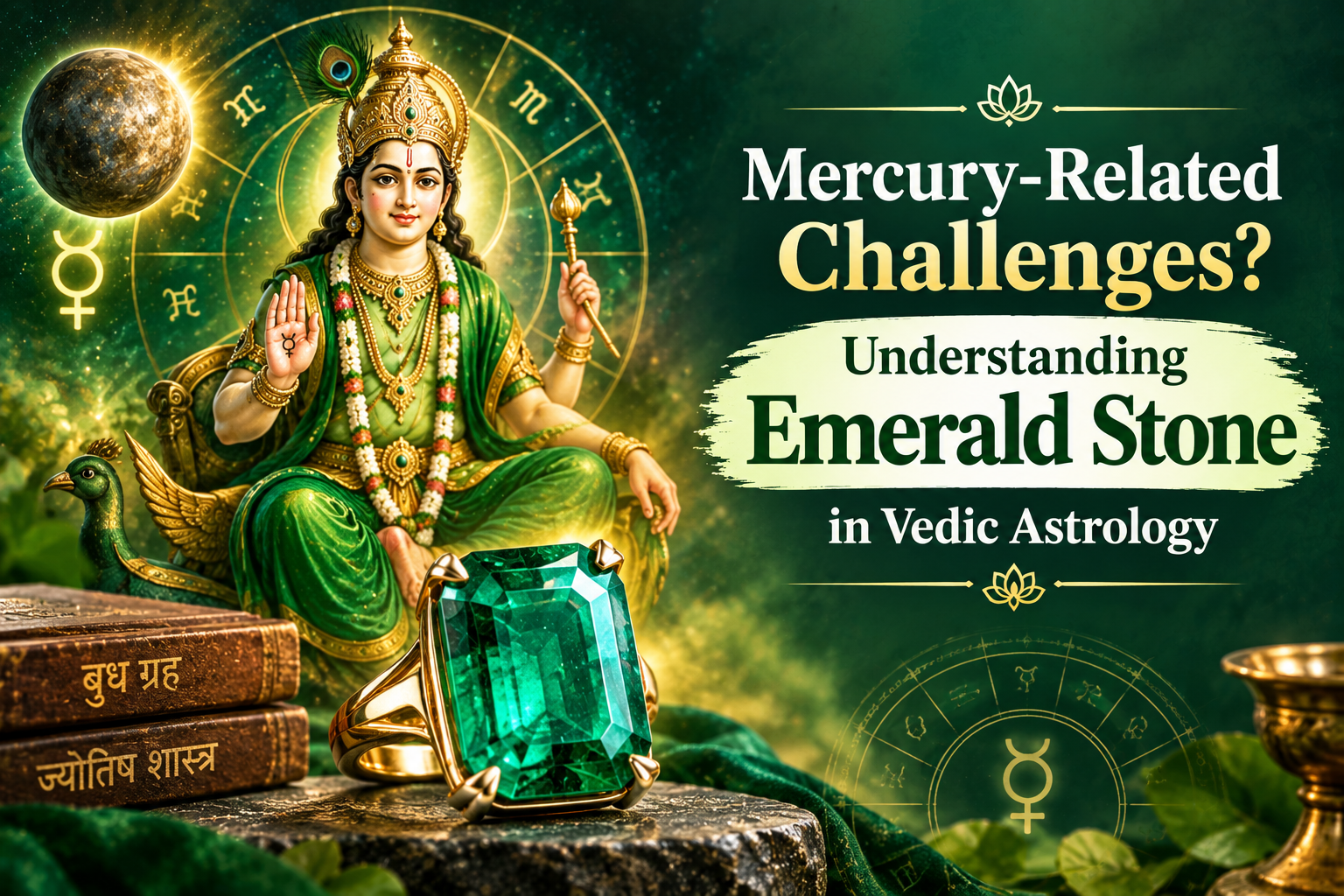
In Vedic astrology, Mercury (Budh) is traditionally associated with intelligence, communication, learning, analytical thinking, business, calculation, adaptability, and speech. When Mercury is considered weak, afflicted, or challenged in a birth chart, astrologers may examine its position and overall strength before suggesting traditional remedies. One of the most well-known gemstones associated with Mercury is Emerald Stone, commonly known as Panna.
But does every person experiencing Mercury-related challenges need to wear Emerald?
According to traditional Vedic astrology, not necessarily. The suitability of Emerald is generally assessed through the individual’s complete Kundli.
What Does Mercury Represent in Vedic Astrology?
Mercury is traditionally known as Budh and is associated with intellect, communication and analytical abilities.
Traditional Mercury-related themes include:
- Intelligence and reasoning
- Communication and speech
- Learning and education
- Writing and expression
- Mathematics and calculation
- Business and commerce
- Negotiation
- Analytical thinking
- Adaptability
- Memory and information processing
The actual interpretation of Mercury depends on its placement, strength and relationship with other planets in the horoscope.
What Are Mercury-Related Challenges?
The term “Mercury-related challenges” can refer to different situations depending on an individual’s birth chart.
In traditional Vedic astrology, an astrologer may examine Mercury’s house, zodiac sign, aspects, conjunctions, dignity, nakshatra and planetary periods.
Depending on the horoscope, traditionally discussed Mercury-related concerns may include:
- Communication difficulties
- Challenges with concentration or learning
- Difficulty expressing ideas clearly
- Problems requiring greater analytical clarity
- Business or negotiation-related challenges
- Difficulty making practical decisions
- Issues involving organisation and information management
These interpretations are part of traditional astrology and should not be treated as scientifically established causes of these experiences.
What Is Emerald Stone?
Emerald, known as Panna in India, is a green variety of the mineral beryl. In Vedic gemstone astrology, Emerald is traditionally associated with Mercury (Budh).
The traditional connection is: Mercury → Budh → Green colour → Emerald/Panna
Because of this planetary association, Panna may be considered when an astrologer believes that strengthening Mercury is appropriate for a particular horoscope.
Why Is Emerald Associated With Mercury?
Mercury is traditionally connected with intellect, communication, calculation and adaptability. Emerald is therefore symbolically associated with Mercury-related qualities.
Intelligence & Reasoning
Mercury represents logical thinking, analysis and information processing. Emerald is traditionally connected with these qualities.
Communication
Speech, writing and communication are important Mercury themes. Panna is therefore traditionally associated with clear expression.
Learning & Education
Mercury is connected with learning, memory and intellectual development in Vedic astrology.
Business & Commerce
Mercury has traditional associations with trade, calculation, negotiation and commercial activities.
Adaptability
Mercury is traditionally regarded as flexible and adaptable, making Emerald symbolically connected with quick thinking and adjustment.
These are traditional astrological associations, not scientifically proven effects of Emerald.
Can Everyone Wear Emerald?
Traditional Vedic astrology does not recommend Emerald universally for everyone. Because Panna is traditionally considered a Mercury-strengthening gemstone, an astrologer may first determine whether strengthening Mercury is appropriate.
A Kundli analysis may consider:
- Ascendant or Lagna
- Mercury’s house placement
- Mercury’s zodiac sign
- Mercury’s strength and dignity
- Planetary aspects
- Conjunctions with other planets
- Nakshatra placement
- Mahadasha and Antardasha
- Relevant divisional charts
- Mercury’s overall role in the horoscope
Therefore, experiencing communication, education or business difficulties does not automatically mean that Emerald should be worn.
Does a Weak Mercury Always Mean You Need Panna?
Not necessarily. This is an important distinction in traditional gemstone astrology. A planet being considered weak does not automatically mean it should be strengthened with a gemstone.
The astrologer may first ask:
- Is Mercury beneficial for this Ascendant?
- Is strengthening Mercury appropriate in this particular Kundli?
- Is Mercury currently active through a Dasha or Antardasha?
Only after considering the complete horoscope may Emerald be recommended within the traditional astrological framework.
Mercury Mahadasha and Emerald
In the traditional Vimshottari Dasha system, Mercury Mahadasha is said to last 17 years. During this period, astrologers may examine Mercury’s position and condition more closely.
However: Mercury Mahadasha does not automatically mean that everyone should wear Emerald.
The complete birth chart remains important when deciding whether strengthening Mercury is appropriate.
Traditional Qualities Associated With Emerald
When considered suitable within traditional Vedic astrology, Emerald is associated with:
- Intelligence
- Communication
- Learning
- Analytical thinking
- Business skills
- Adaptability
- Concentration
- Practical reasoning
- Clear expression
These should be understood as traditional symbolic associations, rather than guaranteed effects of wearing the gemstone.
How to Choose a Natural Emerald?
If you are considering Panna for astrological purposes, gemstone authenticity and quality should be carefully evaluated.
Look for: Natural Status
Confirm whether the Emerald is natural, synthetic or an imitation.
Laboratory Certification
A reliable gemological report can help identify the gemstone and disclose relevant treatments.
Colour
Emeralds range from lighter green to deeper green shades. Colour should be evaluated together with clarity, transparency and overall quality.
Clarity
Natural Emeralds commonly contain inclusions. These inclusions are often referred to as the stone’s “jardin.”
Treatment Disclosure
Many Emeralds are treated to improve clarity. Treatment information should be transparently disclosed.
Cut & Polish
A suitable cut can enhance the appearance, colour and brilliance of the gemstone.
Weight & Measurements
The exact carat weight and dimensions should be clearly mentioned.
Natural vs Synthetic Emerald
When purchasing Panna, understanding the difference between natural and laboratory-grown material is important.
Natural Emerald: Naturally formed in the earth.
Synthetic Emerald: Laboratory-grown material with properties closely related to natural Emerald.
Imitation: A different material made to resemble Emerald.
If you are specifically looking for a natural Emerald, verify the gemstone’s identity through appropriate gemological documentation.
How Is Emerald Traditionally Worn?
Traditional Vedic gemstone practices may prescribe details such as:
- Suitable metal
- Finger
- Gemstone weight
- Day and timing
- Mantra
- Purification or energisation ritual
These recommendations can vary between astrologers and traditions.
A commonly recited Mercury mantra is: “Om Bum Budhaya Namah.”
If Emerald is being considered as an astrological remedy, the wearing method should ideally be selected after examining the individual’s Kundli.
Emerald for Students, Business Owners & Professionals
Because Mercury is traditionally associated with learning, communication and commerce, Emerald is often discussed in relation to several fields.
For Students
Panna is traditionally associated with learning, reasoning, memory and communication.
For Business Owners
Mercury’s traditional associations include trade, negotiation, calculation and business communication.
For Writers & Communicators
Mercury represents speech, writing and expression, making Emerald a traditional gemstone associated with communication-related activities.
For Analytical Professionals
Mercury is traditionally linked with calculation, logic, data and analysis.
However, wearing Emerald does not guarantee academic, professional or business success.
Common Mistakes When Choosing Emerald
- Wearing Panna Because Someone Else Recommended It
A gemstone traditionally suitable for one horoscope may not necessarily be suitable for another. - Assuming Weak Mercury Automatically Requires Emerald
The decision to strengthen a planet depends on the complete horoscope. - Buying Emerald Without Certification
Appearance alone may not reliably establish natural origin or treatment. - Choosing Only by Green Colour
A green stone is not automatically a natural Emerald. - Expecting Guaranteed Results
A gemstone should not replace education, professional expertise, planning, medical care, financial advice or consistent effort.
Conclusion:
Emerald Stone (Panna) holds an important place in traditional Vedic gemstone astrology because of its association with Mercury (Budh). It is traditionally connected with intelligence, communication, learning, business, analytical thinking and adaptability. However, Mercury-related challenges do not automatically mean that Emerald is the right gemstone.
The important question is not simply: “Is my Mercury weak?”
Instead, consider: “Is strengthening Mercury appropriate for my Kundli?”
If you are considering Emerald for astrological purposes, begin with a horoscope-based assessment and then pay attention to the gemstone’s natural status, quality, treatment disclosure and laboratory certification. A thoughtful approach helps you understand both the traditional astrological perspective and the actual gemological characteristics of the Emerald you choose.