In Vedic astrology, the Sun (Surya) is traditionally associated with confidence, vitality, leadership, authority, individuality, and self-expression. When astrologers describe the Sun as weak or afflicted in a birth chart, they may interpret it as an area where these qualities require greater attention.
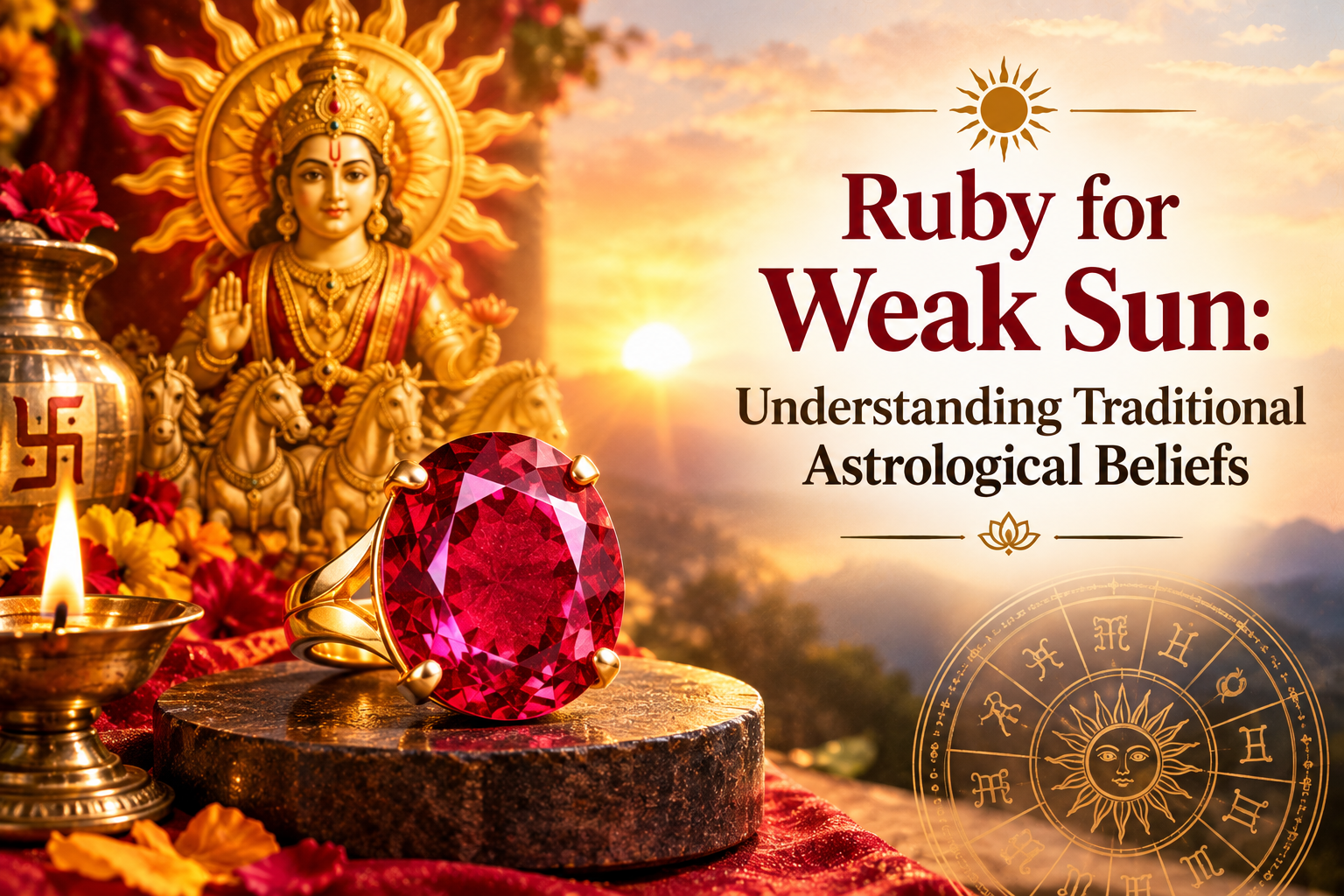
One of the most well-known gemstones associated with the Sun is Ruby, traditionally called Manikya.
But why is Ruby recommended for a weak Sun? What does “weak Sun” actually mean in Vedic astrology? Is Ruby suitable for everyone with a weak Sun?
Let’s explore the traditional astrological understanding.
Important note: The gemstone recommendations in this article are based on traditional Vedic astrology. There is no scientific evidence that wearing Ruby strengthens the Sun or guarantees changes in health, wealth, career, confidence, or other life outcomes.
What Does the Sun Represent in Vedic Astrology?
In Vedic astrology, the Sun is considered a significant planet—or graha—and is traditionally associated with:
- Leadership
- Confidence
- Vitality
- Willpower
- Identity
- Authority
- Self-expression
- Recognition
The Sun is also traditionally connected with one’s relationship with authority, father figures, government, reputation, and sense of individuality. The exact interpretation depends on the entire horoscope rather than the Sun’s position alone.
What Is a “Weak Sun”?
“Weak Sun” is not a single technical condition with one universal definition. A Vedic astrologer may describe the Sun as weak, afflicted, or challenged based on several factors, including:
- Zodiac Sign
The Sun has different levels of traditional strength depending on its sign.
- Planetary Aspects
Other planets influencing the Sun may modify its interpretation.
- Conjunctions
The Sun’s relationship with other planets can be important.
- Nakshatra
The Sun’s Nakshatra may also be considered.
- Overall Chart Strength
An astrologer may assess the Sun in relation to the Ascendant, house lords, divisional charts, Dashas, and other factors.
Therefore: A Sun in one particular house does not automatically mean that the Sun is weak.
What Is Ruby or Manikya?
Ruby is a precious gemstone belonging to the corundum mineral family. Its red colour is primarily associated with chromium. In traditional Indian astrology, Ruby is called Manikya and is associated with the Sun.
This creates the traditional planetary gemstone connection: Sun → Ruby (Manikya)
Because of this association, Ruby is traditionally considered when an astrologer believes strengthening the Sun is appropriate.
Why Is Ruby Traditionally Recommended for a Weak Sun?
The traditional astrological reasoning is straightforward:
Sun → Ruby → Strengthening the Sun’s symbolic planetary influence
Practitioners who recommend Ruby may believe that the gemstone helps harmonise or strengthen Sun-related qualities represented in the birth chart.
These may include:
- Confidence
- Leadership
- Self-expression
- Determination
- Authority
- Vitality
However, Ruby is not automatically appropriate for every person whose Sun is described as weak. The horoscope must be considered as a whole.
Traditional Qualities Associated With a Strong Sun
In Vedic astrology, a well-placed or strong Sun is traditionally associated with qualities such as:
- Leadership
Taking responsibility and guiding others.
- Confidence
Having faith in one’s abilities.
- Willpower
Maintaining determination toward goals.
- Self-expression
Communicating one’s identity and ideas confidently.
- Authority
Handling responsibility and positions of influence.
- Vitality
Traditional astrological symbolism connects the Sun with life force and vitality.
These are astrological interpretations, not scientifically established effects of the planet or gemstone.
Signs Traditionally Associated With Sun-Related Challenges
Different astrologers use different criteria when evaluating the Sun. One commonly discussed condition is the Sun’s placement in Libra, where the Sun is traditionally considered debilitated. However, debilitation alone does not tell the complete story.
An astrologer may also consider:
- Cancellation of debilitation
- House placement
- Aspects
- Conjunctions
- Divisional charts
- Planetary strength
- Dasha periods
Therefore, simply seeing the Sun in Libra should not automatically lead to a Ruby recommendation.
What Are the Traditional Benefits of Ruby?
According to traditional Vedic astrology, a suitable Ruby may be associated with:
- Confidence
Ruby is traditionally believed to support Sun-related qualities such as self-confidence and individuality. - Leadership
The Sun represents authority and leadership in traditional astrology, making Ruby relevant to these themes. - Determination
Ruby is often associated with willpower and the ability to remain focused on one’s goals. - Recognition
The Sun is traditionally connected with reputation and recognition. - Authority
Ruby may be considered for individuals whose professional or personal life strongly involves leadership and responsibility. - Vitality
Traditional astrology associates the Sun with vitality and life force.
Again, these are traditional beliefs and should not be presented as medically or scientifically proven benefits.
Ruby and Career
The Sun is traditionally associated with:
- Government
- Leadership positions
- Administration
- Management
- Authority
- Public recognition
- Positions of responsibility
Because of these associations, astrologers may consider Ruby for certain career-related charts. For example, if the Sun has an important role in a person’s horoscope and is considered suitable to strengthen, Ruby may be suggested as part of a traditional astrological remedy.
However: Ruby does not guarantee career growth or professional success.
Skills, education, experience, decisions, opportunities, and external circumstances remain important.
Ruby and Leadership
One of the strongest traditional associations of the Sun is leadership.
The Sun represents the centre of the solar system, and Vedic astrology uses this symbolism to represent: Identity → Authority → Leadership → Recognition
Ruby‘s connection with the Sun makes it a traditional gemstone for those seeking to work with these themes astrologically.
Ruby and Self-Expression
The Sun is also traditionally associated with individuality and self-expression. A person whose Sun is interpreted as challenged may be described astrologically as experiencing difficulty expressing their individuality or asserting themselves. A suitable Ruby may traditionally be recommended to strengthen Sun-related symbolism. But this should not be confused with a psychological or medical treatment.
Ruby and Relationships With Authority
In traditional Vedic astrology, the Sun can represent one’s relationship with:
- Father
- Government
- Authority figures
- Leadership
- Responsibility
Therefore, astrologers may examine the Sun when interpreting these areas. Ruby is sometimes recommended when the Sun is considered suitable for strengthening.
What Does an Astrologer Check Before Recommending Ruby?
A traditional Vedic astrologer may examine:
- Ascendant
The rising sign determines the framework of the horoscope. - Sun’s House
The house occupied by the Sun provides context. - Sun’s Sign
The Sun’s zodiac sign is considered when assessing its dignity. - Planetary Aspects
Other planets influencing the Sun may modify its interpretation. - Conjunctions
Planets positioned with the Sun can affect its traditional reading. - Nakshatra
The Sun’s lunar mansion may also be considered. - Dasha
Current planetary periods can influence which themes are emphasised. - Overall Planetary Relationships
The Sun’s relationship with the chart’s other planets is important.
This is why personalised horoscope analysis is preferable to generic gemstone advice.
How Is Ruby Traditionally Worn?
Different Vedic astrology traditions prescribe different procedures.
Recommendations may include:
- Specific metal
- Particular finger
- Specific weight
- Day of wearing
- Time of wearing
- Mantra
- Purification
- Energisation or traditional rituals
There is no single universally accepted procedure. If Ruby is being worn specifically as an astrological remedy, follow the method recommended by a knowledgeable practitioner within your tradition.
Traditional Sun Mantra
A commonly used mantra associated with the Sun is:
“Om Suryaya Namah”
Devotees may recite Sun-related mantras as part of traditional spiritual practice, particularly on Sundays. Mantra practice is a devotional tradition and should not be presented as a scientifically proven mechanism for changing planetary effects.
Ruby and Sunday
Sunday is traditionally associated with Surya, the Sun. For this reason, Sunday is commonly considered significant in traditional Sun worship.
Devotees may:
- Offer water to the Sun
- Recite Surya mantras
- Practice meditation
- Perform devotional rituals
Some gemstone traditions also prescribe wearing Ruby on Sunday, although exact procedures vary.
How to Choose a Ruby?
If Ruby is being purchased for astrological purposes, gemstone quality and identification are important.
Look for:
- Natural Ruby
Ask whether the gemstone is natural, synthetic, or imitation.
- Transparent Information About Treatment
Ruby may be treated, including through heat treatment. Relevant treatment information should be disclosed.
- Good Colour
Ruby occurs in different shades of red. Colour is an important quality factor.
- Laboratory Certification
A reliable gemstone laboratory report can help verify the gemstone’s identity and disclose relevant characteristics.
- Reputable Seller
Choose a seller who provides transparent information about the gemstone rather than making guaranteed-result claims.
Ruby Quality vs Astrological Suitability
These are two different questions.
Gemstone quality
Concerns characteristics such as:
- Colour
- Clarity
- Cut
- Carat weight
- Origin
- Treatment
- Natural or synthetic status
- Astrological suitability
Traditionally depends on:
- Birth chart
- Ascendant
- Sun’s condition
- House placement
- Planetary relationships
- Dasha
- Overall chart
A beautiful Ruby is not automatically the right Ruby for every horoscope.
Ruby and Sun Worship
Ruby can also be appreciated outside astrological remedies.
The gemstone’s vivid red colour can symbolically represent:
- Energy
- Solar power
- Vitality
- Leadership
- Courage
For people who follow Surya worship, Ruby may therefore have additional symbolic significance.
However, gemstone symbolism and religious practice should not be treated as identical.
Ruby, Maa Durga and the Symbolism of Strength
Ruby‘s red colour also creates an interesting connection with Maa Durga. Maa Durga is traditionally associated with Shakti, courage, protection, and divine strength, while Ruby is traditionally associated with the Sun and qualities such as vitality and confidence. This is primarily a symbolic connection, not a universally prescribed religious rule.
The traditional astrological association remains:
Ruby → Sun
Ruby During Navratri
Because of its red colour, Ruby may naturally complement the visual symbolism of Navratri and Devi worship. However, Navratri itself does not automatically make Ruby astrologically suitable for everyone. If Ruby is being considered as an astrological gemstone, the birth chart remains the primary traditional consideration.
Conclusion:
In traditional Vedic astrology, Ruby or Manikya is the primary gemstone associated with the Sun. When an astrologer identifies the Sun as weak, afflicted, or otherwise in need of strengthening—and the horoscope supports that approach—Ruby may traditionally be recommended.
The Sun is associated with:
- Confidence
- Leadership
- Willpower
- Authority
- Determination
- Individuality
Ruby‘s traditional symbolism reflects these qualities, which is why it has remained an important gemstone in Indian astrological traditions.
But the most important principle is: A weak Sun does not automatically mean you should wear Ruby. Before choosing Ruby as an astrological remedy, consider the complete birth chart, the Sun’s role in the horoscope, current planetary periods, and the advice of a knowledgeable practitioner.
And when purchasing the gemstone, pay attention to authenticity, quality, treatment disclosure, and laboratory certification. Ruby is not simply a red gemstone—it is traditionally regarded as the gemstone of the Sun, chosen according to the horoscope rather than colour alone.