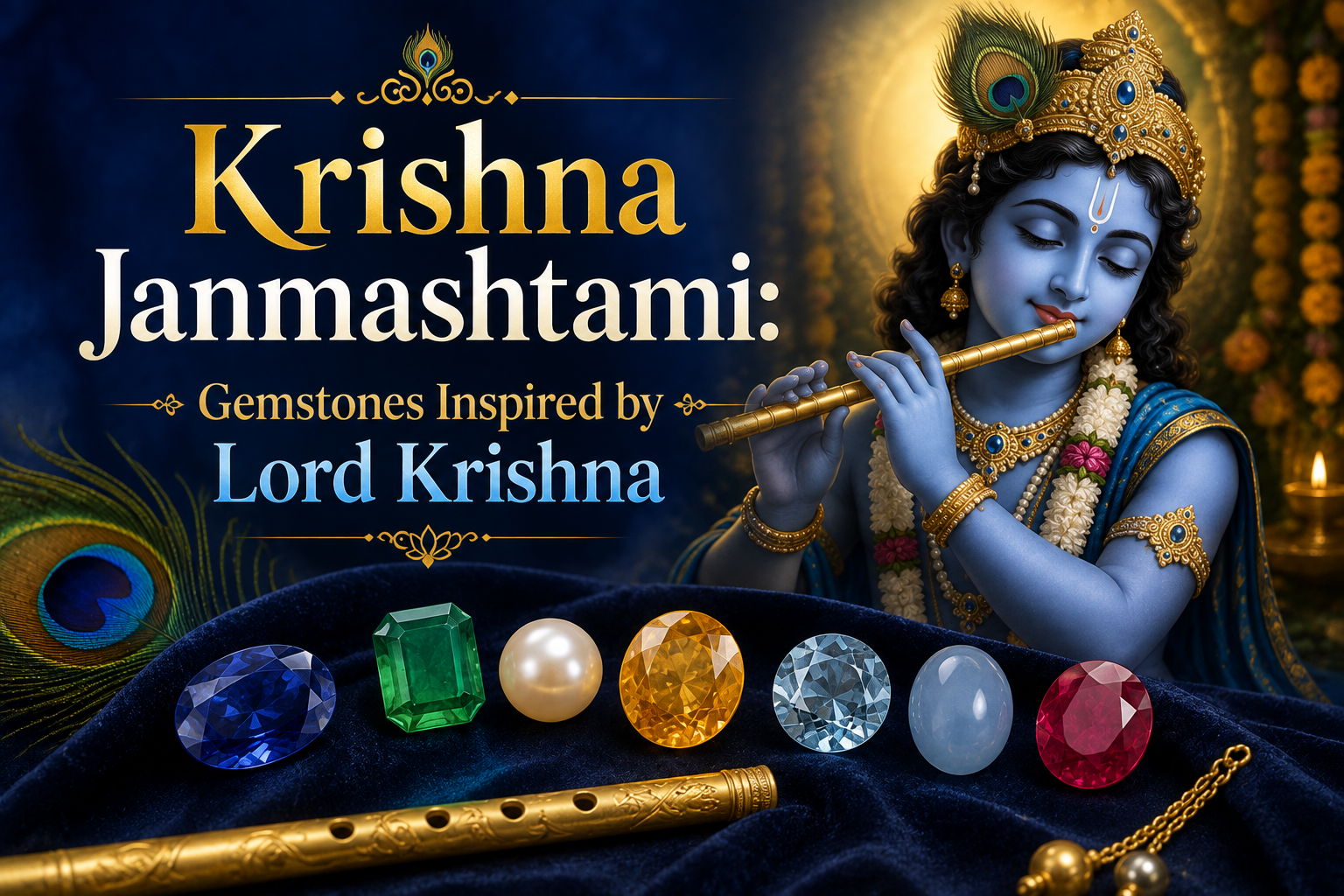
Krishna Janmashtami celebrates the divine birth of Lord Krishna, one of the most beloved deities in Hindu tradition. Known for his wisdom, compassion, playful nature, and teachings in the Bhagavad Gita, Lord Krishna continues to inspire millions of devotees.
From his peacock feather and flute to his beautiful blue complexion, many elements associated with Krishna carry deep symbolism. These symbols have also inspired the use of certain gemstones and crystals in devotional jewellery, meditation, décor, and spiritual practices. This Janmashtami, exploring gemstones inspired by Krishna can be a beautiful way to connect tradition, symbolism, and personal spirituality.
Note: The gemstone associations in this article are symbolic and based on cultural, spiritual, or modern crystal traditions. They should not be considered scientifically proven methods for producing specific spiritual, emotional, or health effects.
Why Are Gemstones Associated With Lord Krishna?
Lord Krishna is traditionally depicted with several distinctive symbols:
- Peacock Feather
- Flute
- Blue complexion
- Lotus
- Yellow Pitambar
- Divine wisdom
These symbols naturally inspire associations with colours such as blue, green, yellow, and white. This makes gemstones in similar colours especially meaningful for Krishna-inspired jewellery and spiritual décor.
- Blue Sapphire – Inspired by Krishna’s Blue Form
Lord Krishna is traditionally described and depicted with a deep blue complexion. This makes blue gemstones an obvious visual inspiration.
Blue Sapphire is one of the most famous blue gemstones.
Its deep blue colour can symbolically remind devotees of:
- The vast sky
- The infinite ocean
- Divine consciousness
- Serenity
- Depth
In Vedic astrology, Blue Sapphire is traditionally associated with Shani (Saturn), not specifically with Lord Krishna. Therefore, it is better to describe Blue Sapphire as inspired by Krishna’s iconic blue appearance, rather than claiming it is Krishna’s gemstone.
- Lapis Lazuli – A Krishna-Inspired Blue Crystal
Lapis Lazuli is another beautiful deep-blue stone. Its intense blue colour and occasional golden pyrite flecks make it particularly attractive for Krishna-inspired jewellery. Modern crystal traditions often associate Lapis Lazuli with:
- Wisdom
- Truth
- Communication
- Inner awareness
- Spiritual reflection
These qualities can be symbolically connected with Krishna’s role as a teacher and guide.
Krishna’s blue form + Lapis Lazuli’s deep blue colour
makes this a beautiful combination for devotional-inspired crystal jewellery.
- Green Aventurine – Inspired by Vrindavan
Think of Krishna’s childhood stories:
- Vrindavan
- Forests
- Peacocks
- Flowers
- Cows
- Flute melodies
The lush green surroundings traditionally associated with Vrindavan make Green Aventurine a natural colour inspiration.
Green Aventurine is commonly associated in modern crystal practices with:
- Growth
- Optimism
- Opportunity
- Harmony
- Positive intentions
It can therefore represent the natural beauty and joyful atmosphere of Krishna’s Vrindavan pastimes.
- Citrine – Inspired by Krishna’s Pitambar
Lord Krishna is often depicted wearing a beautiful yellow garment called Pitambar or Pitambara. The warm golden-yellow colour of Citrine makes it a natural visual match.
In modern crystal traditions, Citrine is associated with:
- Positivity
- Abundance
- Confidence
- Optimism
- Joy
Its golden appearance can symbolically represent the radiance and warmth associated with Krishna’s Pitambar.
- Clear Quartz – Symbol of Clarity
Clear Quartz is one of the most widely recognised crystals.
Its transparent appearance can symbolise:
- Clarity
- Purity
- Focus
- Consciousness
- Spiritual intention
These qualities can be connected symbolically with Krishna’s teachings and the search for clarity and wisdom. For devotees who meditate or read the Bhagavad Gita, Clear Quartz can serve as a simple visual reminder of inner clarity and focused awareness.
- Amethyst – A Symbol of Spiritual Reflection
Amethyst is a purple variety of Quartz and is extremely popular in modern crystal practices.
It is commonly associated with:
- Calmness
- Meditation
- Spiritual awareness
- Introspection
- Peace
Krishna’s teachings encourage people to develop self-awareness, discipline, and spiritual understanding.
Therefore, Amethyst can be used symbolically during:
- Meditation
- Gita reading
- Prayer
- Personal reflection
- Peacock Feather-Inspired Gemstones
The peacock feather is one of Lord Krishna’s most recognisable symbols.
Its colours include:
- Blue
- Green
- Gold
- Iridescent tones
This makes several gemstones suitable for a peacock-inspired Krishna jewellery theme.
Possible choices include:
- Lapis Lazuli: For the deep blue tones.
- Green Aventurine: For the green tones.
- Citrine: For golden highlights.
- Labradorite: For its colourful flashes and iridescent appearance.
Together, these colours can create a beautiful Krishna-inspired gemstone combination.
Krishna-Inspired Crystal Bracelet
If you want to create a Krishna-inspired bracelet, you can focus on the colours associated with his traditional imagery.
For example:
- Lapis Lazuli
Blue — Krishna’s iconic form
- Green Aventurine
Green — Vrindavan and nature
- Citrine
Yellow — Pitambar
- Clear Quartz
White/clear — clarity and spiritual intention
This combination is primarily symbolic and aesthetic, rather than a traditional scriptural gemstone prescription.
The Flute and the Meaning of Inner Harmony
Krishna’s flute is another important symbol.
The flute is often interpreted spiritually as representing:
Surrender and openness
A flute produces beautiful music because it is hollow and allows the breath to pass through it.
This can inspire a powerful spiritual message:
When we become less attached to the ego, we create space for divine guidance.
A Krishna-inspired gemstone bracelet or pendant can therefore serve as a reminder of:
- Inner harmony
- Surrender
- Devotion
- Simplicity
Lotus-Inspired Gemstone Choices:
The lotus is another important spiritual symbol in Indian traditions.
For a lotus-inspired Krishna theme, gemstones in soft colours can work beautifully:
- Moonstone
For a soft, luminous appearance.
- Rose Quartz
For love and compassion symbolism.
- Clear Quartz
For purity and clarity symbolism. These can be used in Krishna-inspired jewellery or devotional décor.
- Krishna and the Bhagavad Gita
Krishna’s role as the speaker of the Bhagavad Gita makes him particularly associated with:
- Dharma
- Wisdom
- Self-discipline
- Detachment
- Devotion
- Right action
This is why gemstones used for Krishna-inspired meditation don’t need to represent only his physical appearance.
There isn’t a universally established rule saying:
“This one gemstone is Lord Krishna’s official gemstone.”
Many Krishna-inspired gemstone associations are based on:
- Colour symbolism
- Religious artwork
- Modern spiritual practices
- Personal devotion
- Cultural interpretation
This distinction is important.
For example, Blue Sapphire is traditionally associated with Saturn in Vedic astrology, even though its blue colour may visually remind people of Krishna.
Krishna and Vedic Astrology
Krishna is also connected with traditional astrology through various cultural and scriptural traditions.
However, gemstone astrology follows a different framework.
If someone is choosing a gemstone specifically as a planetary remedy, the gemstone should traditionally be selected according to the person’s Kundli, rather than simply because the stone reminds them of Krishna. For devotional purposes, however, you can choose a gemstone based on personal symbolism and spiritual connection.
Krishna-Inspired Gemstone Gifts for Janmashtami
Looking for a meaningful Janmashtami gift?
Consider:
- Lapis Lazuli Bracelet
Inspired by Krishna’s blue form.
- Citrine Bracelet
Inspired by the golden-yellow Pitambar.
- Green Aventurine Bracelet
Inspired by Vrindavan’s natural beauty.
- Amethyst Bracelet
For meditation and spiritual reflection.
- Peacock-Inspired Crystal Bracelet
A colourful combination representing the peacock feather.
- Krishna-Inspired Crystal Mala
A devotional accessory for prayer or meditation.
- Krishna-Themed Crystal Décor
A beautiful addition to a meditation or prayer space.
- Krishna-Inspired Gemstone Décor
Gemstones can also be incorporated into devotional spaces.
to create a peaceful Krishna-inspired meditation corner.
A Simple Krishna-Inspired Meditation Practice:
You don’t need elaborate rituals to use gemstones as a meditation symbol.
- Step 1
Choose a gemstone that reminds you of Krishna.
- Step 2
Sit comfortably in a quiet space.
- Step 3
Hold the gemstone gently.
- Step 4
Take a few slow breaths.
- Step 5
Reflect on a quality associated with Krishna:
- Dharma
- Compassion
- Wisdom
- Devotion
- Detachment
- Joy
- Step 6
End with a simple prayer or gratitude.
The gemstone acts as a physical reminder of your intention.
Krishna-Inspired Gemstone Colour Guide:
- Krishna’s form: Blue – Lapis Lazuli / Blue Sapphire
- Peacock feather: Blue & Green – Lapis Lazuli + Green Aventurine
- Pitambar: Yellow – Citrine
- Vrindavan: Green – Green Aventurine
- Lotus: White/Pink – Moonstone / Rose Quartz
- Spiritual: clarity – Clear Quartz
- Meditation: Purple – Amethyst
How to Choose a Krishna-Inspired Gemstone?
Before buying, ask:
- Do I want symbolism or astrology?
If symbolism, choose according to colour and personal meaning. If astrology, consult the birth chart.
- What Krishna quality inspires me?
- Wisdom?
- Love?
- Devotion?
- Peace?
- Courage?
- Joy?
- Do I want jewellery or décor?
Choose a bracelet or pendant for personal use, or a crystal specimen for your spiritual space.
- Is the gemstone natural?
For valuable gemstones, ask about:
- Natural or synthetic origin
- Treatments
- Certification
- Quality
Janmashtami: A Time for Devotion and Reflection
Krishna Janmashtami isn’t simply about celebrating Krishna’s birth. For many devotees, it is also a time to reflect on his teachings and qualities. The gemstones associated with Krishna-inspired themes can act as symbols of those values.
- Blue → Divine depth
- Yellow → Joy and radiance
- Green → Nature and growth
- Peacock colours → Beauty and playfulness
- Clear → Clarity
- Purple → Spiritual reflection
Conclusion:
Krishna Janmashtami is a beautiful occasion to celebrate devotion, wisdom, joy, and the timeless teachings of Lord Krishna. While there is no universally prescribed “Krishna gemstone,” many gemstones can be meaningfully inspired by the colours and symbols associated with Krishna.
- Lapis Lazuli can evoke Krishna’s blue form.
- Citrine can reflect the golden-yellow Pitambar.
- Green Aventurine can represent the greenery of Vrindavan.
- Amethyst can symbolise meditation and spiritual reflection.
- Clear Quartz can represent clarity and intention.
- Labradorite and colourful crystals can evoke the beauty of the peacock feather.
The most meaningful choice is the one that reminds you of a quality you wish to cultivate.
- This Janmashtami, wear a colour.
- Carry a symbol.
- Remember a teaching.
- And celebrate the divine joy of Krishna.
Hare Krishna!