Gemstones and crystals are often used interchangeably in the world of jewellery, spirituality, Vastu, and crystal healing—but they are not exactly the same thing.
While both can occur naturally and may be used for jewellery, meditation, decoration, and spiritual practices, the terms describe different concepts.
Understanding the difference can help you make a better choice when buying gemstones, crystal bracelets, Rudraksha accessories, or Vastu products.
Note: Crystal-healing and spiritual benefits mentioned in this article are based on traditional or modern beliefs. They are not scientifically established medical treatments.
What Is a Gemstone?
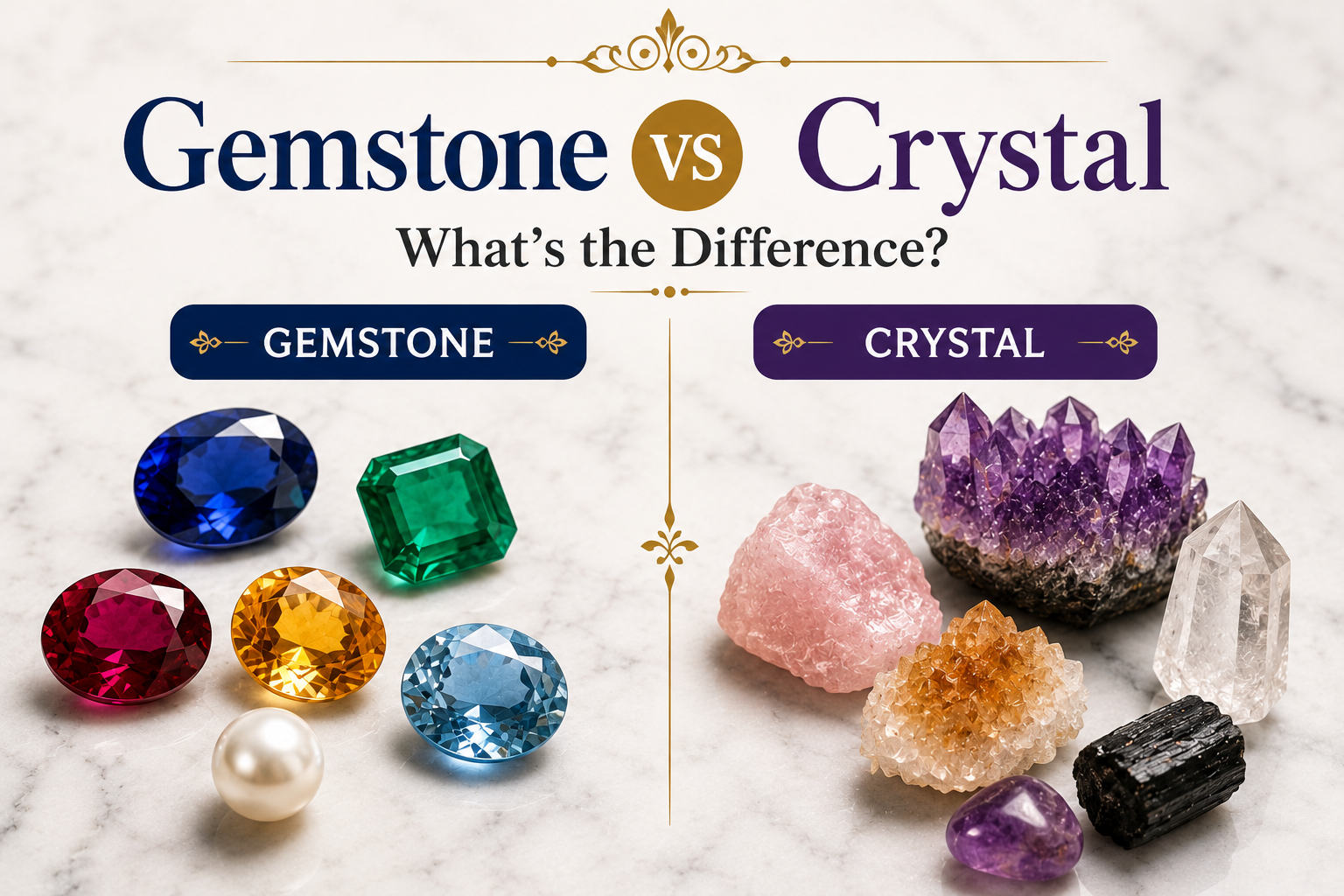
A gemstone is a natural or sometimes synthetic material that is selected, cut, and polished primarily for its beauty, durability, rarity, and use in jewellery or ornamentation.
Examples include:
- Diamond
- Ruby
- Emerald
- Sapphire
- Yellow Sapphire
- Red Coral
- Pearl
- Peridot
- Amethyst
Some gemstones are minerals, while others—such as Pearl and Coral—are organic gemstones.
What Is a Crystal?
A crystal is a solid material whose atoms, ions, or molecules are arranged in a regular, repeating structure. The word “crystal” describes a structure, not simply a spiritual product.
Examples include:
- Clear Quartz
- Amethyst
- Citrine
- Rose Quartz
- Black Tourmaline
- Pyrite
- Fluorite
- Selenite
Many crystals are minerals.
And here’s the important part:
A gemstone can also be a crystal.
For example:
Amethyst:
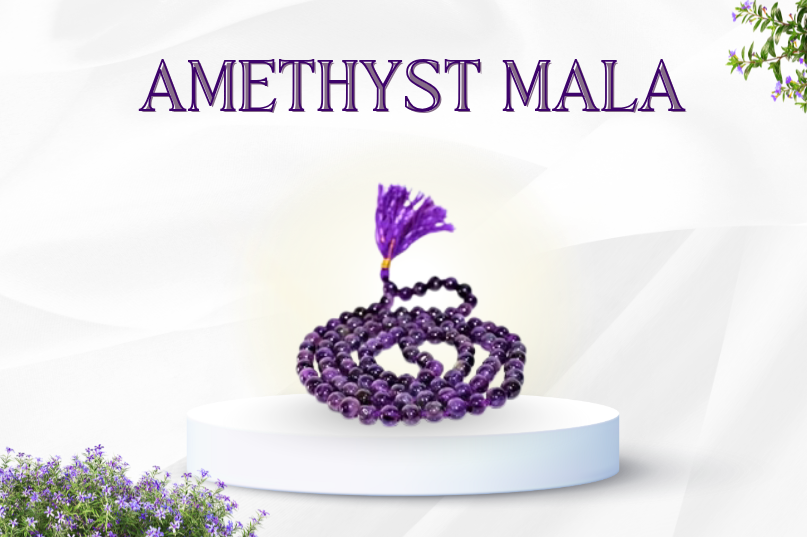
Amethyst is a variety of Quartz and is a crystalline mineral. When selected and polished for jewellery, it can also be considered a gemstone.
Crystal vs Gemstone: The Simple Difference
Think of it this way:
- Crystal = Describes the structure/form of a mineral or material
- Gemstone = Describes a material valued for jewellery or ornamental use
So they aren’t necessarily opposite categories.
Why Are Some Gemstones More Expensive Than Crystals?
Price isn’t determined simply by whether something is called a gemstone or crystal.
Value can depend on:
- Rarity: How uncommon the material is.
- Colour: Intensity, tone, and attractiveness.
- Clarity: How transparent or clean it appears.
- Size: Large, high-quality specimens can be rare.
- Cut: Important for faceted gemstones.
- Origin: Some origins can carry market premiums.
- Treatment: Treatments can affect value.
- Demand: Popular stones can command higher prices.
- Certification: Independent certification can be important for high-value gemstones.
Why Do People Buy Crystals?
Crystals are popular for several reasons.
- Home Décor
Crystal clusters and mineral specimens can be beautiful decorative objects.
- Meditation
Some people use crystals as symbolic objects during meditation.
- Jewellery
Crystals can be made into bracelets, necklaces, and pendants.
- Personal Rituals
Crystal enthusiasts may incorporate stones into intention-setting or mindfulness practices.
- Collection
Natural mineral formations can be fascinating from a geological perspective.
Why Do People Buy Gemstones?
Gemstones have a different range of uses.
- Jewellery
Ruby, Emerald, Sapphire, and Diamond are popular jewellery stones.
- Vedic Astrology
Traditional Vedic astrology associates particular gemstones with planets.
Astrological gemstone selection is traditionally based on the individual birth chart, rather than simply choosing a stone because of a zodiac sign.
Are All Crystals Gemstones?
No. A crystal may be beautiful but not normally classified as a gemstone.
For example, a large:
- Pyrite Cluster
can be a valuable and attractive mineral specimen, but it isn’t typically treated as a traditional jewellery gemstone in the same way as Ruby or Emerald.
Similarly, a large:
- Selenite Crystal
may be prized for its natural formation and decorative value rather than for use as a traditional faceted gemstone.
Are All Gemstones Crystals?
No. This is because not every gemstone is a crystalline mineral.
Some gemstones are organic.
Examples include:
- Pearl: Produced by molluscs.
- Coral: Formed from the skeletal structures of marine organisms.
- Amber: Fossilised tree resin.
These are gemstones, but they don’t fit the same category as crystalline minerals.
Popular Crystals and Their Traditional Associations:
In modern crystal practices, different crystals are commonly associated with different intentions.
Crystal Traditional Association:
- Amethyst: Calmness & spiritual awareness
- Rose Quartz: Love & emotional harmony
- Citrine: Abundance & positivity
- Green Aventurine: Opportunity & growth
- Black Tourmaline: Grounding & protection symbolism
- Clear Quartz: Clarity & intention
- Pyrite: Prosperity & confidence
- Selenite: Cleansing & spiritual symbolism
These associations are traditional beliefs, not scientifically established effects.
Popular Gemstones and Their Traditional Associations:
Gemstones used in Vedic astrology have their own traditional symbolism.
- Ruby
Associated with the Sun and traditionally linked with leadership and confidence.
- Emerald
Associated with Mercury and traditionally linked with intellect and communication.
- Yellow Sapphire
Associated with Jupiter and traditionally linked with wisdom and prosperity.
- Blue Sapphire
Associated with Saturn and traditionally regarded as a powerful planetary gemstone.
- Red Coral
Associated with Mars and traditionally linked with courage and energy.
Again, these are traditional astrological associations.
Crystal Bracelet vs Gemstone Bracelet:
A common question is: “Should I buy a crystal bracelet or gemstone bracelet?”
It depends on your purpose.
Choose a Crystal Bracelet if:
- You like crystal traditions
- You enjoy colourful natural stones
- You want a mindfulness reminder
- You prefer modern spiritual jewellery
- You like combinations of multiple crystals
Choose a Gemstone Bracelet if:
- You prefer traditional gemstones
- You want a specific gemstone
- You’re interested in astrological jewellery
- You want a jewellery-focused piece
- You’re buying based on a personalised astrological recommendation
Can You Wear Crystals and Gemstones Together?
Many people do.
For example:
Amethyst Bracelet + Emerald Ring or, Clear Quartz Bracelet + Ruby Pendant
There isn’t a scientific rule that crystals and gemstones cannot be worn together.
However, if you’re combining multiple planetary gemstones for Vedic astrology, traditional astrological compatibility should be considered.
Which Is More Valuable: Crystal or Gemstone?
There is no universal answer. A small high-quality natural Ruby can be worth far more than a large crystal specimen. At the same time, a rare mineral crystal specimen can be highly valuable to collectors. Value depends on the material and quality—not simply the label.
Natural vs Synthetic: Why It Matters?
Both crystals and gemstones can exist in natural or laboratory-created forms.
For example:
- Natural Ruby
- Naturally formed.
- Synthetic Ruby
Laboratory-grown with essentially the same chemical and crystal structure as natural Ruby.
Similarly, some crystals and mineral materials can also be manufactured or treated.
Therefore, when purchasing expensive material, ask about:
- Natural origin
- Synthetic origin
- Treatments
- Enhancements
- Certification
How to Choose Between a Gemstone and a Crystal?
Ask yourself:
- What is my purpose?
Jewellery?
Astrology?
Meditation?
Décor?
Gift? - Do I want a single stone or a combination?
Gemstone jewellery often focuses on one principal stone. Crystal bracelets often combine multiple stones. - Is the stone for astrology?
If yes, traditional Vedic astrology generally recommends selecting the gemstone according to the Kundli. - Do I want a decorative specimen?
A raw crystal cluster may be ideal. - Do I want everyday jewellery?
A properly cut gemstone or durable crystal bracelet may be more appropriate.
The Most Important Thing to Remember
The biggest misconception is:
“Gemstones and crystals are completely different things.”
They’re not. There is considerable overlap. Crystal describes structure. Gemstone describes use and value as an ornamental material. A single mineral can be both.
For example:
- Quartz → Crystal
- Amethyst → Crystal + Gemstone
- Ruby → Crystalline mineral + Gemstone
Conclusion:
The difference between Gemstones and Crystals becomes much easier to understand once you look beyond marketing terminology.
- Gemstones:
Generally valued for beauty, rarity, durability, jewellery, and sometimes astrological use.
- Crystals:
Generally discussed in terms of crystalline structure, natural formations, mineral specimens, décor, jewellery, and modern spiritual practices.
And sometimes:
They’re both. Whether you choose a Ruby, Emerald, Citrine, Amethyst, Pyrite, Clear Quartz, or another stone, focus on authenticity, quality, intended use, and reliable product information. For expensive gemstones, especially those intended for Vedic astrology, consider independent certification and professional guidance.
- Gemstone for jewellery or astrology.
- Crystal for décor, collection, or personal symbolism.
- And sometimes, one beautiful stone can be both.