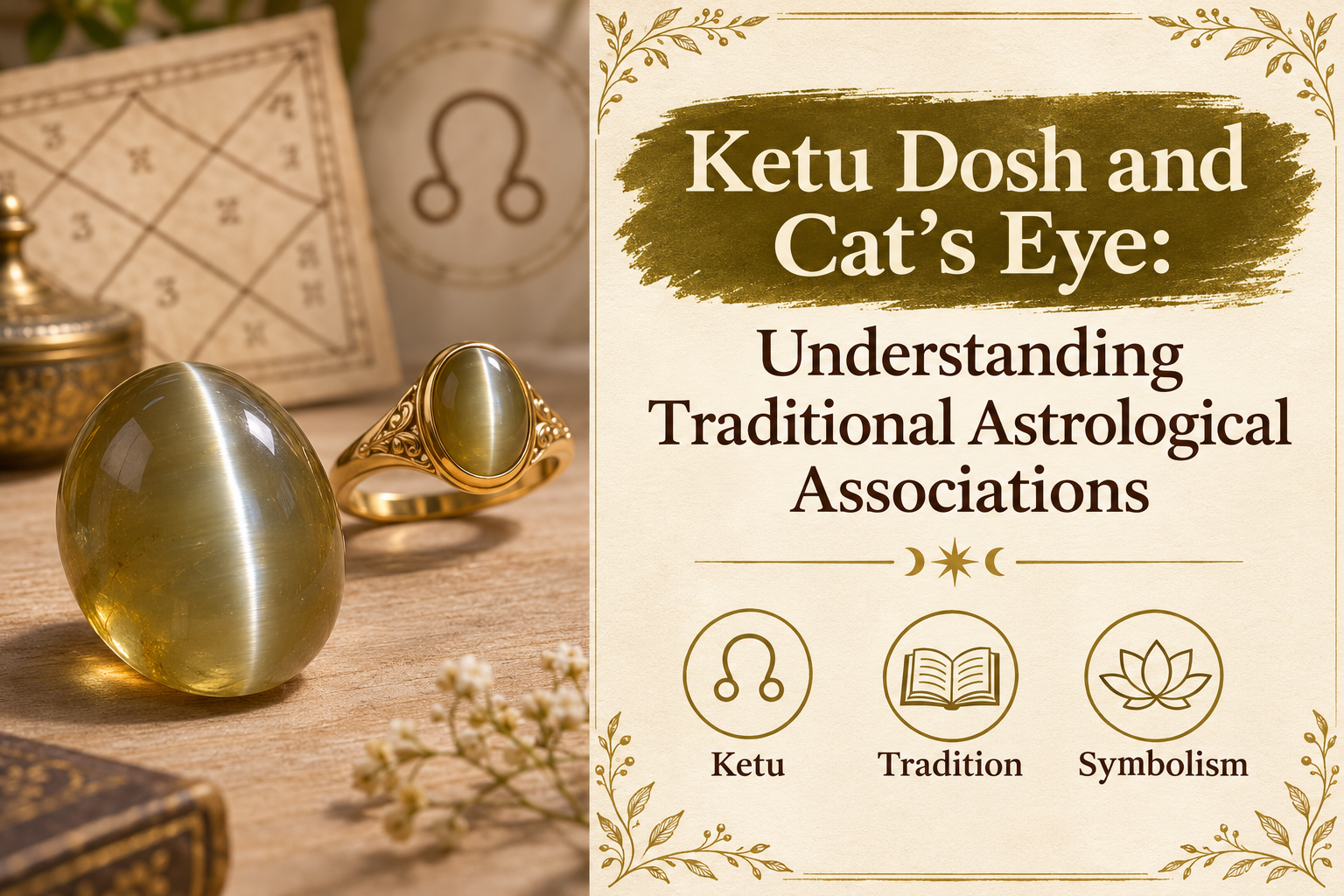
In Vedic astrology, Ketu is considered a shadow planet associated with spirituality, detachment, intuition, past karma and inner transformation. When Ketu is interpreted as challenging in an individual’s birth chart, astrologers may examine its placement and influence to understand what is traditionally known as Ketu Dosh.
One gemstone commonly associated with Ketu is Cat’s Eye (Lehsunia or Vaidurya). Recognised by its distinctive light band that resembles a cat’s eye, this gemstone holds an important place in traditional Vedic astrology.
But what is Ketu Dosh? Why is Cat’s Eye associated with Ketu, and who should consider wearing it? Let’s understand its traditional astrological significance.
- What Is Ketu in Vedic Astrology?
Ketu is one of the two shadow planets in Vedic astrology, along with Rahu. Unlike physical planets, Rahu and Ketu are mathematical points associated with the Moon’s orbital intersections.
Ketu is traditionally associated with:
- Spirituality and inner awareness
- Detachment and renunciation
- Past-life karma
- Intuition and introspection
- Mysticism and liberation (Moksha)
- Sudden changes and transformation
In astrological interpretations, Ketu is often connected with experiences that encourage introspection, self-discovery and spiritual development.
- What Is Ketu Dosh?
Ketu Dosh is a term used in certain Vedic astrology traditions when Ketu’s placement, conjunctions or aspects are interpreted as challenging in a birth chart.
Its interpretation depends on the complete horoscope rather than Ketu’s position alone.
An astrologer may examine:
- Ketu’s house and zodiac sign
- Its conjunction with other planets
- Its aspects and planetary relationships
- The placement of its sign lord
- Current Mahadasha and Antardasha
The overall strength and combinations in the birth chart
Some traditional interpretations associate challenging Ketu placements with confusion, detachment, uncertainty, difficulty maintaining focus or a stronger inclination towards isolation and spirituality.
Important: Ketu Dosh is an astrological concept, not a medical or scientific diagnosis. Not every challenging placement of Ketu indicates a dosh, and its interpretation varies across astrological traditions.
- What Is Cat’s Eye (Lehsunia)?
Cat’s Eye, traditionally known as Lehsunia, is a gemstone recognised for its distinctive optical effect called chatoyancy.
This effect creates a bright band of light across the surface of the gemstone, resembling the eye of a cat.
In jewellery and gemology, the term Cat’s Eye can refer to different minerals displaying this effect. However, the traditional Vedic astrological gemstone for Ketu is generally Chrysoberyl Cat’s Eye.
Key Characteristics of Chrysoberyl Cat’s Eye
- Mineral family: Chrysoberyl
- Chemical composition: Beryllium aluminium oxide
- Appearance: Yellowish-green, honey, brownish or greyish shades
- Special feature: Distinctive moving band of light
- Hardness: 8.5 on the Mohs scale
Its unique appearance and durability make it a valued gemstone in traditional astrological jewellery.
- Why Is Cat’s Eye Associated with Ketu?
In Vedic astrology, Cat’s Eye is traditionally considered the gemstone of Ketu.
Ketu is associated with spirituality, detachment, intuition and transformation. Cat’s Eye is symbolically connected with these qualities in traditional gemstone astrology.
Some commonly described associations include:
Spiritual Awareness
Cat’s Eye is traditionally associated with Ketu’s spiritual symbolism and the pursuit of inner understanding.
Intuition and Introspection
It is symbolically connected with self-reflection, intuition and deeper awareness.
Protection in Traditional Beliefs
Some astrological traditions associate Cat’s Eye with protection against negative influences. This is a spiritual belief, not a scientifically demonstrated protective effect.
Transformation and Detachment
Ketu represents letting go, introspection and spiritual growth. Cat’s Eye is traditionally associated with these themes.
These associations are rooted in traditional astrological beliefs and should not be understood as scientifically proven gemstone effects.
- Who Should Wear Cat’s Eye According to Vedic Astrology?
Cat’s Eye is traditionally considered a powerful astrological gemstone and is not recommended indiscriminately.
An astrologer may examine the following factors before suggesting Lehsunia:
- Ketu’s placement: The house and zodiac sign occupied by Ketu.
- Planetary relationships: Ketu’s conjunctions, aspects and relationship with other planets.
- Sign lord: The strength and condition of the planet ruling the sign occupied by Ketu.
- Dasha periods: Whether Ketu Mahadasha or Antardasha is active or approaching.
- Overall horoscope: The complete planetary configuration and its interpretation.
A person should not wear Cat’s Eye simply because they have been told they have Ketu Dosh. Personalised birth chart consultation is important before considering this gemstone.
- Traditional Astrological Significance of Cat’s Eye
In Vedic gemstone traditions, Cat’s Eye is associated with Ketu’s qualities and is sometimes considered when astrologers assess challenging Ketu placements.
Its traditional symbolism includes:
- Spiritual growth and introspection
- Detachment from unnecessary attachments
- Intuition and self-awareness
- Transformation and inner development
- Protection symbolism in certain traditions
These are traditional associations rather than guaranteed outcomes. Wearing Cat’s Eye cannot promise relief from difficulties or protection from misfortune.
- How to Identify a Genuine Cat’s Eye Gemstone
If Cat’s Eye is recommended after an astrological consultation, gemstone authenticity and quality should be checked carefully.
Consider these points before purchasing:
- Gemstone identity: Confirm whether it is Chrysoberyl Cat’s Eye or another chatoyant mineral.
- Chatoyancy: Look for a distinct, well-defined band of light that moves when the gemstone is tilted.
- Colour: Examine the colour, transparency and overall appearance.
- Treatment disclosure: Ask whether the gemstone has undergone any treatment.
- Laboratory report: Request a suitable gemological report confirming its identity and relevant observations.
- Seller transparency: Choose a reliable seller who provides accurate product details.
Remember that not every stone marketed as Cat’s Eye is Chrysoberyl Cat’s Eye. Confirm the mineral identity before purchasing it for astrological purposes.
- Traditional Method of Wearing Cat’s Eye
Wearing rituals vary across Vedic astrology traditions. If an astrologer recommends Cat’s Eye, follow their specific instructions regarding the gemstone and its use.
Some commonly followed practices include:
- Planet: Ketu
- Day: Tuesday or Thursday, depending on the tradition
- Mantra: ॐ कें केतवे नमः
- Metal: Silver is commonly used in traditional jewellery.
- Finger: The middle finger or another finger may be recommended depending on the tradition.
The recommended weight, metal, day and ritual should be determined through personalised guidance rather than following a universal rule.
- Traditional Remedies for Ketu Dosh
Cat’s Eye is not the only traditional practice associated with Ketu. Depending on the horoscope and the astrologer’s tradition, other devotional practices may also be suggested.
Some commonly followed practices include:
- Chanting the Ketu mantra: ॐ कें केतवे नमः
- Worship and prayer according to personal tradition
- Meditation and spiritual reflection
- Charity and acts of kindness
- Respecting spiritual teachers and maintaining disciplined habits
These practices are followed as expressions of faith and devotion. They should not replace appropriate professional advice for personal, financial or health-related concerns.
Conclusion
Ketu Dosh and Cat’s Eye hold an important place in traditional Vedic gemstone astrology. Ketu is associated with spirituality, detachment, intuition and transformation, while Cat’s Eye (Lehsunia) is traditionally considered its representative gemstone.
However, Cat’s Eye is not suitable for everyone. Its recommendation should be based on the complete birth chart, Ketu’s placement and the individual’s astrological circumstances.
Before purchasing or wearing Lehsunia, seek personalised astrological guidance and verify the gemstone’s authenticity through reliable gemological documentation.


