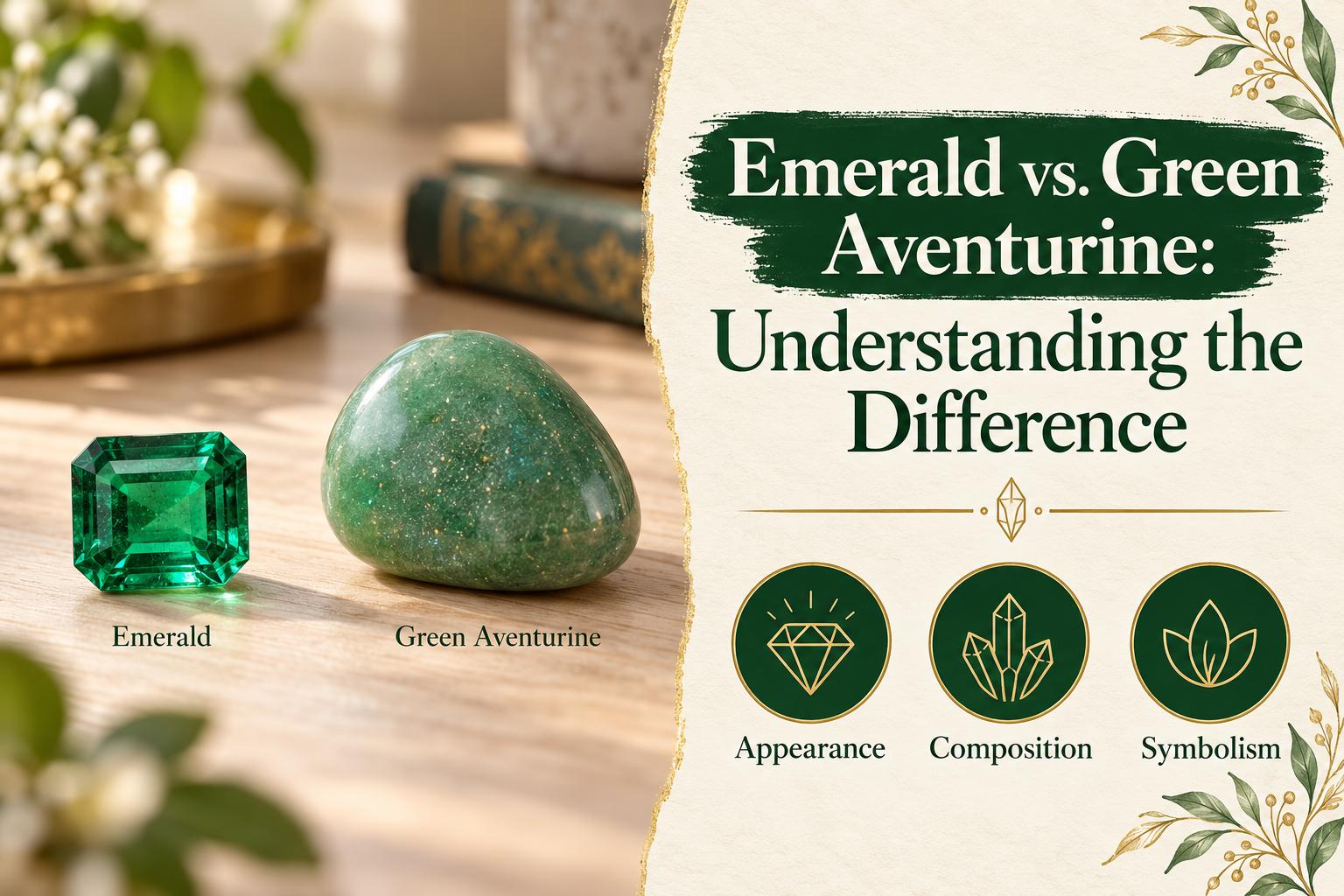
Green gemstones are admired for their refreshing colour, natural beauty, and symbolic associations. Two popular green stones that people often compare are Emerald (Panna) and Green Aventurine. Although they may look similar at first glance, they are very different in terms of mineral composition, appearance, value, and traditional uses.
Emerald is a precious variety of Beryl, traditionally associated with Mercury (Budh) in Vedic astrology. Green Aventurine, on the other hand, is a variety of Quartz known for its subtle sparkle and is popular in modern crystal traditions.
Whether you are exploring gemstones for jewellery, astrological purposes, or crystal collections, understanding their differences can help you make an informed choice.
What Is Emerald (Panna)?
Emerald is a green variety of the mineral Beryl. Its green colour is primarily caused by trace amounts of chromium and/or vanadium.
It is considered a precious gemstone and is valued for its rich green colour, rarity, and use in fine jewellery.
Traditional Significance of Emerald
In Vedic astrology, Emerald, also known as Panna, is associated with Mercury (Budh). Mercury is traditionally connected with:
- Communication and expression
- Intelligence and analytical thinking
- Learning and education
- Business and trade
- Reasoning and decision-making
Some astrologers recommend Emerald after examining an individual’s birth chart. It should not be considered suitable for everyone simply because of its planetary association.
What Is Green Aventurine?
Green Aventurine is a variety of Quartz recognised for its green colour and characteristic shimmering effect, known as aventurescence. This subtle sparkle is generally caused by tiny mineral inclusions, commonly mica or related minerals.
It is popular in decorative objects, gemstone bracelets, pendants, meditation accessories, and crystal collections.
Traditional Crystal Symbolism of Green Aventurine
In modern crystal traditions, Green Aventurine is often associated with:
- Opportunity and new beginnings
- Growth and optimism
- Confidence and motivation
- Emotional balance
- Abundance and prosperity symbolism
These associations are based on crystal traditions and personal beliefs, not scientifically established effects.
5 Important Differences Between Emerald and Green Aventurine
- Mineral Composition
The most important difference is their mineral composition.
Emerald belongs to the Beryl mineral family, while Green Aventurine belongs to the Quartz family. Their chemical structures and physical properties are different, even though both can have a green appearance.
- Colour and Appearance
Emerald is known for its distinctive green colour, ranging from lighter green to deep, vivid green. Natural emeralds commonly contain inclusions, sometimes referred to as a jardin.
Green Aventurine generally has a softer, more earthy green appearance. Its tiny mineral inclusions may create a shimmering effect when viewed under light.
- Hardness and Durability
Emerald has a Mohs hardness of 7.5–8, while Green Aventurine is approximately 6.5–7.
However, hardness alone does not determine how well a gemstone withstands everyday wear. Emeralds can be brittle and commonly contain fractures, so they require careful handling. Green Aventurine is also best protected from hard impacts and scratches.
- Price and Availability
Natural Emeralds of good colour, clarity, and quality can command high prices, particularly when they have desirable origins and documented characteristics.
Green Aventurine is generally more affordable and widely available in different forms, making it a popular option for everyday jewellery and decorative gemstone products.
The actual price of either stone depends on quality, size, treatment, origin, and workmanship.
- Astrological and Crystal Traditions
Emerald has a recognised association with Mercury in Vedic astrology and may be prescribed by astrologers after examining a person’s horoscope.
Green Aventurine is more commonly used in modern crystal traditions, where it is symbolically associated with growth, opportunity, and optimism.
The two stones are not interchangeable as astrological gemstones.
Emerald vs. Green Aventurine: Which One Should You Choose?
Your choice depends on why you want the gemstone.
Choose Emerald if:
- You are interested in a precious green gemstone.
- You want a gemstone for fine jewellery.
- You are considering Panna for traditional Mercury-related astrological purposes after consulting an astrologer.
- You prefer the distinctive appearance of natural emerald.
Choose Green Aventurine if:
- You enjoy crystal bracelets and decorative gemstones.
- You prefer an affordable green stone.
- You appreciate its subtle shimmer and natural appearance.
- You are interested in modern crystal symbolism associated with growth and new beginnings.
- Neither gemstone is universally better. They serve different preferences and purposes.
Can Green Aventurine Be Used Instead of Emerald?
Green Aventurine can be an alternative if you are looking for a green gemstone for jewellery or decorative use. However, it is not a mineral substitute for Emerald.
From a Vedic astrological perspective, Green Aventurine is not generally recognised as a direct replacement for Panna in the traditional Navagraha gemstone system.
If an astrologer recommends Emerald for a specific birth-chart consideration, discuss suitable alternatives with them rather than assuming that another green stone will have the same astrological significance.
How to Identify Genuine Emerald and Green Aventurine?
Before purchasing either gemstone, consider the following:
Emerald (Panna)
- Check the gemstone’s identity and natural or synthetic status.
- Ask whether it has undergone clarity enhancement or other treatments.
- Examine the colour, clarity, cut, and overall quality.
- Request a reliable gemological laboratory report where appropriate.
Green Aventurine
- Look for its characteristic green colour and subtle shimmering inclusions.
- Check for a natural stone identity rather than relying only on the product label.
- Examine the polish, surface finish, and consistency.
- Purchase from a seller who provides clear product information.
- A professional gemological assessment is the most reliable way to confirm gemstone identity and detect treatments.
Conclusion
Emerald and Green Aventurine may share a beautiful green colour, but they are two distinct gemstones with different mineral properties, appearances, price ranges, and traditional associations.
Emerald (Panna) is a precious Beryl gemstone traditionally associated with Mercury in Vedic astrology, while Green Aventurine is a Quartz variety popular in jewellery and modern crystal traditions.


