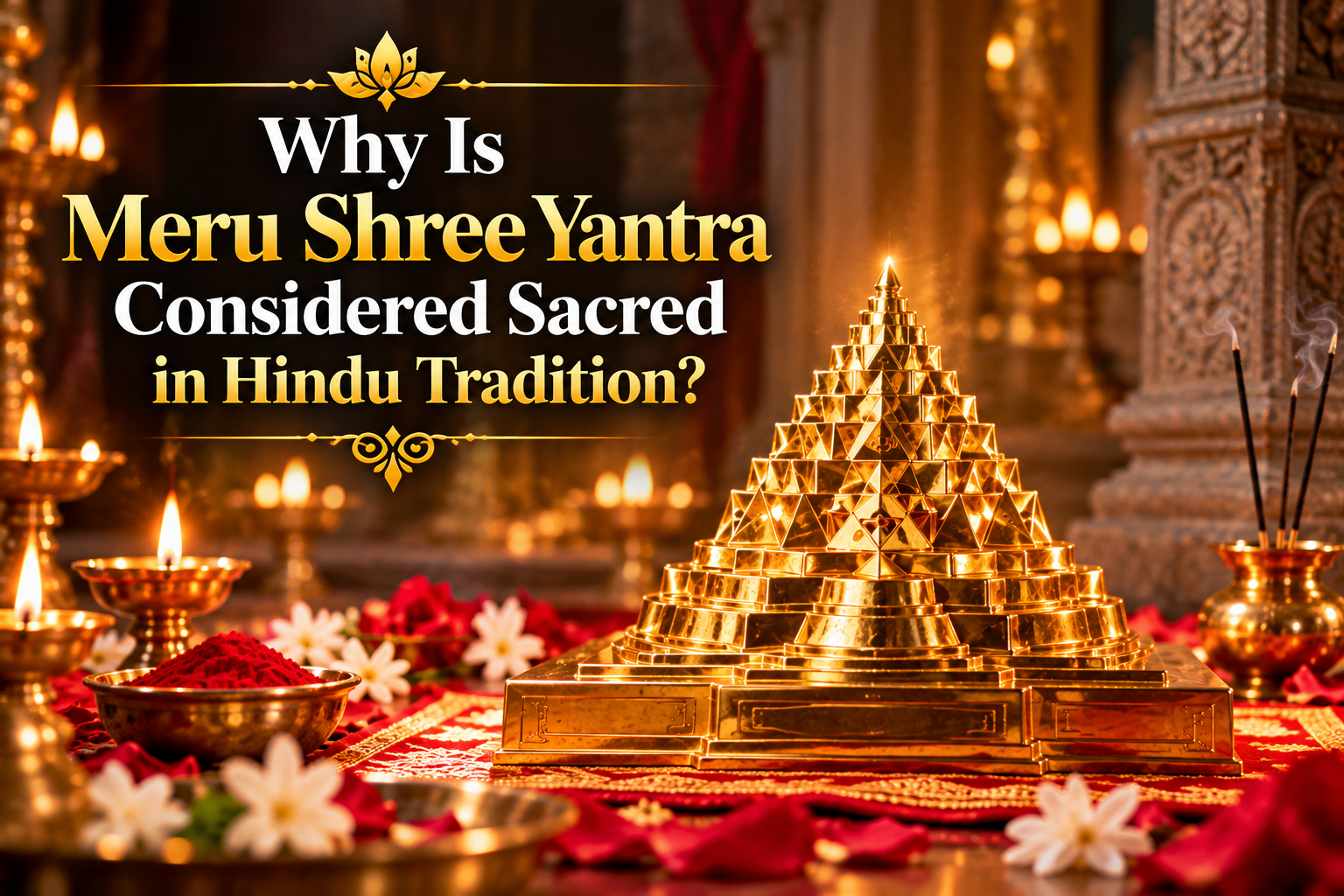
The Meru Shree Yantra holds a special place in Hindu spiritual tradition because of its intricate sacred geometry and its association with Goddess Tripura Sundari, also known as Lalita Devi. Revered in Shakta traditions, the Shree Yantra is regarded as a sacred representation of the divine feminine, cosmic unity, and the relationship between the material and spiritual worlds.
Unlike a flat Shree Yantra, the Meru Shree Yantra is a three-dimensional form that rises in a mountain-like structure. Its layered geometry makes it distinctive in Hindu worship and spiritual décor.
But why is the Meru Shree Yantra considered sacred? What do its geometric patterns represent, and why do devotees place it in their home temples or places of worship?
Let’s explore its traditional significance, spiritual symbolism, and role in Hindu practices.
What Is a Meru Shree Yantra?
The Meru Shree Yantra is a three-dimensional representation of the sacred Shree Yantra, a geometric diagram used in certain Hindu spiritual and tantric traditions.
The Shree Yantra consists of interlocking triangles arranged around a central point called the Bindu. The traditional diagram is associated with Goddess Tripura Sundari and represents the union of complementary cosmic principles, the manifestation of creation, and the journey towards spiritual realisation.
In the Meru form, the geometry is rendered in raised, layered levels, creating a structure that resembles a sacred mountain. This three-dimensional appearance is one reason it is often used as a focal point for worship.
Why Is the Meru Shree Yantra Considered Sacred?
The sacred status of the Meru Shree Yantra comes from its religious associations, geometric symbolism, and use in specific forms of Hindu worship.
- Association With Goddess Tripura Sundari
In Shakta traditions, the Shree Yantra is closely associated with Goddess Tripura Sundari, a revered manifestation of the Divine Mother. She is also known as Lalita Devi and is worshipped as a symbol of divine beauty, consciousness, and the power underlying creation.
For devotees, the Meru Shree Yantra can serve as a sacred focus for prayer and devotion to the Goddess.
- Representation of Sacred Geometry
The Shree Yantra features nine interlocking primary triangles—four traditionally associated with Shiva and five with Shakti. Together, they form a complex geometric arrangement surrounding the central Bindu.
In traditional interpretations, these intersecting triangles symbolise the relationship between consciousness and creative energy. Their arrangement is also understood as a representation of the interconnected nature of existence.
The Meru form translates this sacred geometry into a three-dimensional structure, making its layered design particularly prominent.
- Symbolism of Mount Meru
Mount Meru holds an important place in Hindu cosmological traditions as a sacred cosmic mountain and symbolic centre of the universe.
The raised, mountain-like form of the Meru Shree Yantra evokes this imagery. Its ascending levels may be understood as representing spiritual progression, contemplation, and movement towards the central source of consciousness.
This association adds another dimension to its traditional religious significance.
- Symbol of the Union of Shiva and Shakti
One of the most important interpretations of the Shree Yantra concerns the union of Shiva and Shakti.
Shiva is commonly associated with consciousness, while Shakti represents divine power and creative energy. Their interlocking triangular forms symbolise the complementary principles through which existence is understood in these traditions.
For devotees, this symbolism expresses harmony, completeness, and the interconnectedness of spiritual life.
- A Sacred Focus for Worship and Meditation
The Meru Shree Yantra is used in certain Hindu worship practices as a focal point for mantra recitation, meditation, and devotional rituals.
Its precise geometry encourages sustained attention, while its traditional associations give worshippers a meaningful focus for prayer.
Specific methods of worship, consecration, and mantra practice can vary by lineage. Those following a particular Shakta or Sri Vidya tradition may consult a knowledgeable teacher for guidance.
Meru Shree Yantra and Goddess Lakshmi
The Shree Yantra is also widely associated with prosperity and abundance in popular Hindu devotional practice. Many devotees connect it with Goddess Lakshmi, the goddess of wealth, auspiciousness, and well-being.
For this reason, the Meru Shree Yantra is sometimes placed in home temples, offices, or business spaces as a devotional symbol of prosperity and gratitude.
However, the Shree Yantra’s association with Goddess Tripura Sundari is particularly important in Shakta and Sri Vidya traditions. Its connection with Lakshmi and material prosperity is emphasised in other devotional interpretations and practices.
Keeping a Meru Shree Yantra should not be understood as a guarantee of wealth or business success. For many worshippers, its significance lies in faith, prayer, ethical living, and the values it represents.
Where Is the Meru Shree Yantra Traditionally Placed?
People often display a Meru Shree Yantra in a home shrine, meditation area, or place used for prayer. Some also keep it in an office or business setting as a reminder of their spiritual values and aspirations.
Consider these practical points when choosing a location:
- Home temple: A natural choice for those who wish to include the yantra in their daily devotional routine.
- Meditation space: Its geometry can provide a visual focus for quiet contemplation.
- Office or workspace: It can serve as a symbol of discipline, clarity, and mindful decision-making.
- Clean, stable surface: Choose a secure location where the yantra will not easily be disturbed or damaged.
Placement directions and ritual requirements differ across traditions. If you follow a specific religious lineage, family practice, or consecration method, follow its guidance rather than assuming that one placement rule applies to everyone.
How Is the Meru Shree Yantra Worshipped?
Worship practices vary according to the devotee’s tradition, the type of yantra, and whether it has been formally consecrated.
A simple devotional approach may include:
- Prepare the space: Keep the worship area clean and arrange any customary offerings.
- Place the yantra respectfully: Position it securely according to your family’s or tradition’s guidance.
- Offer prayers: Devotees may offer flowers, incense, or other customary items where appropriate.
- Recite a prayer or mantra: Use a prayer associated with the Goddess that you are familiar with.
- Spend time in reflection: Conclude with gratitude, meditation, or a moment of quiet contemplation.
Formal Sri Vidya worship can involve specific mantras, initiation, and detailed ritual procedures. These practices should be learned from a qualified teacher within the relevant tradition rather than improvised from general instructions.
How to Choose a Meru Shree Yantra
If you are considering purchasing a Meru Shree Yantra for worship or spiritual décor, pay attention to the following:
- Geometric workmanship: Look for a clearly formed, well-finished structure.
- Material: Common options include brass, copper, silver, crystal, and other materials. Choose according to your preferences and intended use.
- Size: Select a size that fits your home shrine, meditation area, or workspace.
- Construction quality: Check the stability of the base and the finish of the raised levels.
- Product transparency: Ask about the material, dimensions, manufacturing method, and any included consecration claims.
- Care requirements: Follow the seller’s instructions for cleaning and maintaining the material.
A well-made yantra can be appreciated both as a devotional object and as an example of intricate sacred design.
Conclusion:
The Meru Shree Yantra is more than an intricate three-dimensional geometric design. In Hindu tradition, it represents sacred order, the relationship between Shiva and Shakti, and devotion to the Divine Mother. Its association with Mount Meru further connects it with traditional ideas of cosmic structure and spiritual ascent.
Whether placed in a home shrine, meditation area, or workspace, the Meru Shree Yantra can serve as a meaningful reminder of faith, balance, gratitude, and mindful living.
Explore spiritual products at Effective Gems, including yantras, gemstones, Rudraksha, and crystals for your devotional space.


