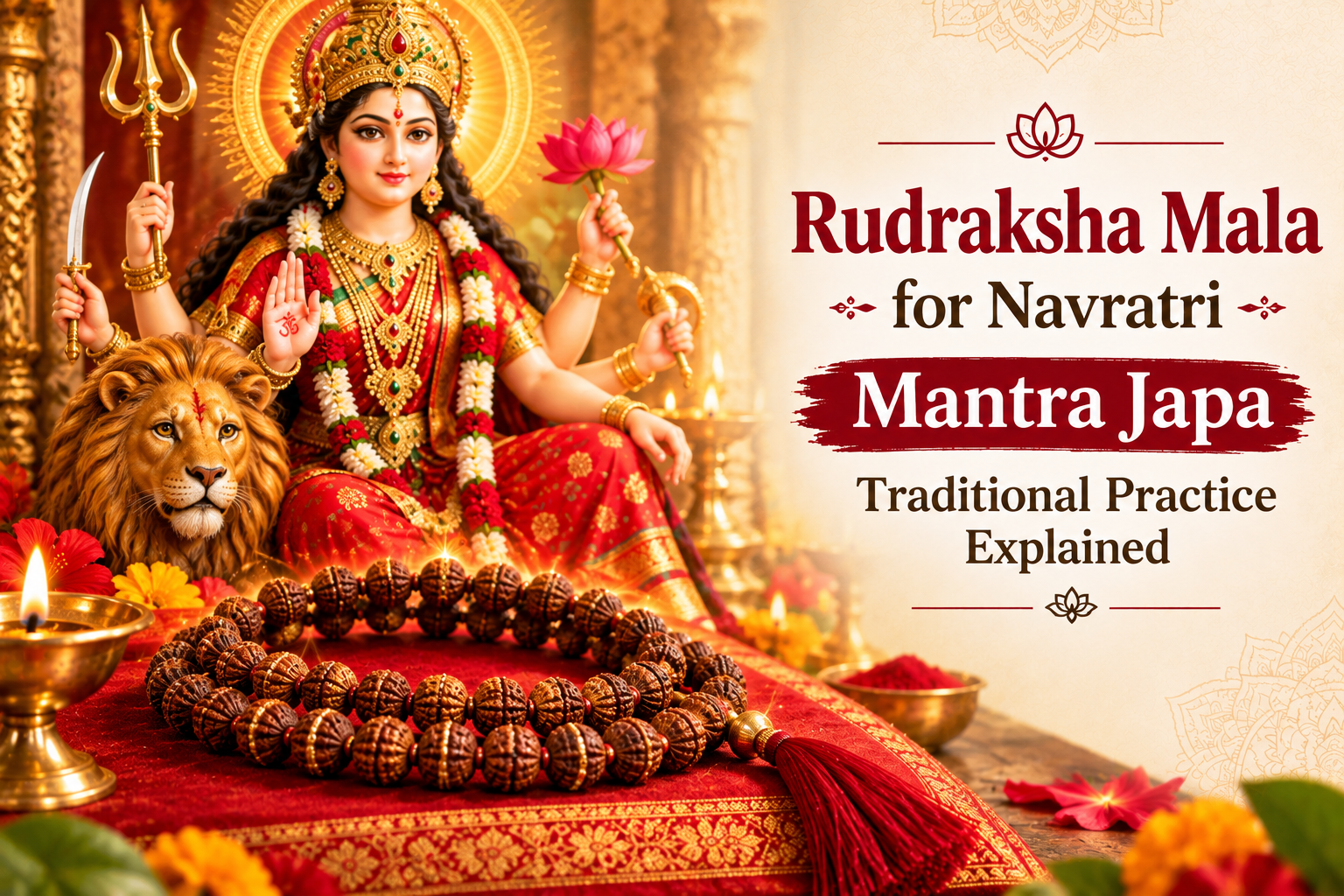
Navratri is a sacred period dedicated to the worship of Maa Durga and the Divine Feminine power of Shakti. Across these nine days, devotees engage in prayer, fasting, meditation, devotional singing, and mantra japa.
One traditional tool used for japa is the Rudraksha Mala.
Rudraksha beads have been revered in Hindu spiritual traditions for centuries and are commonly used for counting mantra repetitions during meditation and prayer. During Navratri, a Rudraksha Mala can become a meaningful companion for devotees who wish to establish a consistent daily mantra practice.
But how is a Rudraksha Mala traditionally used for japa? Which type of Rudraksha Mala can you choose? How many times should a mantra be chanted? And what should you keep in mind during Navratri?
Let’s explore the traditional practice.
Note: This article discusses religious and spiritual traditions. Rudraksha Mala is traditionally used as a devotional and meditation aid. Claims that Rudraksha produces guaranteed physical, medical, financial, or other worldly outcomes should not be treated as scientifically established facts.
What Is a Rudraksha Mala?
A Rudraksha Mala is a string of Rudraksha beads traditionally used for mantra japa, meditation, prayer, and spiritual practice.
Rudraksha refers to the seeds of trees of the Elaeocarpus genus, especially Elaeocarpus ganitrus, which are traditionally associated with Lord Shiva. A mala generally consists of multiple beads arranged on a thread, often with a larger or distinct Guru bead.
The mala serves a practical purpose: It helps the practitioner keep count of mantra repetitions without constantly checking a clock or counting mentally. This allows greater attention to remain on the mantra and devotional practice.
Why Use Rudraksha Mala During Navratri?
Navratri is traditionally a period of increased spiritual discipline.
Devotees may dedicate additional time to:
Puja
Mantra japa
Meditation
Devi worship
Prayer
Reading sacred texts
Bhajans and devotional singing
A Rudraksha Mala can provide a simple structure for daily japa.
Instead of chanting randomly, a practitioner can decide:
“I will complete one mala of my chosen mantra every morning.”
This creates consistency and discipline throughout the nine days.
What Is Mantra Japa?
Japa means the repeated recitation of a mantra, either aloud, softly, or mentally.
Depending on the tradition, japa may be performed in different ways.
Vachika Japa
The mantra is spoken audibly.
Upamshu Japa
The mantra is repeated very softly, with little or no sound audible to others.
Manasika Japa
The mantra is repeated mentally.
A Rudraksha Mala can be used with all these forms, depending on the practitioner’s tradition and preference.
Why Is a Mala Used for Japa?
The mala provides a physical counting system. With each repetition of the mantra, the practitioner moves from one bead to the next.
This can help:
Maintain a fixed number of repetitions
Reduce distractions
Establish a rhythm
Encourage consistency
Keep attention on the mantra
In this way, the mala acts as a spiritual practice tool rather than simply an ornament.
Why Is 108 Important?
The number 108 is considered sacred in many Hindu and yogic traditions.
It appears in various spiritual contexts, including:
108 names of deities
108-bead malas
Traditional chanting practices
Yogic and devotional traditions
The symbolism of 108 has been interpreted in different ways across traditions. Rather than focusing on one explanation, it is useful to understand 108 as a deeply established sacred number within Indian spiritual practice.
Which Mantras Can Be Chanted During Navratri?
There are many Durga and Devi mantras used across different traditions.
One simple mantra commonly used in devotional practice is:
ॐ दुं दुर्गायै नमः
Om Dum Durgayei Namaha
It is commonly used as an invocation of Goddess Durga.
Devotees may also recite specific mantras dedicated to different forms of Devi, such as:
Maa Katyayani
A traditional Katyayani mantra is associated with the Gopis’ worship described in the Bhagavata Purana.
Maa Kalaratri
Devotees may follow mantras and stotras traditionally associated with her worship.
Maa Mahagauri
Specific Devi prayers may be used according to family or regional tradition.
The important point is:
Follow a mantra appropriate to your spiritual tradition rather than randomly combining rituals.
How to Use Rudraksha Mala for Navratri Japa?
A traditional mala practice can be simple.
Step 1: Sit in a Clean, Peaceful Place
Choose a location where you can chant without frequent interruption.
Step 2: Hold the Mala Correctly
Traditionally, japa malas are commonly handled with the thumb and middle finger, while the index finger is kept away from the beads.
Practices can vary between traditions.
Step 3: Begin With the Guru Bead
The Guru bead is generally treated as the starting and ending point of one round.
Step 4: Chant One Mantra
Repeat your chosen mantra once for each bead.
Step 5: Move One Bead at a Time
After each repetition, gently move to the next bead.
Step 6: Do Not Cross the Guru Bead
When you reach the Guru bead after completing one round, many traditional practices recommend turning the mala around and continuing in the opposite direction rather than crossing over it.
Step 7: Complete Your Chosen Count
You may complete one, two, or more malas depending on your practice and guidance.
Can Rudraksha Mala Be Used for Durga Mantra?
Yes. Although Rudraksha is traditionally associated strongly with Lord Shiva, Rudraksha malas are also widely used in Hindu devotional practices for mantra japa.
A mala is fundamentally a japa tool, and its use can depend on the mantra, tradition, and practitioner’s practice.
Therefore, using a Rudraksha Mala for a Durga or Devi mantra can be appropriate within many devotional traditions.
If your family or spiritual lineage prescribes a particular mala for a particular mantra, follow that guidance.
Which Rudraksha Mala Is Best for Navratri?
There is no single universally prescribed Rudraksha Mala that every Navratri devotee must use. A simple 5 Mukhi Rudraksha Mala is commonly used for general japa and meditation. Other Rudraksha varieties may be selected according to specific spiritual traditions or personal practices.
For general Navratri mantra japa, the most important considerations are:
Authenticity
Comfortable handling
Appropriate bead size
A suitable mantra
Consistent practice
Rather than choosing a bead solely because it is marketed as “powerful,” understand its traditional significance first.
What Is a 5 Mukhi Rudraksha Mala?
The 5 Mukhi Rudraksha is one of the most commonly available Rudraksha types.
A 5 Mukhi mala is often used for:
Japa
Meditation
Prayer
Daily spiritual practice
Its widespread use makes it a practical option for someone beginning a regular mantra routine.
If you are specifically following a particular spiritual lineage, however, follow the mala recommendation given by your teacher.
Should You Use a Different Mala for Each Devi Mantra?
Not necessarily. A single mala can be used for your regular devotional practice if that is consistent with your tradition. For example, you may choose one Durga mantra and continue with the same mala throughout all nine days.
This can actually make the practice simpler:
One Mala + One Mantra + One Intention + Nine Days
If your spiritual tradition prescribes separate malas or specific purification practices, follow those instructions instead.
Rudraksha Mala and Meditation
Mantra japa and meditation can work together naturally.
After completing your mala:
Put the mala down or hold it comfortably.
Close your eyes.
Take a few slow breaths.
Observe the mind quietly.
Reflect on the quality of Shakti you want to cultivate.
For example:
Day 1 — Strength
Day 2 — Discipline
Day 3 — Courage
Day 4 — Creativity
Day 5 — Compassion
Day 6 — Determination
Day 7 — Fearlessness
Day 8 — Purity
Day 9 — Spiritual fulfilment
This can turn Navratri japa into a period of personal reflection as well as prayer.
Should You Chant 108 Times During Navratri?
A 108-bead mala naturally provides 108 repetitions in one complete round.
You can choose:
1 Mala → 108 repetitions
2 Malas → 216 repetitions
3 Malas → 324 repetitions
There is no need to force yourself into a high number. If you are beginning, one mala a day can be a practical and sustainable starting point.
Can You Use Rudraksha Mala During Fasting?
Yes, devotees may continue mantra japa while observing Navratri fasting if they feel comfortable. However, fasting practices vary significantly. If fasting causes weakness, dizziness, dehydration, or other concerning symptoms, prioritise your health and follow appropriate medical advice. Spiritual practice should not require harmful physical strain.
Can You Wear Your Japa Mala After Chanting?
Practices differ. Some people use their Rudraksha Mala specifically for japa and keep it respectfully in a clean place afterward.
Others wear their Rudraksha Mala throughout the day. If the mala is being used specifically as a japa mala, keeping it dedicated to prayer can help maintain a clear devotional routine. Follow your family or spiritual tradition if it has specific instructions.
How to Care for Your Rudraksha Mala?
Rudraksha is a natural seed, so proper care can help maintain its condition.
Keep it dry
Avoid unnecessary prolonged exposure to water.
Keep it clean
Gently wipe it with a soft cloth when needed.
Avoid harsh chemicals
Perfumes, soaps, and cleaning chemicals may affect the thread or bead surface.
Store it respectfully
When not in use, keep it in a clean pouch or dedicated place.
Check the thread
Natural wear can eventually weaken the thread, so inspect the mala periodically.
How to Know if a Rudraksha Mala Is Suitable for Japa?
When choosing a mala, consider:
- Bead Quality
Look for beads that are reasonably well-formed and free from obvious damage. - Authenticity
Purchase from a trustworthy source that provides clear information about the Rudraksha. - Thread Strength
The mala should be securely strung. - Comfortable Size
Choose beads that are easy to move with your fingers. - Purpose
For general japa, a simple mala can be sufficient.
If a specific Rudraksha is recommended for a particular spiritual purpose, understand its traditional significance before purchasing.
Can Children Use Rudraksha Mala for Navratri Japa?
Children can participate in age-appropriate devotional practices, but the practice should be simple and comfortable.
Instead of requiring long chanting sessions, encourage:
A short prayer
A few repetitions
Learning about Maa Durga
Participating in family puja
For formal mantra practices, follow the guidance of parents, family tradition, or a knowledgeable teacher.
The Deeper Meaning of Navratri Japa
The true value of mantra japa is not merely the number of repetitions.
It can encourage:
Focus
Returning the mind repeatedly to one sacred phrase.
Devotion
Connecting with Maa Durga through prayer.
Discipline
Maintaining a practice for nine days.
Inner Strength
Reflecting on the qualities represented by Devi.
Self-Reflection
Using Navratri as an opportunity to look inward.
The Rudraksha Mala simply helps structure this process.
A Simple 9-Day Rudraksha Japa Plan
If you’re looking for an easy Navratri routine, try:
Day 1
1 Mala + prayer for stability.
Day 2
1 Mala + prayer for discipline.
Day 3
1 Mala + prayer for courage.
Day 4
1 Mala + prayer for creativity.
Day 5
1 Mala + prayer for compassion.
Day 6
1 Mala + prayer for strength.
Day 7
1 Mala + prayer for fearlessness.
Day 8
1 Mala + prayer for peace.
Day 9
1 Mala + prayer for wisdom and spiritual fulfilment.
You can use the same mantra throughout the nine days or follow a traditional practice specific to each form of Devi.
Why a Rudraksha Mala Can Make Navratri More Meaningful
Navratri lasts only nine days, but the discipline developed during those nine days can continue beyond the festival.
A daily mala practice can encourage you to build a routine of:
Prayer → Focus → Reflection → Gratitude
The mala becomes a physical reminder to pause and reconnect with your spiritual intention.
Conclusion:
A Rudraksha Mala for Navratri mantra japa is a simple and traditional way to bring greater structure and focus to devotional practice.
During Navratri, when devotees honour the nine forms of Maa Durga, a Rudraksha Mala can help support:
Mantra repetition
Meditation
Prayer
Devotional discipline
Spiritual reflection
You don’t need an elaborate routine. A quiet space, a suitable mantra, one Rudraksha Mala, and sincere devotion can be enough to begin.
One mala. One mantra. Nine days of devotion.
Let the movement of each bead bring your attention back to the mantra, and let each repetition become a reminder of the strength, courage, compassion, and wisdom represented by Maa Shakti. Most importantly, remember that the purpose of japa is not simply to complete a number. It is to bring the mind back to the Divine—one repetition at a time.
Jai Mata Di!