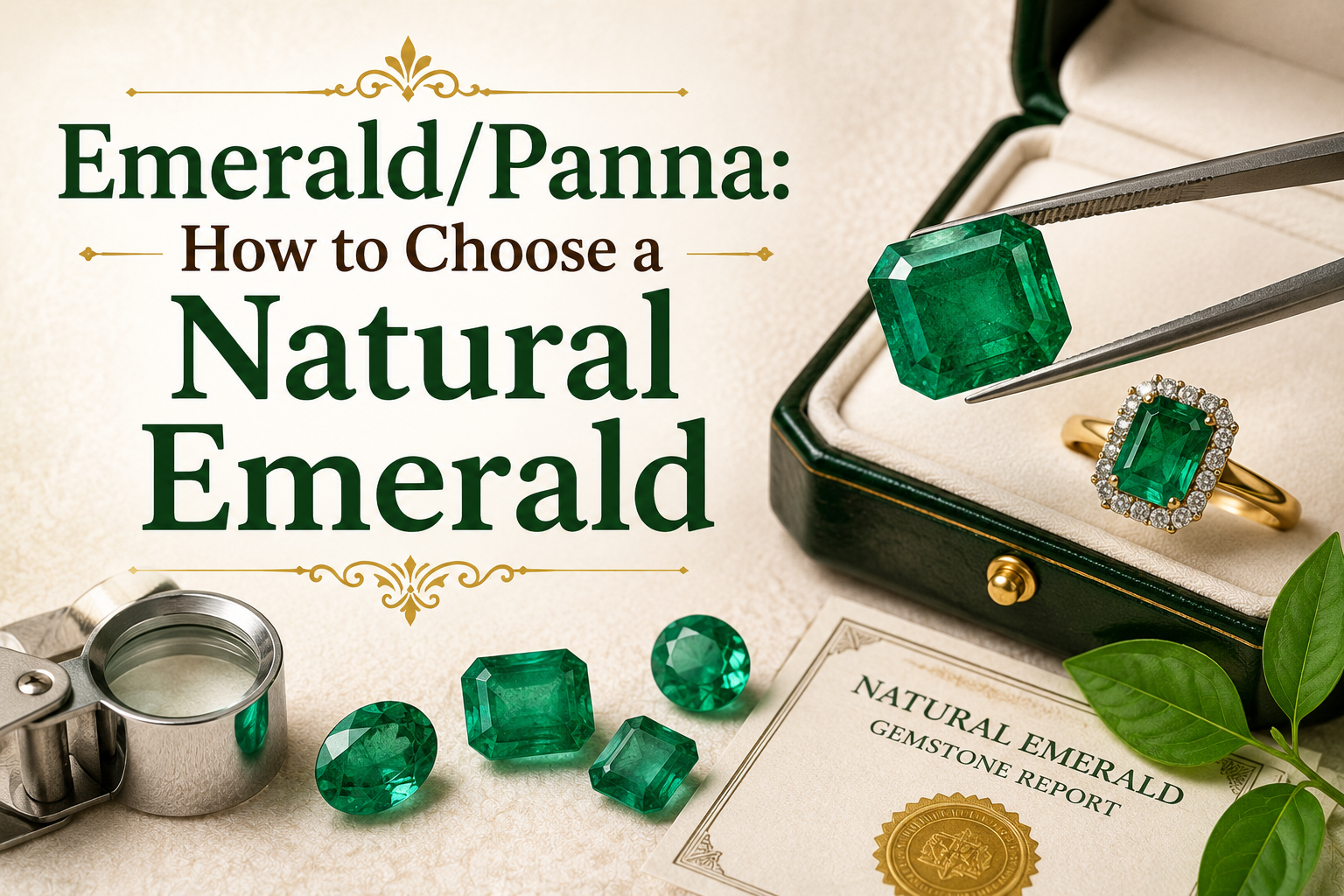
Emerald, also known as Panna, is one of the most admired green gemstones in the world. Traditionally associated with Mercury (Budh) in Vedic astrology, Emerald is valued for its vibrant green colour, rarity, and place in fine jewellery.
But choosing a good natural Emerald requires more than simply looking for the brightest green stone. You need to consider its origin, colour, clarity, treatments, inclusions, certification, and overall quality.
If you’re planning to buy an Emerald/Panna for jewellery or astrological purposes, this guide will help you understand what to look for.
Note: The astrological associations mentioned here are based on Vedic astrology traditions. There is no scientific evidence that wearing Emerald produces specific astrological or health effects.
What Is Emerald/Panna?
Emerald is the green variety of the mineral beryl.
Its green colour is primarily associated with trace amounts of chromium, vanadium, or both.
Other members of the beryl family include:
- Aquamarine
- Heliodor
- Morganite
- Goshenite
Emerald is generally considered one of the world’s four traditional precious gemstones, alongside:
Diamond + Ruby + Sapphire + Emerald
Why Is Emerald So Special?
Emerald has several characteristics that make it highly desirable:
- Distinctive Green Colour
Its rich green appearance is its defining feature.
- Rarity
Fine-quality Emerald can be rare, especially with attractive colour and good transparency.
- Historical Importance
Emeralds have been treasured across different ancient and royal cultures.
- Astrological Significance
In Vedic astrology, Emerald is traditionally associated with Mercury (Budh).
- Jewellery Appeal
Its green colour works beautifully in rings, pendants, earrings, and other jewellery.
- Natural Emerald vs Synthetic Emerald
This is the first thing you should understand before buying.
- Natural Emerald
A gemstone formed naturally through geological processes.
- Synthetic Emerald
A laboratory-grown Emerald with essentially the same chemical composition and crystal structure as natural Emerald.
- Imitation Emerald
A different material designed to resemble Emerald. For example, some green glass or other gemstones may be sold or marketed to resemble Emerald. Synthetic does not mean fake—but it is different from a natural Emerald and should be priced accordingly.
How to Choose a Natural Emerald?
Here are the most important factors to consider.
- Look at the Colour First
Colour is one of the most important quality factors for Emerald.
A desirable Emerald generally has:
- Attractive green colour
- Good saturation
- Pleasant tone
An Emerald that is too pale may have less visual impact, while one that is extremely dark can lose brightness.
The ideal balance is usually:
Rich green + good saturation + attractive brightness
- Emerald Clarity Is Different From Many Other Gemstones
Here’s an important point:
Natural Emeralds commonly contain inclusions.
These internal features are often called the Emerald’s:
“Jardin”
French for garden. The inclusions can create a mossy or garden-like appearance inside the stone. Unlike Diamond, where high clarity is often strongly preferred, Emerald is generally expected to contain some inclusions.
- Don’t Automatically Reject an Emerald Because of Inclusions
When buying Emerald, you may see:
- Internal fractures
- Liquid inclusions
- Mineral inclusions
- Veils
- Growth features
Some inclusions can actually provide clues that the stone is natural. However, excessive fractures can reduce durability and value.
- The goal isn’t necessarily:
“No inclusions.”
- Instead, look for:
Attractive colour + good transparency + acceptable clarity + sound structure
- Transparency Matters
Two Emeralds can have the same colour but look completely different.
One may appear: Bright and lively
while another may look:
Dark and dull. Good transparency can make an Emerald appear more vibrant. For valuable stones, evaluate the overall visual appearance, not simply the colour name.
- Pay Attention to the Cut
Emerald is relatively prone to fractures, so cutters generally need to be careful.
A common cutting style is the:
Emerald Cut
This rectangular step-cut style is associated with the gemstone itself, although Emeralds can be cut into many shapes.
A good cut can help:
- Display colour
- Improve appearance
- Maximise beauty
- Reduce the visibility of some inclusions
- Why Certification Matters
If you’re buying a valuable Emerald, especially for astrological purposes, consider obtaining a report from a reputable gemological laboratory.
A laboratory report can help establish information such as:
- Natural or synthetic origin
- Gemstone identity
- Detectable treatments
- Sometimes geographic origin, depending on the laboratory and testing
A certificate is particularly valuable when buying a high-value gemstone.
- Ask These Questions Before Buying
Before purchasing Emerald/Panna, ask the seller:
- Is it natural Emerald?
- Is it synthetic or laboratory-grown?
- Has it been treated?
- If treated, what treatment was used?
- Does it come with a laboratory report?
- What is the reported origin, if any?
- What is the carat weight?
- Are there visible fractures?
- Is the stone suitable for jewellery use?
- Is the price based on quality or just weight?
A transparent seller should be willing to explain these points.
Emerald/Panna in Vedic Astrology
In Vedic astrology, Emerald is traditionally known as: Panna
and is associated with:
Mercury — Budh
Mercury is traditionally connected with:
- Communication
- Intellect
- Learning
- Business
- Analytical thinking
- Speech
- Reasoning
Because of this, Emerald is traditionally selected in certain Kundlis to strengthen Mercury-related qualities.
Should Everyone Wear Emerald?
No—not according to traditional Vedic astrology.
Traditional gemstone selection considers the complete birth chart.
An astrologer may analyse:
- Ascendant
- Mercury’s house
- Mercury’s strength
- Planetary aspects
- House ownership
- Dasha
- Relationship with other planets
before recommending Panna.
How Is Panna Traditionally Worn?
If Emerald is recommended as an astrological gemstone, traditional practices may specify:
- Metal
- Finger
- Day
- Time
- Mantra
- Weight
- Wearing procedure
These practices vary among astrologers and traditions.
So avoid following a generic rule without considering your personal Kundli.
Why Do Emerald Prices Vary So Much?
Emerald prices can differ dramatically.
Factors include:
- Colour: A major factor.
- Transparency: More transparent, attractive material can command higher prices.
- Clarity: The type and extent of inclusions matter.
- Treatment: Treatment level can influence value.
- Origin: Some origins command premiums, depending on quality.
- Carat Weight: Larger fine-quality stones can be particularly rare.
- Cut: Affects beauty and presentation.
- Certification: Independent reports can add confidence to a purchase.
Famous Emerald Sources
Important Emerald-producing regions include:
- 🇨🇴 Colombia
- 🇿🇲 Zambia
- 🇧🇷 Brazil
- 🇦🇫 Afghanistan
- 🇪🇹 Ethiopia
- 🇵🇰 Pakistan
Each source can produce Emeralds with different characteristics.
However, remember:
Origin alone does not determine quality.
Emerald for Jewellery
Emerald can be used in:
- Rings
- Pendants
- Earrings
- Bracelets
- Statement jewellery
However, Emerald requires somewhat more care than very durable stones like Ruby and Sapphire. It has a Mohs hardness of around 7.5–8, but its inclusions and fractures can make it more vulnerable to damage.
How to Care for Emerald?
This is especially important if you own an Emerald ring or bracelet.
Avoid:
- Ultrasonic cleaners
- Steam cleaning
- Harsh chemicals
- Sudden temperature changes
- Rough handling
Prefer:
- Gentle cleaning
- Soft cloth
- Mild soapy water when appropriate
- Separate storage
- Professional cleaning advice
If the Emerald has been fracture-filled, extra care is especially important.
How to Spot a Suspiciously Cheap Emerald?
Be careful if someone offers a supposedly high-quality natural Emerald at an unusually low price.
Ask:
- Is it synthetic?
- Is it an imitation?
- Is it heavily treated?
- Is the colour artificially enhanced?
- Does it have a laboratory report?
- Is the seller providing full treatment disclosure?
A very low price isn’t necessarily a bargain—it may indicate a major difference in material or quality.
Why Emerald/Panna Remains So Popular?
Emerald combines several qualities that make it special:
- Beautiful green colour
- Interesting natural inclusions
- Rich historical heritage
- Fine-jewellery appeal
- Strong astrological significance
- Rare high-quality material
Whether you’re a jewellery lover, gemstone collector, or someone exploring Vedic astrology, Emerald offers something unique.
Conclusion:
Choosing a Natural Emerald/Panna is about much more than finding a green gemstone.
Look beyond the colour and consider:
- Natural origin
- Colour
- Transparency
- Clarity
- Treatment
- Cut
- Certification
- Seller credibility
And if you’re purchasing Panna specifically as a Vedic astrological gemstone, don’t select it based only on your Sun sign or a generic zodiac chart. A traditional recommendation should be based on your complete Kundli.
- Choose natural.
- Check the certificate.
- Ask about treatments.
- Focus on quality.
- Wear astrologically only when it is suitable for your chart.
A beautiful Emerald is not just a green stone—it is a remarkable natural gemstone with a story written inside its Jardin.