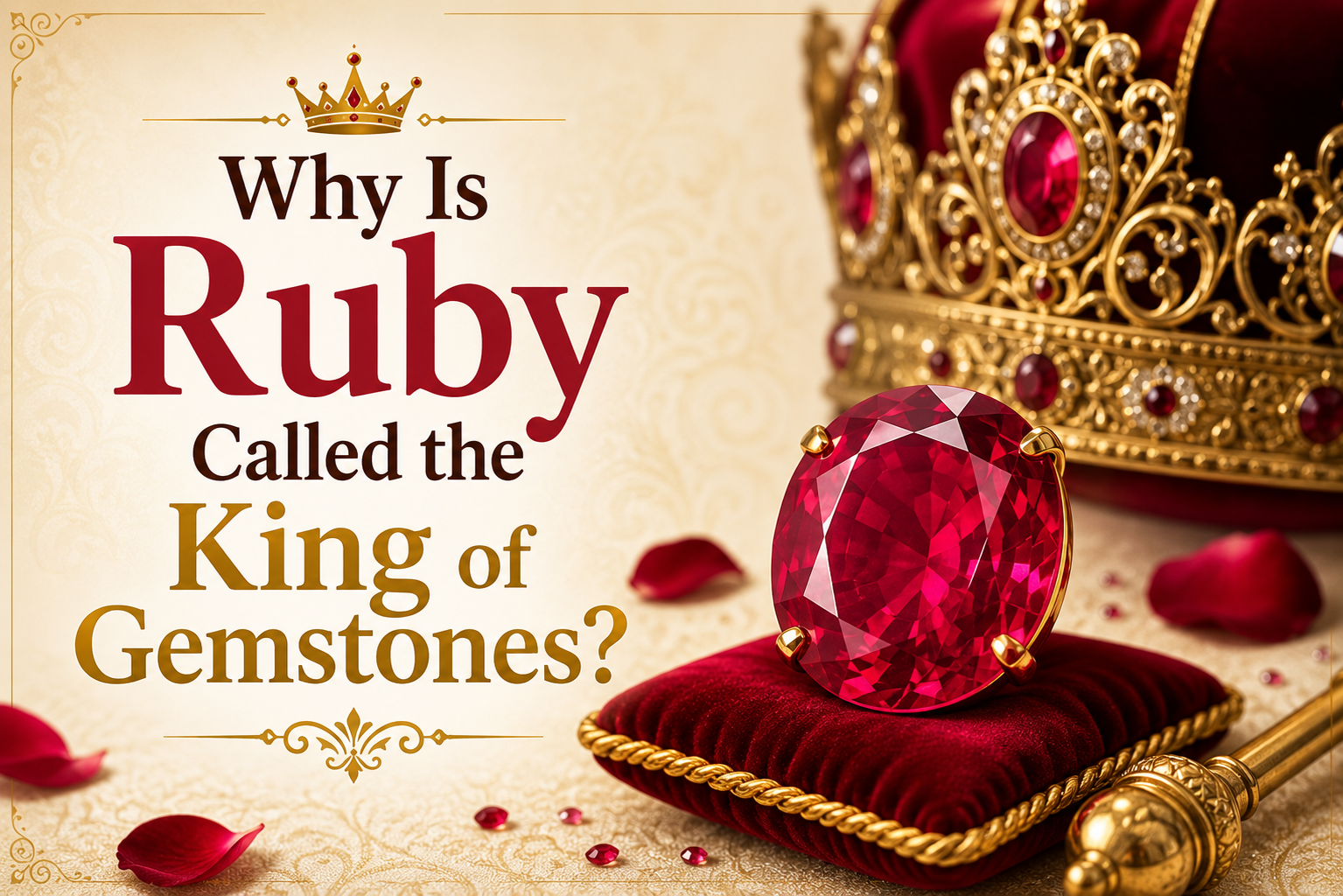
Few gemstones have the colour, rarity, history, and symbolism of Ruby. Known for its rich red colour and exceptional beauty, Ruby has been treasured by royalty, collectors, and jewellery lovers for centuries.
But why is Ruby often called the “King of Gemstones”?
The answer lies in its fascinating combination of colour, rarity, durability, cultural significance, and astrological importance.
What Is Ruby?
Ruby is the red variety of the mineral corundum. The same mineral family also includes Sapphire, with the red colour of Ruby mainly associated with the presence of chromium.
Ruby colours can range from:
- Light pinkish red
- Bright red
- Deep red
- Rich purplish red
The most prized Rubies generally display a vivid, attractive red colour with strong saturation.
Why Is Ruby Called the “King of Gemstones”?
- Its Royal Red Colour
Ruby‘s most distinctive feature is its red colour.
Red has traditionally been associated with:
- Power
- Passion
- Royalty
- Strength
- Vitality
This powerful colour has helped Ruby develop its reputation as a gemstone of status and prestige.
- Ruby Is Extremely Durable
Ruby has a Mohs hardness of 9, making it one of the hardest naturally occurring gemstones.
Only Diamond, at 10, is harder on the Mohs scale.
This makes Ruby highly suitable for:
- Rings
- Bracelets
- Pendants
- Earrings
- Everyday jewellery
Its durability is another reason it has remained popular for generations.
- Fine Ruby Can Be Extremely Rare
Not all Rubies are equally valuable.
A fine-quality Ruby with:
- Strong red colour
- Good transparency
- Attractive appearance
- Fine clarity
- Desirable origin
- Minimal treatment
can be exceptionally rare. This combination of beauty and scarcity is a major reason top-quality Rubies can command very high prices.
- The Famous “Pigeon Blood” Red
You may have heard the term:
Pigeon Blood Ruby
It traditionally refers to an especially desirable vivid red colour. The term is widely used in the gemstone trade, although colour descriptions and grading practices can vary between laboratories and sellers. A fine Ruby with an intense, vivid red appearance can be considerably more valuable than a dull or overly dark stone.
- Ruby Has a Long Royal History
Ruby has been associated with wealth, royalty, power, and prestige for centuries.
Kings, queens, nobles, and wealthy collectors have used Rubies in:
- Crowns
- Necklaces
- Rings
- Brooches
- Ceremonial jewellery
Its intense red colour naturally lends itself to royal jewellery.
- Ruby Has Major Importance in Vedic Astrology
Ruby isn’t only admired as a gemstone—it has an important place in Vedic astrology.
Ruby is traditionally associated with:
Surya — The Sun
The Sun is traditionally connected with:
- Leadership
- Authority
- Confidence
- Recognition
- Vitality
- Self-expression
Because of this association, Ruby is traditionally recommended in certain astrological charts. However, Ruby is not suitable for everyone simply because it is a powerful gemstone. Traditional gemstone selection should consider the individual’s Kundli, Ascendant, planetary placement, and other astrological factors.
Ruby and the Sun
The symbolic connection between Ruby and the Sun is particularly strong.
Think of the symbolism:
- Sun → Power and leadership
- Ruby → Red brilliance
- Ruby → Royal status
This connection has made Ruby one of the most important gemstones in traditional Indian astrology.
- Ruby Symbolises Confidence and Leadership
In traditional gemstone and astrological practices, Ruby is often associated with:
- Confidence
- Leadership
- Courage
- Ambition
- Self-expression
- Recognition
This symbolism makes Ruby especially appealing to people who want a gemstone representing strength and authority.
- Ruby Is Associated With Vitality
The vibrant red colour of Ruby has historically inspired associations with life force, energy, and vitality. In traditional beliefs, Ruby is sometimes connected with the Sun’s life-giving energy. However, these are traditional associations, not scientifically proven health effects. Ruby should never be considered a substitute for medical treatment.
- Ruby Makes Exceptional Jewellery
Ruby‘s combination of:
Colour + Hardness + Rarity
makes it an excellent jewellery gemstone.
It looks especially striking in:
- Rings
- Pendants
- Earrings
- Statement jewellery
- Traditional jewellery
Ruby also pairs beautifully with metals such as:
- Gold
- Platinum
- White gold
- Silver, depending on the jewellery design and tradition
- Natural Ruby vs Synthetic Ruby
If you’re purchasing Ruby, this distinction is extremely important.
- Natural Ruby
Formed naturally in the earth.
- Synthetic Ruby
Created in a laboratory but chemically and structurally related to natural Ruby.
- Imitation Ruby
A different material made to resemble Ruby.
A synthetic Ruby isn’t necessarily “fake”—it is a laboratory-created corundum—but its value and origin are different from a natural Ruby. For expensive purchases, ask for a reputable gemological laboratory report.
Should You Buy an Untreated Ruby?
Untreated natural Ruby can be especially valuable when it has excellent colour and clarity. However, heat-treated Ruby is common in the market and can still be a legitimate gemstone. The important thing is transparency.
Before buying, ask:
- Is it natural?
- Has it been heated?
- Are there other treatments?
- Does the certificate mention treatment?
Don’t assume that a high price automatically means an untreated stone.
How to Choose a Good Ruby?
If you’re considering buying Ruby, look for:
- Attractive Colour: Prefer a vivid and appealing red rather than simply choosing the darkest stone.
- Good Transparency: Depending on the variety and quality, good transparency can add to its beauty.
- Suitable Clarity: Natural Rubies often contain inclusions. Some can be acceptable or even help indicate natural origin.
- Gemological Report: For a valuable stone, consider independent certification.
- Treatment Disclosure: Make sure treatments are clearly disclosed.
- Reasonable Pricing: Compare stones based on quality—not just carat weight.
Who Should Wear Ruby According to Vedic Astrology?
This is one of the most important questions. Ruby is traditionally considered suitable when the Sun is a beneficial planet in the individual’s birth chart and strengthening it is appropriate.
It should not be selected simply because:
“Ruby is the gemstone of the Sun, so everyone should wear it.”
A traditional astrologer may examine:
- Ascendant
- Sun’s house placement
- Sun’s strength
- Planetary aspects
- House ownership
- Dasha
- Relationship with other planets
before recommending Ruby.
How Is Ruby Traditionally Worn?
Traditional Vedic gemstone practices may specify:
- Metal
- Finger
- Day
- Time
- Mantra
- Weight
- Purification ritual
These recommendations can vary among astrological traditions. If Ruby is being worn specifically as an astrological gemstone, follow a personalised recommendation rather than a generic internet rule.
Where Is Ruby Found?
Historically important Ruby sources include regions such as:
- Myanmar
- Mozambique
- Sri Lanka
- Madagascar
- Vietnam
- Tanzania
Different origins can produce different colours, qualities, and characteristics.
However: Origin alone does not determine whether a Ruby is valuable. A high-quality Ruby from one location can be more valuable than a lower-quality Ruby from a famous origin.
Ruby and Modern Crystal Practices:
Ruby is sometimes included in modern crystal and energy practices and is associated symbolically with:
- Passion
- Motivation
- Confidence
- Vitality
- Courage
However, these crystal-healing claims are not scientifically established.
Ruby’s strongest established value comes from its gemological properties, beauty, rarity, and cultural history.
Ruby in Indian Tradition
- Ruby has a particularly important place in Indian gemstone culture.
- In traditional Indian astrology, it is known as: Manik / Manikya
- and is associated with Surya (Sun).
This is one reason Ruby continues to be popular among people interested in:
- Vedic astrology
- Traditional jewellery
- Gemstones
- Spiritual practices
- Royal-style ornaments
Why Is Ruby Still Popular Today?
Ruby has successfully moved from ancient royal jewellery into modern fashion and gemstone culture.
Today, people choose Ruby for:
- Jewellery: Its colour makes it a striking statement gemstone.
- Astrology: It is traditionally associated with the Sun.
- Gifting: Ruby jewellery can represent passion, strength, and prestige.
- Collecting: Fine natural Rubies can be highly desirable collector gemstones.
- Personal Symbolism: Many people associate its red colour with confidence and determination.
King of Gemstones
- Colour: Red to purplish red
- Mineral: Corundum
- Hardness: 9 on the Mohs scale
- Vedic Astrology: Associated with Sun (Surya)
- Traditional Indian Name: Manik / Manikya
- Symbolism: Leadership, confidence, vitality, courage
- Popular Uses: Rings, pendants, earrings, traditional jewellery
Conclusion:
Ruby has earned its reputation as the “King of Gemstones” through a remarkable combination of intense colour, exceptional durability, rarity, royal history, and cultural significance. Its connection with the Sun in Vedic astrology adds another dimension to its popularity, particularly in India. But a beautiful Ruby is more than an astrological stone.
It is a fascinating natural material with:
- A captivating colour
- Exceptional hardness
- Centuries of history
- Interesting geology
- Strong cultural symbolism
Whether you’re considering Ruby for jewellery, collection, or traditional astrological purposes, focus on authenticity, quality, treatment disclosure, and a trustworthy gemstone certificate.
- Let the colour inspire you.
- Appreciate its history.
- Choose quality carefully.
- And if wearing it astrologically, choose it according to your Kundli—not just your zodiac sign.