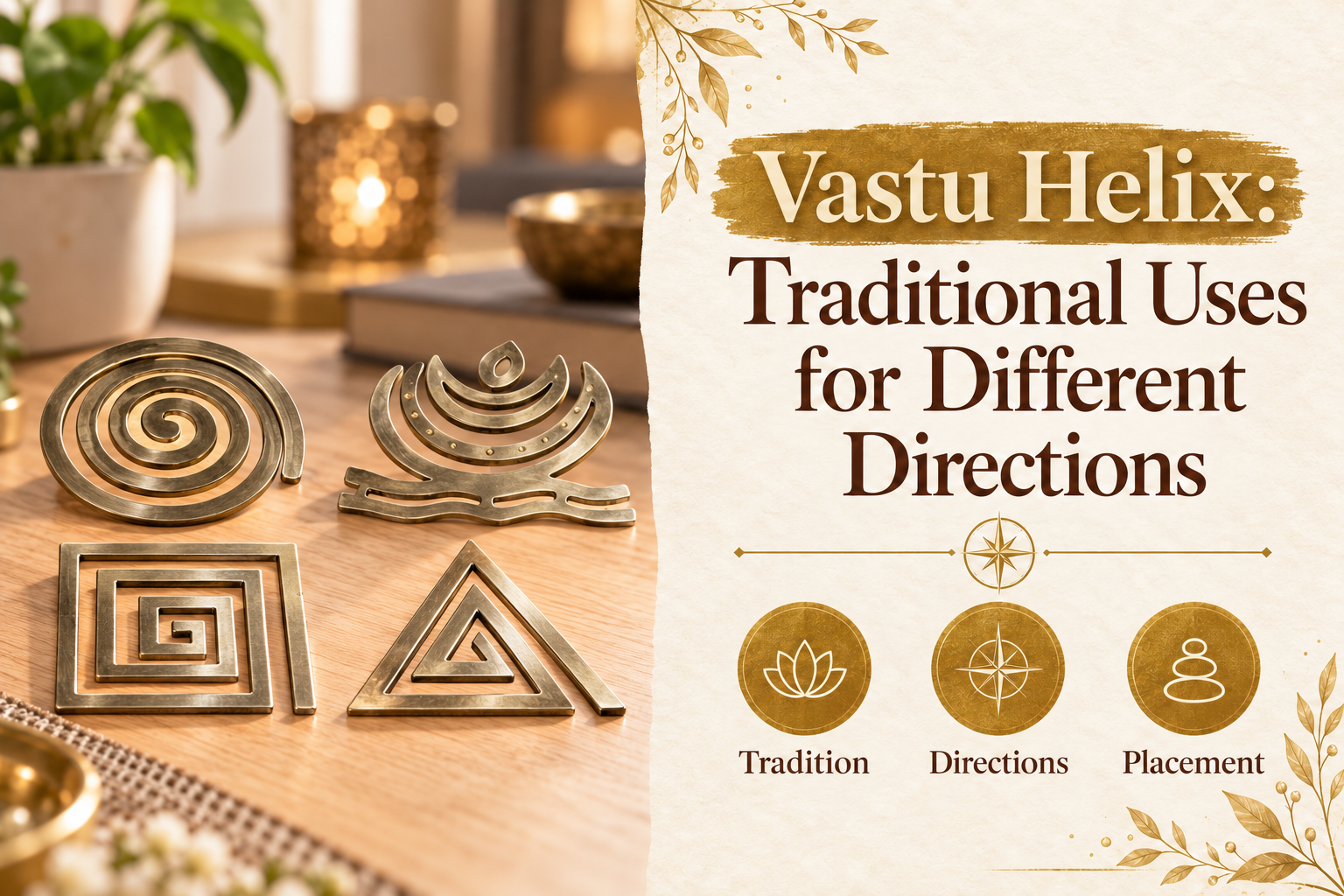
Vastu Shastra is a traditional Indian system of architecture and spatial arrangement that considers directions, room layouts, and the placement of objects when planning homes, offices, and commercial spaces. A Vastu Helix is a directional Vastu remedy that some practitioners recommend as part of traditional efforts to harmonise a space.
Different directions are associated with different functions in Vastu practice. The placement of a Vastu Helix may therefore depend on the direction being considered and the specific concern a practitioner is addressing. Recommendations can vary by Vastu tradition, property layout, and the type of helix used.
In this guide, explore the traditional uses of Vastu Helix in the North, South, East, West, Northeast, Southeast, Southwest, and Northwest directions.
What Is a Vastu Helix?
A Vastu Helix is a spiral-shaped or helix-style object used in some Vastu practices as a directional remedy. Practitioners may recommend it when addressing perceived imbalances associated with a particular area of a property.
The helix design is sometimes interpreted symbolically as representing movement, continuity, or the flow of energy. However, these interpretations are part of traditional or spiritual beliefs; there is no established scientific evidence that a Vastu Helix changes energy fields or guarantees improvements in health, relationships, or finances.
Before choosing a Vastu Helix, understand its intended purpose and follow the placement guidance provided for that specific product.
Why Do Directions Matter in Vastu Shastra?
In traditional Vastu Shastra, each direction is associated with particular symbolic meanings and activities. These associations guide how practitioners approach the arrangement of rooms, entrances, workspaces, and certain objects.
For example, the North is commonly associated with prosperity, the East with the rising Sun and new beginnings, and the Northeast with prayer and spiritual practices. These are traditional associations rather than universal rules that apply identically to every building.
Traditional Uses of Vastu Helix in Different Directions
- North Direction — Traditional Association With Prosperity
The North is commonly associated with Kubera, the deity of wealth, in many Vastu traditions.
Traditional purpose:
- Symbolically associated with financial opportunities and prosperity.
- Sometimes considered when reviewing the arrangement of a business or workspace.
- May be recommended by a practitioner as part of a broader Vastu consultation.
Placement tip: Identify the actual North direction with a reliable compass before placing a directional remedy. Do not assume that a particular corner is North based on the room’s appearance.
- South Direction — Stability and Strength
The South is associated with Yama in traditional Hindu directional symbolism and may be discussed in Vastu consultations in relation to stability and the layout of a property.
Traditional purpose:
Used in some remedial approaches intended to address a perceived directional imbalance.
May be considered when assessing room arrangement or the placement of heavy objects.
Placement tip: Recommendations for the South can vary depending on the building’s layout and the specific Vastu method being followed. Seek guidance for your individual space rather than applying a general rule.
- East Direction — Growth and New Beginnings
The East is associated with the rising Sun, light, and beginnings. In Vastu practice, this direction is often discussed in relation to entrances, natural light, and daily activities.
Traditional purpose:
- Symbolises renewal, clarity, and forward movement.
- May be considered in traditional remedies for a perceived imbalance in the eastern section of a property.
- Placement tip: Keep the area well-lit and uncluttered where practical. Natural daylight, ventilation, and safe access should remain priorities.
- West Direction — Completion and Balance
The West is associated with the setting Sun and is interpreted differently across Vastu traditions.
Traditional purpose:
- May be included in directional assessments intended to improve the overall balance of a property.
- Can be considered when reviewing the arrangement and use of a western room or section.
- Placement tip: The appropriate remedy, if any, depends on the property’s layout and the practitioner’s method. Avoid assuming that every western section requires a helix.
- Northeast Direction — Spirituality and Clarity
The Northeast, often called the Ishan corner, is traditionally regarded as an important area for prayer, meditation, and spiritual activities.
Traditional purpose:
- Associated with prayer, reflection, and spiritual awareness.
- May be discussed when assessing the arrangement of a meditation or worship area.
- Placement tip: Many Vastu practitioners recommend keeping this area clean, light, and uncluttered. A Vastu Helix should only be placed here if the instructions for the particular product or a qualified practitioner recommend it.
- Southeast Direction — Fire Element and Activity
The Southeast is traditionally associated with Agni, the fire deity, and the fire element. It is commonly discussed in connection with kitchens and cooking activities.
Traditional purpose:
- Considered in Vastu consultations relating to kitchen placement and fire-related functions.
- A directional remedy may be suggested by some practitioners when they identify a specific concern in this area.
- Placement tip: Never let a Vastu object interfere with cooking equipment, electrical installations, ventilation, or fire safety. Practical safety takes priority over symbolic placement.
- Southwest Direction — Stability and Grounding
The Southwest is often associated with stability, grounding, and the occupants’ sense of security in traditional Vastu interpretations.
Traditional purpose:
- May be considered when reviewing bedroom placement, room arrangement, or the overall layout of a property.
- Sometimes included in remedies intended to address a perceived imbalance in this direction.
- Placement tip: Keep furniture and decorative objects secure and appropriately positioned. The need for a helix depends on the specific layout and the tradition being followed.
- Northwest Direction — Movement and Relationships
The Northwest is traditionally associated with Vayu, the wind deity, and is often interpreted in relation to movement, circulation, and change.
Traditional purpose:
May be considered in consultations about guest rooms, movement through a property, or the arrangement of a particular section.
Some practitioners may recommend a directional remedy when they identify a specific concern.
Placement tip: Ensure that doors, windows, and passageways remain easy to use. Do not obstruct ventilation or movement to accommodate a decorative remedy.
How to Choose the Right Vastu Helix
Before buying a Vastu Helix, consider these points:
- Identify the intended direction: Determine which area you want to assess and verify its direction accurately.
- Understand the purpose: Ask the seller or practitioner what the particular helix is designed for within their Vastu method.
- Check product instructions: Shape, material, orientation, and installation guidance can differ between products.
- Consider the complete layout: A room’s use, entrance, windows, and surrounding areas may influence a practitioner’s recommendations.
- Avoid one-size-fits-all claims: A remedy recommended for one property may not be suitable for another.
- Prioritise practical improvements: Lighting, ventilation, cleanliness, safe electrical work, and functional room arrangements are important regardless of spiritual beliefs.
Common Mistakes to Avoid
- Placing a helix in a direction without confirming its orientation.
- Assuming that every direction needs a separate remedy.
- Expecting a Vastu Helix to guarantee wealth, career growth, relationship harmony, or good health.
- Ignoring the manufacturer’s installation and care instructions.
- Allowing a Vastu object to obstruct walkways, ventilation, or electrical and fire-safety features.
- Following conflicting placement instructions without clarifying which Vastu tradition or product guidance is being used.
Conclusion
A Vastu Helix is used in some Vastu traditions as a directional remedy, with placement recommendations varying according to the direction, property layout, and type of product. North, South, East, West, Northeast, Southeast, Southwest, and Northwest each have distinct symbolic associations within traditional Vastu interpretations.
Before installing one, verify the direction, read the product instructions, and consider the layout of your space. Treat Vastu Helix placement as a traditional or spiritual practice rather than a guaranteed solution, and combine any personal beliefs with practical steps to create a safe, comfortable, and functional environment.